PTO Accrual vs Lump-Sum: Which Model to Choose

Blasko Sarcevic
Published
A comparison of the two most common ways to grant paid time off, with the trade-offs in administration, payout liability, and employee experience.
Topic

Topic: accrual compared with lump-sum.
What is the difference between accrual and lump-sum PTO?
Accrual and lump-sum are the two main ways to grant paid time off. With accrual, employees earn PTO gradually across the year, for example a fixed amount each pay period or each month, so the available balance rises over time. With lump-sum, also called front-loaded PTO, the full annual allowance is granted at once, usually at the start of the year or on a work anniversary, so the entire balance is available immediately. Accrual reduces the risk of an employee taking more than they have earned and lowers payout exposure if someone leaves early, but it is more complex to administer and can frustrate employees early in the year. Lump-sum is simpler to understand and generous up front, but it increases payout liability and the chance of unused time at year end. Many organizations blend the two: lump-sum for statutory minimums and accrual for additional or tenure-based days.
How accrual builds across the year
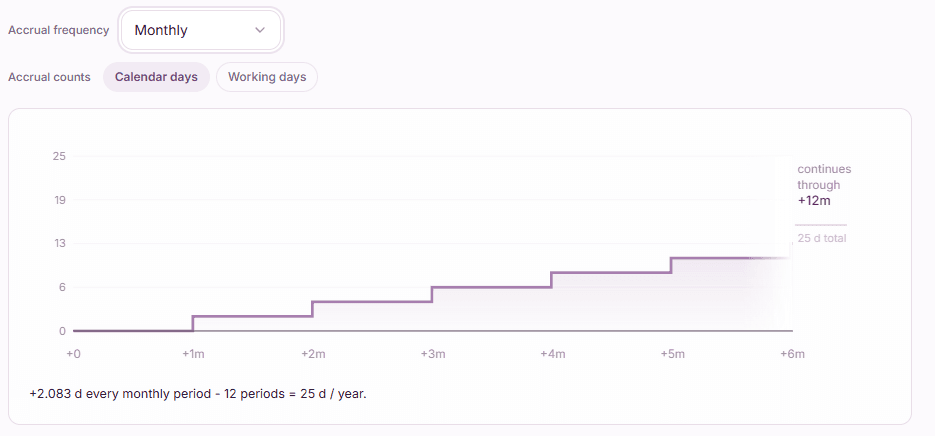
With accrual, the balance starts low and rises on a schedule, for example a fixed amount each month or each pay period. Employees earn time as the year progresses, so early in the year the available balance is smaller than the annual allowance.
Accrual reduces the risk of someone taking more than they have earned and lowers payout exposure if they leave early. The trade-off is more administration: you define a frequency, and often a cap and a waiting period.
Accrual vs lump-sum at a glance
Lump-sum grants the full annual allowance at once, usually at the start of the year or on a work anniversary, so the entire balance is available immediately. It is simpler to understand and generous up front, but it raises payout liability and the chance of unused time at year end.
| Dimension | Accrual | Lump-sum |
|---|---|---|
| Availability | Rises across the year | Fully available immediately |
| Payout liability | Lower if someone leaves early | Higher, since all is granted up front |
| Admin effort | Higher (frequency, caps) | Lower, easy to understand |
| Employee experience | Can feel tight early on | Generous up front |
How to choose, and how to blend the two
Choose based on your priorities. Lump-sum is simpler to administer, while accrual limits payout liability and smooths usage across the year. Many teams start simple and refine later.
You do not have to pick only one. A common model grants the statutory minimum up front and accrues additional or tenure-based days on top.
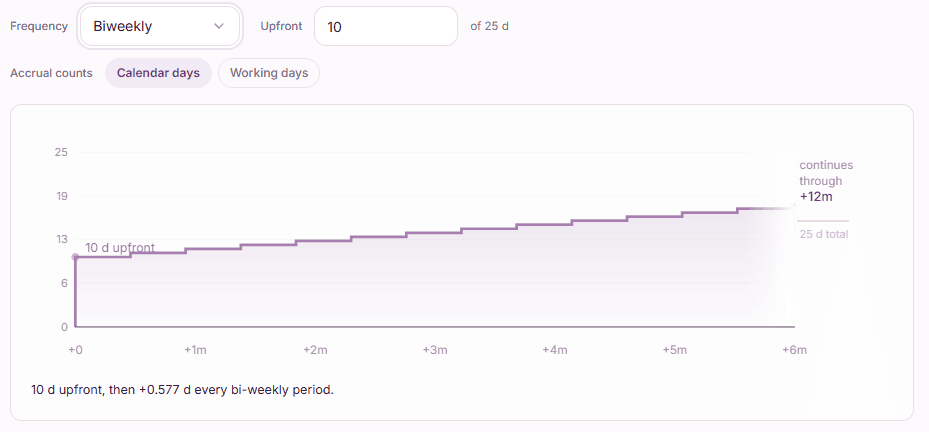
Conceptual comparison with no statutory figures. Design the specific model around your own policies.
Frequently asked questions
- What is the difference between accrual and lump-sum PTO?
- With accrual, PTO builds up gradually across the year. With lump-sum, the full annual allowance is granted at once and is immediately available.
- Is accrual or lump-sum better for a small company?
- It depends on priorities. Lump-sum is simpler to administer, while accrual limits payout liability. Many small teams start simple and refine later.
- Does lump-sum PTO increase payout liability?
- It tends to, because the full allowance is available early. If someone leaves, more unused paid time may be outstanding.
- Can you combine accrual and lump-sum?
- Yes. A common model grants the statutory minimum up front and accrues additional or tenure-based days.
About the author
Blasko Sarcevic
Founder, Time-Out Zone
Connect on LinkedIn Connect on LinkedIn
Blasko writes about leave management, policy design, and running time-off operations at scale.
Related
Model the numbers
Use the PTO accrual calculator to see how accrual, lump-sum, or hybrid grants affect the balance across the year.