Leave Entitlement Calculator

Blasko Sarcevic
Published · Updated
Work out how much paid leave an employee is entitled to this year, including a proper proration when they start partway through the year.
Topic
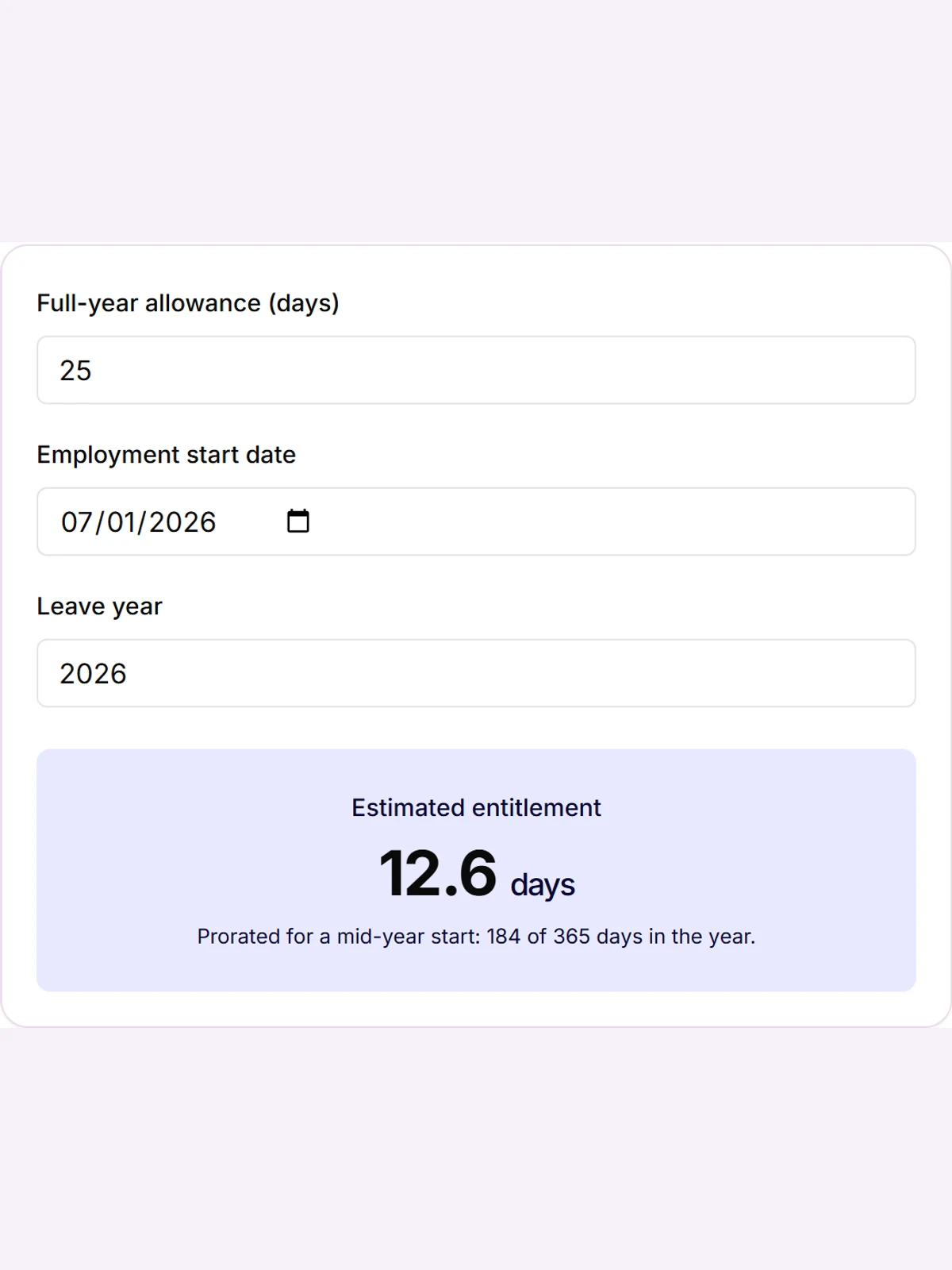
Leave entitlement calculator: full-year and prorated entitlement using date-based proration.
Estimated entitlement
12.6 days
Prorated for a mid-year start: 184 of 365 days in the year.
How is leave entitlement calculated?
Leave entitlement starts from a full-year allowance, the number of paid days an employee earns for a complete calendar year. When someone joins partway through the year, that allowance is prorated to the part of the year they actually work. The standard method is calendar-year daily proration: take the full-year allowance, multiply it by the number of days remaining in the year from the start date, and divide by the total number of days in that year. For example, an employee with a 25 day allowance who starts exactly halfway through the year is entitled to about 12.5 days for that first year, then the full 25 days in following complete years. Public holidays and any carry-over from the previous year are handled separately and added on top. This calculator uses the same proration model that Time-Out Zone applies to real policies, so the estimate matches how the product would compute it.
How the proration is calculated (step by step)
The daily proration formula is: full-year allowance × days remaining in the year from the start date ÷ total days in the year. It works for any start date and any allowance, and it degrades gracefully for leap years because the denominator is the real number of days in that specific year.
Worked example: a 25-day allowance and a start date of 1 September. From 1 September to 31 December there are 122 days, and the year has 365. The first-year entitlement is 25 × 122 ÷ 365 ≈ 8.36 days. Most policies then round to the nearest half or full day: check yours before promising a number to the employee.
| Step | Calculation | Result |
|---|---|---|
| Days remaining | 1 Sep - 31 Dec | 122 days |
| Fraction of year | 122 ÷ 365 | 0.334 |
| Prorated entitlement | 25 × 0.334 | ≈ 8.36 days |
Edge cases to watch
Part-time schedules: entitlement is usually expressed in the employee's own working days, so a 5-day-week allowance must be converted before prorating: 25 days at 5 days a week equals 15 days at 3 days a week (25 × 3 ÷ 5). Prorate after the conversion, not before.
Leavers: the same daily logic applies in reverse when someone exits mid-year, but statutory rules can override it. In Germany, for example, leaving in the second half of the year with the waiting period fulfilled keeps the full statutory allowance rather than a pro-rata share.
Rounding: pick one rounding rule (nearest half day is common) and apply it consistently. Rounding each month separately and rounding the final figure once can differ by a full day over a year, which is exactly the kind of discrepancy that erodes trust in HR numbers.
Frequently asked questions
- What is proration of leave entitlement?
- Proration reduces a full-year leave allowance to match the portion of the year an employee actually works. A mid-year joiner earns a fraction of the annual days, calculated from their start date to the end of the leave year.
- Does this include public holidays?
- No. Public holidays are tracked separately from paid leave entitlement. This calculator estimates the paid leave allowance only; holidays are added by your location's holiday calendar.
- Is the German statutory minimum included?
- Germany's statutory minimum is 20 working days for a five-day week under BUrlG section 3. You can enter that as the full-year allowance, or any higher contractual amount. Check your employment or collective agreement for the figure that actually applies, since contracts commonly grant more than the statutory minimum.
- How do I prorate entitlement for part-time employees?
- Convert the allowance to the employee's working pattern first: full-time days × part-time days per week ÷ full-time days per week. Then apply the normal date-based proration if they also start mid-year.
- What happens to unused entitlement at the end of the year?
- That depends on your policy and jurisdiction: it may carry over (often with a cap and a deadline), be paid out, or lapse. Several US states treat accrued vacation as earned wages that must be paid out at separation: check the state-by-state payout rules.
About the author
Blasko Sarcevic
Founder, Time-Out Zone
Connect on LinkedIn Connect on LinkedIn
Blasko writes about leave management, policy design, and running time-off operations at scale.
Related
Stop calculating leave by hand
Time-Out Zone applies these rules automatically across every employee, location, and policy, with a full audit of how each balance was reached.
Questions about leave tracking?
See how Time-Out Zone automates accruals, balances, and approvals for your team.