How to Write a PTO Policy: Guide, Examples and Template

Blasko Sarcevic
Published · Updated
What a complete PTO policy covers, the models to choose from, common mistakes, and a copy-paste template you can adapt to your company.
Topic

Topic: a policy everyone can actually follow.
What should a PTO policy include?
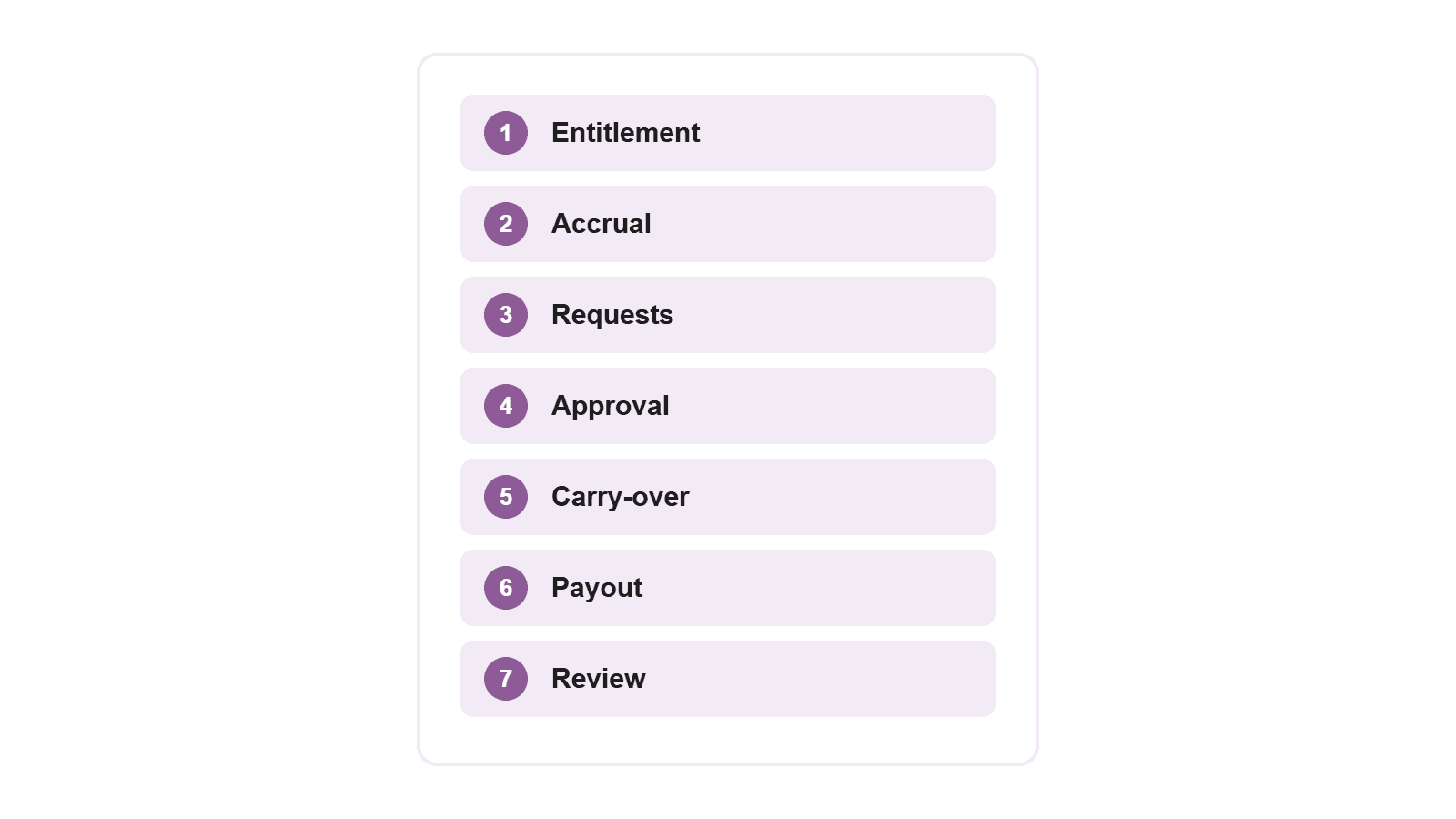
A complete PTO policy answers seven questions: who is covered (scope), how much time off people get (entitlement), how that time is earned (lump-sum grant or accrual), how time off is requested and approved (process and notice periods), what happens to unused days at year end (carry-over and expiry), what happens at termination (payout), and which special cases apply (part-time staff, new hires, sickness during vacation). US employers set most of these terms freely, but state law constrains two of them: several states treat accrued PTO as earned wages, which restricts use-it-or-lose-it forfeiture and can require payout at termination. The most common failure mode is vagueness: 'time off by arrangement' creates more conflict than any strict rule. The template below covers all seven sections and can be copied and adapted directly; no download or email required.
Why you need a written PTO policy
Without a written policy, habit decides, and habit is unevenly distributed. People who ask loudly get more; people who stay quiet lose days. A clear policy protects both sides: employees know what they are entitled to, and managers approve against the same criteria.
For the company, the policy is also compliance documentation. Where state law treats accrued PTO as wages, the policy wording determines what you owe at termination, which makes precise language a financial matter, not just an HR one.
The seven building blocks of every PTO policy
Every workable policy answers the same seven questions. Wherever one is missing, that is where the next dispute starts.
| Building block | Core question |
|---|---|
| Scope | Who does the policy apply to? |
| Entitlement | How many days per year, from when, with what tenure scaling? |
| Earning model | Lump-sum grant at the start of the year, or accrual per period? |
| Requests and approval | How, to whom, and with how much advance notice? |
| Carry-over and expiry | What happens to unused days at year end? |
| Termination | Is unused PTO paid out, and how is it calculated? |
| Special cases | Part-time, new hires, sickness during vacation, leave types |
Know your legal floor before you write
There is no US federal law requiring paid vacation, so the policy itself defines the benefit. State law still constrains it: California, Montana, and Nebraska treat accrued vacation as earned wages, which bans use-it-or-lose-it forfeiture and requires payout of accrued balances at termination. Other states enforce whatever the written policy promises. The full state-by-state picture is in our PTO payout calculator pages.
The practical rule: decide which states your employees work in, find the strictest applicable rule, and either write one policy that satisfies it everywhere or maintain state-specific baselines. If you operate internationally, statutory minimums (like Germany's 20-day floor) are non-negotiable layers underneath the policy.
A US policy also has to say how PTO behaves during protected leave. Whether accrued PTO must or may be used during FMLA leave, whether it keeps accruing while the employee is out, and whether a paid holiday inside the leave counts against the balance are decisions the FMLA leaves to the employer, and a policy that is silent on them gets decided case by case. Put those clauses here or in a companion leave of absence policy; our guide to writing one walks through the twelve clauses it needs.
Choose the earning model: grant, accrual, or unlimited
The foundational choice is how time is earned. A lump-sum grant credits the full annual allowance up front: simple to understand and administer. Accrual builds the balance per pay period or month. It smooths usage and limits payout exposure, at the cost of more administration. Unlimited PTO removes the allowance entirely and manages time off through approval and guardrails instead.
For most small and mid-sized companies, accrual per pay period with a defined cap is the pragmatic default in payout states, and a lump-sum grant is the simpler choice elsewhere. The trade-offs are covered in depth in our accrual vs lump-sum comparison and the unlimited PTO guide.
Requests, notice periods and approval rules
The request process is the everyday life of the policy. Proven defaults: requests go through a system rather than hallway conversations, notice grows with duration (for example one week of notice per week of vacation), and approvals carry a response deadline so requests never sit unanswered.
Also define collision rules: who has priority when requests overlap, how many people per team may be absent at once, and whether blackout periods exist where time off is only approved by exception.
Carry-over, caps and use-it-or-lose-it
Year end is the most dispute-prone part of any policy. State law shapes what you can write: where accrued PTO counts as wages, a use-it-or-lose-it clause is unenforceable, and the compliant alternatives are an accrual cap (accrual pauses at a ceiling) or a carry-over allowance with a generous use-by window.
Whatever you choose, make the mechanics explicit: how many days carry over, when carried days expire, and how employees are reminded before anything lapses. Our carry-over guide covers the models in detail.
Template: a PTO policy you can copy
The template below covers all seven building blocks. Replace the bracketed placeholders and adjust the values to your company. It is a starting point, not legal advice.
1. Scope. This policy applies to all full-time and part-time employees of [Company, Inc.]. Contractors and interns are covered by separate agreements.
2. Entitlement. Full-time employees receive [15] days of paid time off per calendar year, rising to [20] days after [3] years of service. Part-time employees accrue PTO on a prorated basis according to scheduled hours.
3. Earning model. PTO accrues evenly per pay period ([15] days / [26] pay periods = [0.58] days per period), beginning on the hire date. Accrual pauses when the balance reaches the cap of [1.5x] the annual allowance and resumes once the balance drops below the cap.
4. Requests and approval. PTO is requested through [system] and approved by the direct manager. Notice periods: at least [1 week] for one or two days, at least [4 weeks] for a full week or more. Requests receive a response within [5 business days]. Where requests overlap, business needs and submission order decide; no more than [30%] of a team may be absent at once. The weeks of [blackout period] are approved by exception only.
5. Carry-over. Up to [5] unused days carry over into the next calendar year and must be used by [March 31]. Employees receive a written reminder of their remaining balance in [Q4]. Where state law prohibits forfeiture, the accrual cap in section 3 applies instead of expiry.
6. Termination. Accrued, unused PTO is paid out at the employee's final base rate of pay where required by state law or where this policy so provides. Negative balances may be reconciled against final pay only where state law permits.
7. Special cases. Documented sick days during booked vacation are re-credited to the PTO balance where a physician's note is provided. New hires may use accrued PTO after [30] days of employment. Separate policies cover sick leave, parental leave, and bereavement.
Examples: three typical configurations
The same building blocks, three different shapes:
- Small business (up to 20 people): 15 days granted up front, owner approves, simple 5-day carry-over. One page is enough.
- Growing company (20-200): accrual per pay period with a cap, manager approval with a deputy rule, per-team coverage limits, blackout weeks for peak season.
- Multi-state or multi-entity: a baseline policy per location for compliance, refined per department or team, with the effective policy per person documented centrally.
Common mistakes when writing a PTO policy
Most PTO disputes come from gaps in the policy, not bad faith:
- Vague wording ('by arrangement') instead of clear notice periods and owners.
- A use-it-or-lose-it clause in a state that treats accrued PTO as wages.
- No collision or coverage rules for overlapping requests.
- Payout language that contradicts how balances are actually tracked.
- A policy that exists on paper but differs from the lived process.
Turning the policy into enforced rules
A policy only works when the system enforces it. Entitlement, accrual schedules, notice periods, carry-over and expiry rules, and coverage limits should live as configured rules, not as knowledge in one HR person's head.
That way requests are validated against the policy automatically, expiry reminders go out on time, and the effective policy per person stays traceable across locations, departments, and teams.
US state rules on PTO payout and use-it-or-lose-it vary and change; the template is an editorial starting point, and the per-state rules are documented in the PTO payout calculator pages. This article explains common US practice at a general level and is not legal advice; state laws and company policies differ, so confirm specifics for your state.
Frequently asked questions
- What should a PTO policy include?
- Scope, entitlement, the earning model, the request and approval process, carry-over and expiry rules, payout at termination, and special cases like part-time staff or sickness during vacation.
- How many PTO days is standard in the US?
- There is no legal minimum. Common ranges are 10-15 days for new hires and 15-20+ with tenure, often alongside separate sick leave where state or city law requires it.
- Is a use-it-or-lose-it PTO policy legal?
- It depends on the state. States that treat accrued PTO as earned wages, such as California, prohibit forfeiture; an accrual cap is the standard compliant alternative.
- Does PTO have to be paid out when someone leaves?
- In some states yes, if it is accrued and unused; in others it depends on what the written policy promises. Precise policy wording decides.
- Do small businesses need a written PTO policy?
- Yes, especially small ones. Without written rules, habit decides, and habit is unevenly distributed. One page covering the seven building blocks is often enough.
About the author
Blasko Sarcevic
Founder, Time-Out Zone
Connect on LinkedIn Connect on LinkedIn
Blasko writes about leave management, policy design, and running time-off operations at scale.
Related
Turn the policy into enforced rules
Time-Out Zone models entitlement, accrual, waiting periods, carry-over, and coverage limits as enforceable rules: per location, department, team, or person.