Employee Leave Laws in Germany: Vacation, Sick Leave, and Parental Leave

Jovana Avramovic
Published
The statutory leave framework German employers must apply: minimum vacation under the BUrlG, six weeks of employer-paid sick leave, parental leave of up to three years, maternity protection, and the special leave categories in between, explained for an international audience.
Topic

Topic: the German statutory leave stack.
What leave are employees entitled to in Germany?
German employees are entitled to a statutory minimum of 24 working days of paid vacation per year based on a six-day week, which converts to 20 days for the standard five-day week; most employers grant 25 to 30 contractual days on top of the minimum. During sickness, the employer continues full salary for up to six weeks per illness under the Continued Remuneration Act (EFZG); after that, statutory health insurance pays Krankengeld of 70 percent of gross salary (capped at 90 percent of net) for up to 78 weeks within three years for the same illness. Parents can take up to three years of job-protected parental leave (Elternzeit) per child, with the state paying Elterngeld of roughly 65 percent of prior net income for up to 14 months. Maternity protection adds six weeks of leave before and eight weeks after birth at full pay. Public holidays, typically 9 to 13 days depending on the federal state, come on top of all of it.
Vacation: the BUrlG minimum and what companies actually give
The Federal Leave Act (Bundesurlaubsgesetz) sets the floor: 24 working days per year, counted on the six-day week the law was written around, which equals 20 days for a five-day week. Every employee gets it, including part-timers (pro-rated by weekdays worked, not hours) and minijobbers. The full entitlement is earned after six months of employment; before that, employees earn a twelfth per month.
The market is far more generous than the law. Contractual allowances of 25 to 30 days are the norm in office roles, and collective agreements often fix 30. The statutory and contractual layers can carry different rules, which matters at year end: statutory leave must generally be taken in the calendar year, may be carried to March 31 only for operational or personal reasons, and, per ECJ and Federal Labor Court case law, does not expire unless the employer explicitly warned the employee in time. Unused statutory leave must be paid out only when employment ends (Urlaubsabgeltung).
Sick leave: six employer weeks, then Krankengeld
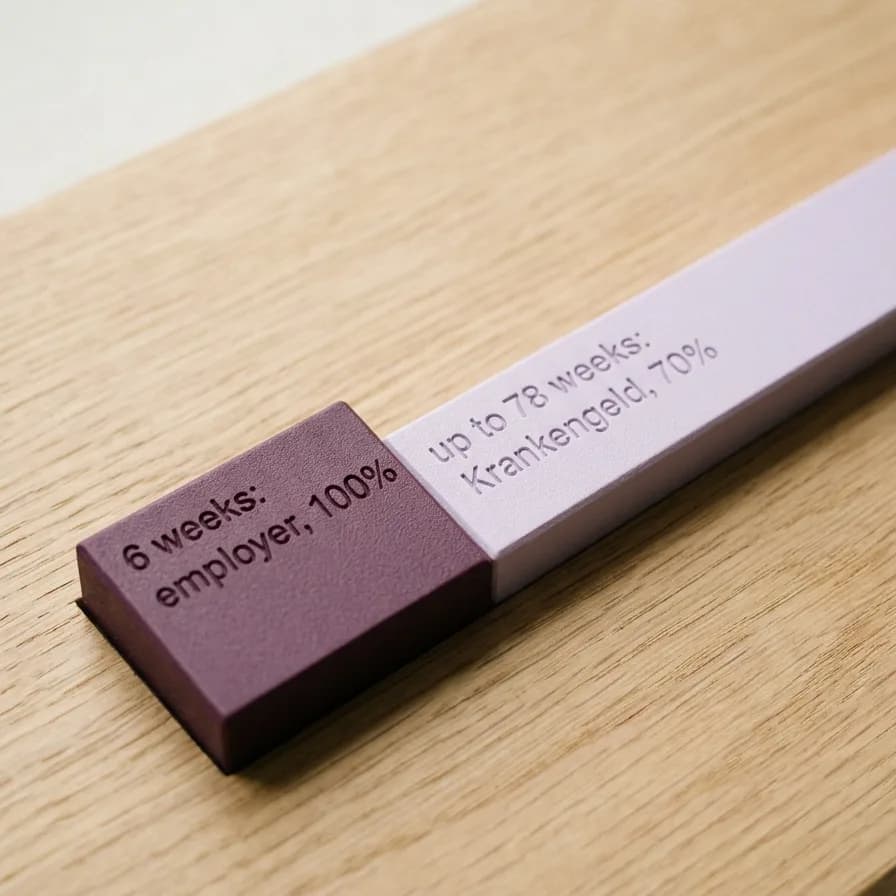
Germany has no waiting days and no reduced sick rate in the first phase: under the Entgeltfortzahlungsgesetz (EFZG), the employer pays 100 percent of salary for up to six weeks per illness, from the first day, once the employment has lasted four weeks. A new illness starts a new six-week entitlement; the same illness re-opens one only after six months without that illness, or twelve months after the first occurrence.
From week seven, statutory health insurance takes over with Krankengeld: 70 percent of gross pay, capped at 90 percent of net and at the contribution assessment ceiling, for up to 78 weeks within a three-year window for the same illness (the six employer-paid weeks count toward the 78). Sick notes are electronic (eAU): the doctor files the certificate digitally with the insurer and the employer retrieves it; by default a certificate is required from the fourth calendar day, though employers may demand one from day one. Vacation keeps accruing during sickness, and statutory leave that could not be taken because of long illness expires only 15 months after the leave year ends.
Parental leave and Elterngeld
Each parent can take up to three years of Elternzeit per child, unpaid by the employer but fully job-protected: dismissal protection starts up to eight weeks before the leave begins, and the employee returns to an equivalent role. Up to 24 months of the three years can be deferred to any point before the child's eighth birthday, and employees in companies with more than 15 staff have a right to work part time (24 to 32 hours) during the leave.
Income replacement comes from the state, not the employer. Basic Elterngeld pays about 65 to 67 percent of prior net income (between 300 and 1,800 euros per month) for up to 12 months, extended to 14 when both parents take at least two months. ElterngeldPlus halves the monthly amount but doubles the duration, which fits part-time returns. Vacation entitlement may be reduced by a twelfth for each full calendar month of parental leave, but only if the employer actively declares the reduction.
Maternity protection
The Maternity Protection Act (MuSchG) prohibits employment six weeks before the expected due date (the employee can waive this part) and eight weeks after birth, extended to twelve weeks for premature and multiple births; the post-birth period is absolute. During these periods the combination of Mutterschaftsgeld from the health insurer and a mandatory employer top-up replaces full net pay.
Dismissal protection covers the entire pregnancy and four months after birth. Vacation continues to accrue through maternity protection in full, unlike parental leave, where a reduction is possible.
The special leave categories in between
Beyond the big three, German practice recognizes several smaller statutory or quasi-statutory leaves that international HR teams routinely miss:
- Sonderurlaub (special paid leave) under § 616 BGB for short personal events: own wedding, birth of a child, close family funerals, typically one to two days each; contracts and collective agreements can extend or exclude it.
- Caregiver leave: up to 10 working days of acute care leave per relative and care situation (with a wage-replacement benefit, Pflegeunterstuetzungsgeld), plus up to six months of unpaid Pflegezeit in companies above 15 employees, and up to 24 months of partial Familienpflegezeit above 25 employees.
- Bildungsurlaub (educational leave): five paid days per year for recognized training in most federal states; Bavaria and Saxony are the notable exceptions.
- Public holidays: nine nationwide, up to thirteen in Bavaria depending on the municipality; they are paid non-working days by law and come on top of vacation.
- Unpaid leave beyond these categories is a matter of agreement, not entitlement; there is no general statutory right to a sabbatical.
What this means for international employers
Three habits keep a Germany operation compliant. First, separate statutory from contractual vacation in your records, because they carry different expiry and payout rules; a system that tracks one merged bucket will eventually pay out or expire the wrong days. Second, run the year-end warning process seriously: without a documented, individual notice that leave will expire, it legally does not. Third, respect the accrual quirks around long sickness (15-month expiry) and parental leave (reduction only if declared).
Our German-language legal cluster covers each topic in statutory depth, from the base entitlement to termination cases and special leave, and the Germany page in our leave-law reference summarizes the framework with sources. Both are linked below.
Statutory bases: Bundesurlaubsgesetz (BUrlG) §§ 3, 7; Entgeltfortzahlungsgesetz (EFZG); SGB V § 44 ff. (Krankengeld); Bundeselterngeld- und Elternzeitgesetz (BEEG); Mutterschutzgesetz (MuSchG); Pflegezeitgesetz; § 616 BGB. This is a general overview for an international audience and not legal advice; collective and individual agreements can deviate above the statutory floor.
Frequently asked questions
- How many vacation days do employees get in Germany?
- The statutory minimum is 24 working days on a six-day week, which equals 20 days on a five-day week. In practice most employers grant 25 to 30 contractual days, and collective agreements commonly fix 30.
- Is sick leave paid in Germany?
- Yes, and generously: the employer pays 100 percent of salary for up to six weeks per illness from the first sick day. After that, statutory health insurance pays Krankengeld of 70 percent of gross (capped at 90 percent of net) for up to 78 weeks within three years for the same illness.
- How long is parental leave in Germany?
- Up to three years per child and parent, job-protected and unpaid by the employer. State-paid Elterngeld replaces about 65 percent of net income for up to 14 months between both parents; ElterngeldPlus stretches half the monthly amount over twice the time.
- Do unused vacation days expire in Germany?
- Statutory leave is meant to be taken in the calendar year and, if carried over, used by March 31. But case law adds a decisive condition: leave only expires if the employer warned the employee individually and in time. After long sickness, statutory leave expires 15 months after the leave year ends.
- Are public holidays counted as vacation in Germany?
- No. Public holidays are paid non-working days by law and sit on top of the vacation entitlement. Their number depends on the federal state: nine apply nationwide, and states add more, up to thirteen in parts of Bavaria.
About the author
Jovana Avramovic
Product Excellence, Time-Out Zone
Jovana writes hands-on guides to time-off workflows, calendar tooling, and the rules behind vacation, sick leave, and payouts.
Related
Run German leave rules automatically
Time-Out Zone tracks statutory and contractual vacation separately, applies carry-over and expiry rules per location, and handles German public holidays by state.