What Is a Floating Holiday? Meaning, Rules and vs PTO

Blasko Sarcevic
Published · Updated
What a floating holiday is, how it differs from PTO and public holidays, whether it is paid, and the policy rules that make the benefit work.
Topic

Topic: the holiday employees choose themselves.
What is a floating holiday?
A floating holiday is a paid day off that employees can use flexibly for an occasion of their choice: most often a religious or cultural observance that is not on the company holiday calendar, a birthday, or a bridge day between holidays. Unlike PTO, floating holidays are typically granted up front rather than accrued, usually do not carry over at year end, and in most states are not paid out at termination, with a notable exception: California treats floating holidays with unrestricted use like accrued vacation, which must be paid out. Companies usually grant one to three floating holidays per year. The benefit exists because a fixed holiday calendar always reflects a majority culture; floating holidays give every employee the same flexibility to observe the days that matter to them, without the company adding every occasion to the official calendar. The cleanest setup tracks them as a separate entitlement with their own rules, not mixed into the PTO balance.
How floating holidays work
The principle is simple: the company grants a small number of paid days (one to three per year is typical), and employees decide what to use them for. Requesting and approval work like normal PTO; only the bucket is different.
The most common uses: religious and cultural observances outside the company calendar, birthdays, bridge days around public holidays, and personal anniversaries. Some companies tie the days to defined occasions; others leave usage completely open, a distinction that matters legally in some states.
Floating holiday vs PTO: the difference
At first glance a floating holiday looks like one more PTO day. The differences are in the mechanics:
| Aspect | Floating holiday | PTO |
|---|---|---|
| Granting | Up front, usually at the start of the year | Annual allowance, often accrued |
| Carry-over | Usually none | Policy-defined, often capped carry-over |
| Payout at termination | Usually none (California differs) | Required in several states |
| Purpose | A chosen observance or occasion | Rest and recreation, freely used |
| Typical amount | 1-3 days per year | 10-20+ days per year |
Floating holiday vs public holiday
A public holiday applies to everyone on the same date and is set by law or the company calendar. A floating holiday is the opposite: individual, freely scheduled, and a voluntary company benefit.
In multi-location organizations the two complement each other: the holiday calendar maps statutory holidays per location, while floating holidays absorb individual variety without inflating the official calendar.
Are floating holidays paid?
Yes, being paid is part of the definition. A floating holiday is a paid day off; that is what distinguishes it from simply taking an unpaid personal day.
Payout at termination is a different question. Unused floating holidays are usually not paid out, unlike accrued vacation in payout states. The key exception is California: under the Labor Commissioner's (DLSE) interpretation, floating holidays that can be used for any purpose are treated like vacation, accrue as wages, and must be paid out; days tied to a specific occasion (like a birthday) generally are not.
Why companies offer floating holidays
The main driver is inclusion: a fixed holiday calendar always reflects a majority culture. Floating holidays give every employee the same flexibility to observe their important days, without the company litigating each occasion into the official calendar.
There are practical effects too: fewer one-off exception debates, a clear framework instead of case-by-case decisions, and a benefit that costs little but is visible in recruiting.
Typical policy rules: amount, expiry, deadlines
To keep the benefit from becoming a dispute source, floating holidays need the same precision as any leave rule:
- Amount: one to three days per year, prorated for mid-year hires if desired.
- Expiry: usually December 31 with no carry-over, communicate this clearly.
- Requests: like PTO, with notice and approval, just on a separate bucket.
- Occasion binding: define whether days are open-use or tied to occasions, this affects payout treatment in California.
- No payout at termination where legally permitted, state it explicitly.
The California exception in detail
California treats vacation-like paid time off as earned wages that cannot be forfeited. A floating holiday that employees may use for any reason at any time is vacation-like, so it accrues, cannot expire unused, and must be paid out at termination.
The common workaround is occasion-binding: a day tied to a specific event (the employee's birthday, a named observance) is treated like a holiday rather than vacation and generally escapes payout treatment. If you employ people in California, the policy wording decides which side of that line you are on.
Track them separately: their own entitlement
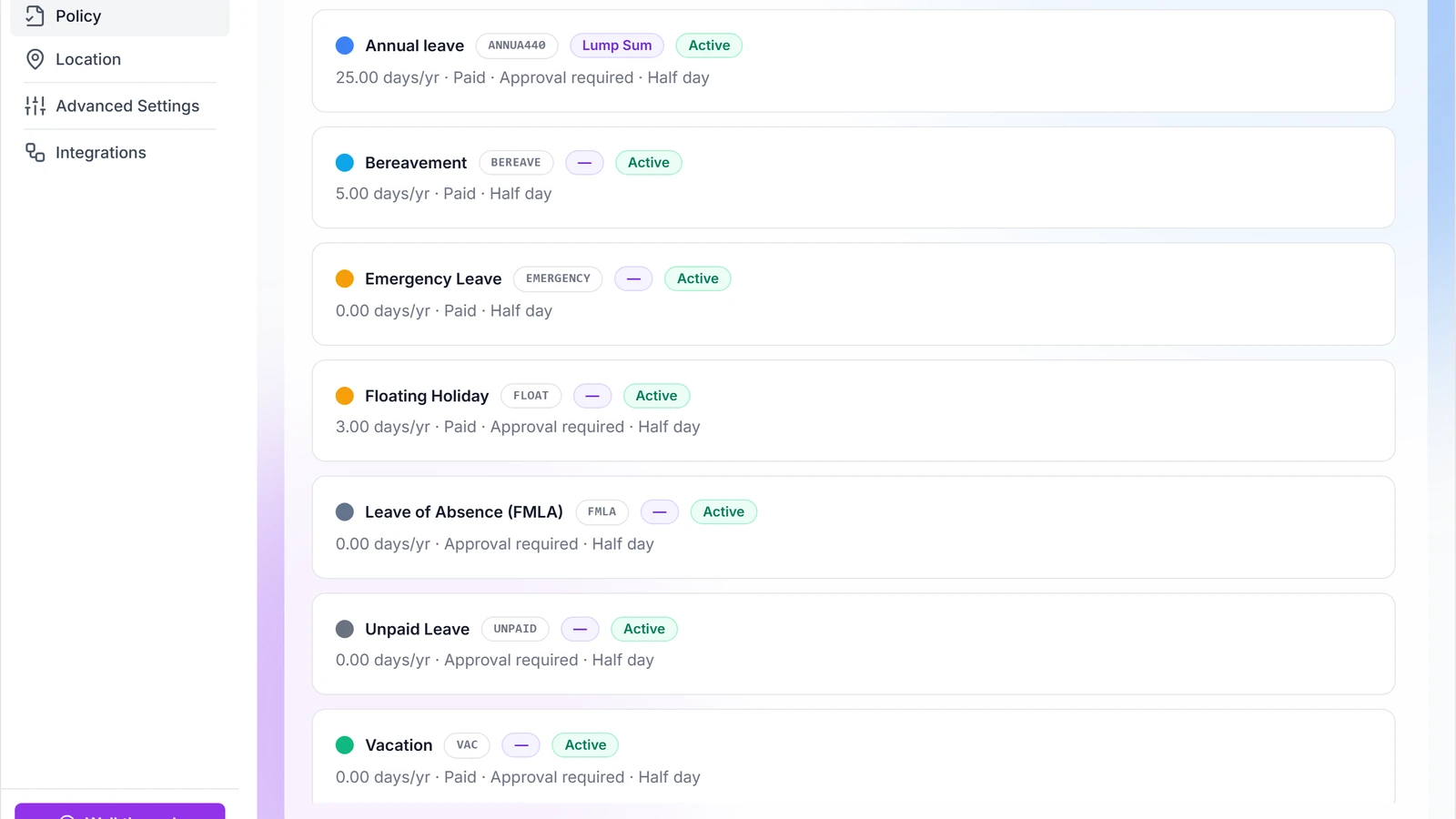
The most common administrative mistake is lumping floating holidays into the PTO balance. They then inherit the PTO rules (carry-over, payout, expiry) that are exactly what they should not have.
The clean setup is a separate entitlement with its own rules: own amount, own expiry, own reporting. Employees see both balances distinctly, and HR can report on usage without distorting vacation numbers.
Is the model worth it for your company?
Floating holidays pay off almost everywhere teams are culturally diverse or spread across locations with different holiday calendars. They cost little, dissolve recurring exception debates, and send a visible inclusion signal.
They matter less where the company already grants very generous PTO and the team has no diversity of observance needs. There, one more regular PTO day is often the simpler answer.
Editorial explainer. US treatment varies by state; the California vacation-equivalence rule for open-use days follows the Labor Commissioner's (DLSE) published interpretation and is the key exception. This article explains common US practice at a general level and is not legal advice; state laws and company policies differ, so confirm specifics for your state.
Frequently asked questions
- What is a floating holiday?
- A paid day off that employees use flexibly for an occasion of their choice: typically a religious or cultural observance not on the company calendar, a birthday, or a bridge day.
- Is a floating holiday paid?
- Yes, being paid is part of the definition. Unused floating holidays are usually not paid out at termination, though; California is the main exception for open-use days.
- What is the difference between a floating holiday and PTO?
- Floating holidays are granted up front rather than accrued, usually do not carry over, and are typically not paid out at termination. PTO follows the policy's accrual, carry-over, and payout rules.
- How many floating holidays do companies give?
- One to three per year is typical. Some companies tie them to defined occasions; others leave usage open, which affects payout treatment in California.
- Do floating holidays carry over to the next year?
- Usually not: Most policies expire them on December 31. In California, open-use floating holidays are treated like vacation and cannot be forfeited.
About the author
Blasko Sarcevic
Founder, Time-Out Zone
Connect on LinkedIn Connect on LinkedIn
Blasko writes about leave management, policy design, and running time-off operations at scale.
Related
Floating holidays as their own entitlement
Time-Out Zone tracks floating holidays separately from PTO: with their own amount, expiry, and reporting per location.