Intermittent FMLA: How It Works in Hours, Not Days (2026)

Blasko Sarcevic
Published
Intermittent FMLA lets you take your 12 weeks in separate blocks, days, or hours. A 40-hour employee has 480 hours to draw from, a 32-hour employee has 384. How the arithmetic, the certification, and the tracking work for employees and for the HR team keeping the ledger.
Topic

Topic: FMLA taken an hour at a time.
What is intermittent FMLA?
Intermittent FMLA is leave taken in separate blocks of time for a single qualifying reason rather than in one continuous stretch: a few hours for a chemotherapy session, two days for a migraine episode, one afternoon a week for physical therapy. A reduced leave schedule, where the employee works fewer hours per day or week for a period, is handled the same way. The entitlement is still 12 workweeks, but it is measured in hours against the employee's normal schedule: 12 weeks at 40 hours is 480 hours, 12 weeks at 32 hours is 384. Employers must account for it in increments no larger than the shortest period they use for other forms of leave, and never larger than one hour. Intermittent leave is a right when it is medically necessary for a serious health condition or for military family leave; for bonding with a new child it requires the employer's agreement. Source: 29 CFR 825.202 to 825.205.
When can FMLA leave be taken intermittently?
The regulations draw a clear line. For the employee's own serious health condition, or to care for a family member with one, intermittent leave and reduced schedules are a right whenever they are medically necessary, and the medical certification is where that necessity is established: the provider states that the condition causes episodic flare-ups, or that treatment is scheduled in sessions, or that the person can work part of a day but not all of it. Recovery from surgery that leaves someone able to work half days, a chronic condition like Crohn's disease with unpredictable episodes, prenatal appointments, and dialysis three times a week are all textbook cases. Military qualifying exigency leave and military caregiver leave follow the same rule.
Bonding with a new child after birth, adoption, or foster placement is the exception. Because there is no medical necessity, taking that leave in pieces, say every Friday for a year, requires the employer's agreement. Many employers grant it, and a few state laws require it, but the federal floor is a continuous block unless the parties agree otherwise, or unless the mother has a serious health condition connected to the birth, which puts her back under the medical rule.
When leave is for planned medical treatment, the employee has a duty to make a reasonable effort to schedule it so as not to unduly disrupt operations, subject to the provider's approval. That does not let an employer veto a treatment time; it lets the employer ask whether the Tuesday 9 a.m. dialysis slot could be the 5 p.m. one, and expect a good-faith answer.
How many hours of intermittent FMLA do you get?
The entitlement is 12 workweeks, and for intermittent use the regulations convert it into the number of hours the employee would normally have worked in 12 weeks. The formula is the regular weekly schedule multiplied by 12. If a schedule varies from week to week so much that no regular pattern exists, the employer uses a weekly average over the 12 months before the leave starts, including any leave hours taken. Mandatory overtime the employee would have worked counts as part of the schedule and can be taken as FMLA leave; voluntary overtime that was declined does not count against the entitlement.
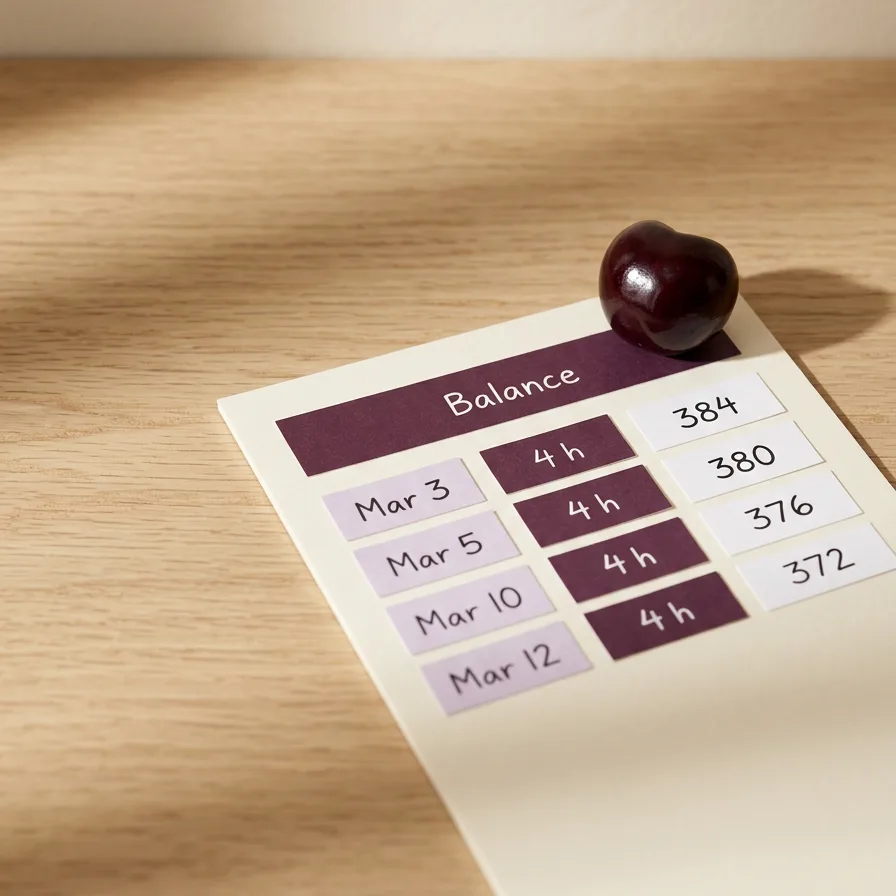
Consider Maria, the 32-hour dental hygienist from the eligibility guide, who now needs dialysis. Her entitlement is 384 hours. Each session takes four hours including travel, three times a week, so she draws 12 hours a week from the ledger. After 32 weeks she has used all 384 hours, and her FMLA protection for that leave year is exhausted with 20 weeks of the year still to run, even though she never took a full day off. Her employer's 12-month period is measured backward on a rolling basis, so hours come back into her balance exactly 52 weeks after each session, a trickle rather than a reset. Whether she keeps her job for the remaining sessions is then an ADA accommodation question, a state law question, or a policy question, not an FMLA one, which is why employees and HR teams need to watch the hours, not the calendar.
| Regular weekly schedule | 12-week entitlement in hours | Equivalent in 4-hour sessions |
|---|---|---|
| 20 hours | 240 hours | 60 sessions |
| 24 hours | 288 hours | 72 sessions |
| 32 hours | 384 hours | 96 sessions |
| 37.5 hours | 450 hours | 112 sessions and 2 hours |
| 40 hours | 480 hours | 120 sessions |
| 48 hours (regular mandatory overtime) | 576 hours | 144 sessions |
What increments can an employer use to count intermittent FMLA?
The employer may count intermittent leave in the smallest increment its payroll system uses for any other kind of leave, but never in increments larger than one hour, and never more than the employee actually took. A company that tracks vacation in 15-minute units must track FMLA in 15-minute units; a company that tracks everything in whole days must still track FMLA in one-hour increments at most. If an employee needs 75 minutes for an appointment and the increment is one hour, the employer may charge two hours only if the employee did not return to work after the first hour; if the employee came back, only the time actually missed is charged.
There are two edge cases the regulations spell out. Where it is physically impossible for an employee to start or finish a shift partway, a flight attendant who cannot board a plane mid-flight, a lab technician who cannot enter a clean room mid-shift, the whole period the employee is forced to be off may count as FMLA leave. And where an employer allows employees to use other leave in increments of less than one hour, the same increment applies to FMLA. The result on the ledger is decimal hours, which is another reason a dedicated leave type beats a spreadsheet of days.
How does certification work for intermittent leave?
The medical certification for intermittent leave, on form WH-380-E or WH-380-F, asks the provider for an estimate of frequency and duration: for example, two episodes a month lasting one to two days each, or one four-hour appointment a week for three months. That estimate becomes the yardstick. Absences that fit inside it are covered without further paperwork; a pattern that consistently exceeds it, or that clusters suspiciously around weekends, lets the employer ask for recertification.
Recertification is otherwise limited. For an ongoing condition the employer may generally ask no more often than every 30 days and only in connection with an absence, and if the certification states a longer duration, such as six months, the employer must wait until that period ends, except that it may always recertify every six months in connection with an absence. Employers may also recertify when circumstances change significantly, or when they receive information that casts doubt on the stated reason. In every case the employee gets at least 15 calendar days to return the form, and the employer may not ask the provider to justify the diagnosis beyond what the form calls for.
Can an employer transfer me to a different job during intermittent leave?
For foreseeable intermittent leave or a reduced schedule based on planned medical treatment, yes, temporarily. The employer may move the employee to an alternative position that better accommodates the recurring absences, as long as it carries equivalent pay and benefits. It does not have to carry equivalent duties; a field supervisor who needs every Wednesday afternoon off for three months might be moved to a desk role at the same pay for that period, and must be returned to the original job or an equivalent one when the intermittent leave ends.
The transfer power does not extend to unforeseeable intermittent leave, the migraine or the asthma attack, and it cannot be used to discourage leave: a transfer to a worse shift or a distant site with the same nominal pay is treated as interference. Where state law forbids such transfers outright, the state rule wins.
How should employers track intermittent FMLA hours?
Intermittent leave is where FMLA administration breaks down most often, because a single certification generates dozens of small absences over a year and each one has to be logged, checked against the certified frequency, and subtracted from a balance that is measured in hours under a 12-month method the company chose. The regulations require records of the dates and hours of FMLA leave taken and the notices given, kept for three years, with medical documents in a separate confidential file. A note in the time clock that says "sick" does not meet that.
The workable design has four parts. A separate FMLA leave type with an hours balance per employee, distinct from PTO, so a Tuesday chemotherapy session never draws down vacation. A ledger entry per absence with the date, the hours, and the certification it falls under. The 12-month measuring method applied consistently, with rolling-backward periods computed by the system rather than by hand. And a call-in flow that lets the employee reference the approved FMLA reason in one step, since the regulations allow the employer to require that. Time-Out Zone models leave cases this way: the FMLA clock and the certification live on the case, and the PTO balance stays untouched unless substitution is agreed.
What are the common problems with intermittent FMLA?
From the employee's side the main risk is exhaustion of hours without noticing. Because intermittent leave rarely involves a full week off, people lose track, and the day the balance hits zero is the day attendance rules apply again. Ask for the running balance in writing; the employer must provide the amount of leave counted against the entitlement on request, at least every 30 days if leave was taken in that period.
From the employer's side the risks are procedural. Counting FMLA absences under a no-fault attendance policy is interference, full stop. Denying a perfect-attendance bonus is allowed only if the policy also denies it for other equivalent leave. Exempt employees may have their salary reduced for intermittent FMLA hours without losing exempt status, but only for FMLA hours, and hourly employees cannot be required to take more time than they need. Suspected abuse is handled through recertification and second opinions, not through informal questioning of the diagnosis. Where the same person's absences follow a Monday-and-Friday pattern, the regulations explicitly allow the employer to describe that pattern to the provider and ask whether it is consistent with the condition.
Statutory references: 29 CFR 825.202 (intermittent leave and reduced schedules; bonding requires agreement), 825.203 (scheduling planned treatment), 825.204 (temporary transfer to an alternative position), 825.205 (increments of leave; calculation in hours; variable schedules; overtime), 825.206 (salary deductions for exempt employees), 825.220 (attendance policies and bonuses), 825.300(c) and 825.300(d)(6) (rights notice and reporting of leave counted), 825.302 to 825.303 (call-in procedures), 825.305 and 825.308 (certification and recertification), 825.500 (recordkeeping); US Department of Labor forms WH-380-E and WH-380-F. Checked September 2026. This article explains US federal and state leave law at a general level and is not legal advice. State program rules, benefit rates and caps change, usually each January, so confirm the current figures with the agency that runs the program or with qualified counsel.
Frequently asked questions
- How many hours is 12 weeks of intermittent FMLA?
- Twelve times the employee's regular weekly schedule. For a 40-hour week that is 480 hours; for 32 hours it is 384; for 20 hours it is 240. If the schedule varies without a pattern, the employer uses the weekly average over the previous 12 months. Mandatory overtime counts as part of the schedule.
- Can intermittent FMLA be denied?
- Not when it is medically necessary for a certified serious health condition, or for military family leave, and the employee is eligible. Intermittent leave for bonding with a new child can be declined because it requires the employer's agreement. An employer may also require that planned treatment be scheduled to limit disruption, and may deny absences that fall outside the certified frequency until a recertification supports them.
- Does intermittent FMLA reset every year?
- It depends on which of the four permitted 12-month methods the employer uses. Under a calendar or fixed leave year the balance resets on one date. Under a rolling backward method, the most common, each hour returns exactly 12 months after it was taken, so the balance replenishes gradually rather than resetting. The employer must apply one method to everyone and state it in the rights and responsibilities notice.
- Can my employer ask why I need each intermittent absence?
- The employer may require you to follow its usual call-in procedure and to state specifically that the absence is for the approved FMLA reason, so that it can be logged correctly. It cannot demand new medical details for each episode. Questions about the condition itself go through recertification, which is generally limited to every 30 days and tied to an absence.
- Can I be fired while on intermittent FMLA?
- Not because of the FMLA absences, which cannot be counted against you under attendance policies or used as a factor in discipline. You remain subject to the same rules as everyone else for reasons unrelated to the leave, including layoffs that would have happened anyway. Absences beyond the certified frequency, or after the hours are exhausted, are not protected by the FMLA.
- Is a reduced schedule the same as intermittent FMLA?
- They are treated the same way. A reduced leave schedule cuts the usual hours per day or per week for a period, for example half days during chemotherapy; intermittent leave is taken in separate blocks. Both are measured in hours against the 12-week entitlement, both require medical necessity for health-related reasons, and both allow a temporary transfer to an alternative position when the leave is foreseeable.
About the author
Blasko Sarcevic
Founder, Time-Out Zone
Connect on LinkedIn Connect on LinkedIn
Blasko writes about leave management, policy design, and running time-off operations at scale.
Related
An hours ledger, not a day count
Time-Out Zone records intermittent FMLA per absence in hours, computes the rolling 12-month balance automatically, and keeps certifications on the case rather than in the time clock.