Leave of Absence: Meaning, Types, and How to Request One

Blasko Sarcevic
Published · Updated
What a leave of absence means, how it differs from PTO, which leaves are protected by law, when FMLA applies, and how both sides keep the process clean.
Topic

Topic: extended time away with the job held.
What does leave of absence mean?
A leave of absence (LOA) is an extended period away from work, granted for a specific life situation, during which the person remains employed but does not work. It differs from vacation in three ways: it responds to an event rather than a plan, it usually runs longer than a PTO block, and it is often unpaid. Leaves of absence fall into two groups. Mandatory leaves are protected by law: the federal FMLA gives eligible employees up to 12 weeks of unpaid, job-protected leave per year for a serious health condition, a new child, or care of a close family member, and other statutes protect military service, jury duty, and, in several states, paid family and medical leave. Voluntary leaves are granted at the employer's discretion for reasons such as education, extended travel, or personal matters. Whether pay, benefits, and the exact job are preserved depends on which law or policy applies, so both sides should confirm the terms in writing before the leave starts.
Leave of absence vs PTO: the difference
PTO is a planned, recurring entitlement drawn from a balance: a week at the beach, a long weekend. A leave of absence is event-driven and typically balance-independent: weeks or months away triggered by health, family, service, or study. The practical differences:
| Aspect | Leave of absence | PTO / vacation |
|---|---|---|
| Trigger | A specific life event | Employee's own planning |
| Duration | Weeks to months | Days to weeks |
| Pay | Often unpaid; laws or policies may add pay | Paid from the balance |
| Approval | HR process, sometimes a legal entitlement | Manager approval |
| Job protection | Guaranteed only under protecting laws or policy | Not in question |
Mandatory leaves: what the law protects
Mandatory leaves exist independent of company goodwill. The core federal layer is the FMLA: employees at covered employers (50+ employees within 75 miles) who have worked 12 months and 1,250 hours get up to 12 weeks of unpaid, job-protected leave per 12-month period for a serious health condition, the birth or adoption of a child, or care of a spouse, child, or parent with a serious health condition. Military caregiver leave extends this to 26 weeks.
Around the FMLA sit other protections: USERRA for military service, jury duty statutes, ADA accommodation leave where extended time off is a reasonable accommodation, and the state paid family and medical leave programs that add wage replacement on top of job protection. As of 2026, thirteen jurisdictions pay those benefits: California, Colorado, Connecticut, Delaware, the District of Columbia, Maine, Massachusetts, Minnesota, New Jersey, New York, Oregon, Rhode Island, and Washington. Maryland (January 2028) and Virginia (December 2028) have enacted programs that are not yet paying. Where several laws cover the same absence, they run concurrently where allowed and the employee gets the strongest combination.
Medical leave of absence
A medical LOA covers the employee's own serious health condition: surgery and recovery, a chronic illness flare, ongoing treatment. Under the FMLA this requires a condition involving inpatient care or continuing treatment by a provider, certified on a medical form; the employer may require the certification but not the diagnosis details beyond it.
Pay during a medical leave comes from whatever stack applies: accrued sick days, short-term disability insurance, or a state PFML benefit. The leave itself protects the job; the pay question is separate, and confusing the two is the most common employee misunderstanding.
Mental health leave of absence
Mental health conditions qualify the same way physical ones do. Depression, anxiety disorders, PTSD, or burnout that a provider treats as a serious health condition can support FMLA leave, intermittent FMLA (hours or days at a time rather than one block), or ADA accommodation leave.
The practical barrier is usually disclosure. An employee does not have to name the diagnosis to their manager: the medical certification goes to HR, and the manager only needs the dates and coverage plan. Companies that make this path visible in policy get earlier, shorter leaves instead of late, long ones.
Personal leave of absence
A personal LOA is the voluntary kind: finishing a degree, extended travel, family matters that no statute covers, or recovering from circumstances that do not meet a legal definition. Because no law compels it, the employer sets the terms: whether it is granted at all, for how long, unpaid or partially paid, and what happens to benefits.
A fair personal-leave policy defines eligibility (often a tenure minimum), a maximum length with extension rules, benefits treatment, and the return commitment. For long planned breaks earned by tenure, a sabbatical program is the more structured cousin.
How to request a leave of absence
For employees, the sequence that keeps a leave clean:
- Check the policy and the law first: what leave types exist, and whether the situation may be FMLA-qualifying.
- Give notice early: 30 days ahead for foreseeable FMLA leave; as soon as practicable otherwise.
- Put the request in writing with dates, the leave type, and the expected return.
- Provide certification if required: medical forms for health leaves, orders for military service.
- Agree on the terms in writing: pay, benefits, premium payments during unpaid leave, and the return role.
- Plan the handover and confirm the return date before the leave starts.
What employers should track
For the employer, an LOA is a compliance object, not just an absence. It needs its own leave type with a paper trail: the qualifying reason, certifications, the 12-week FMLA clock per employee, benefits continuation, and the return date. Intermittent leaves multiply the bookkeeping, because a single certification can generate dozens of partial absences.
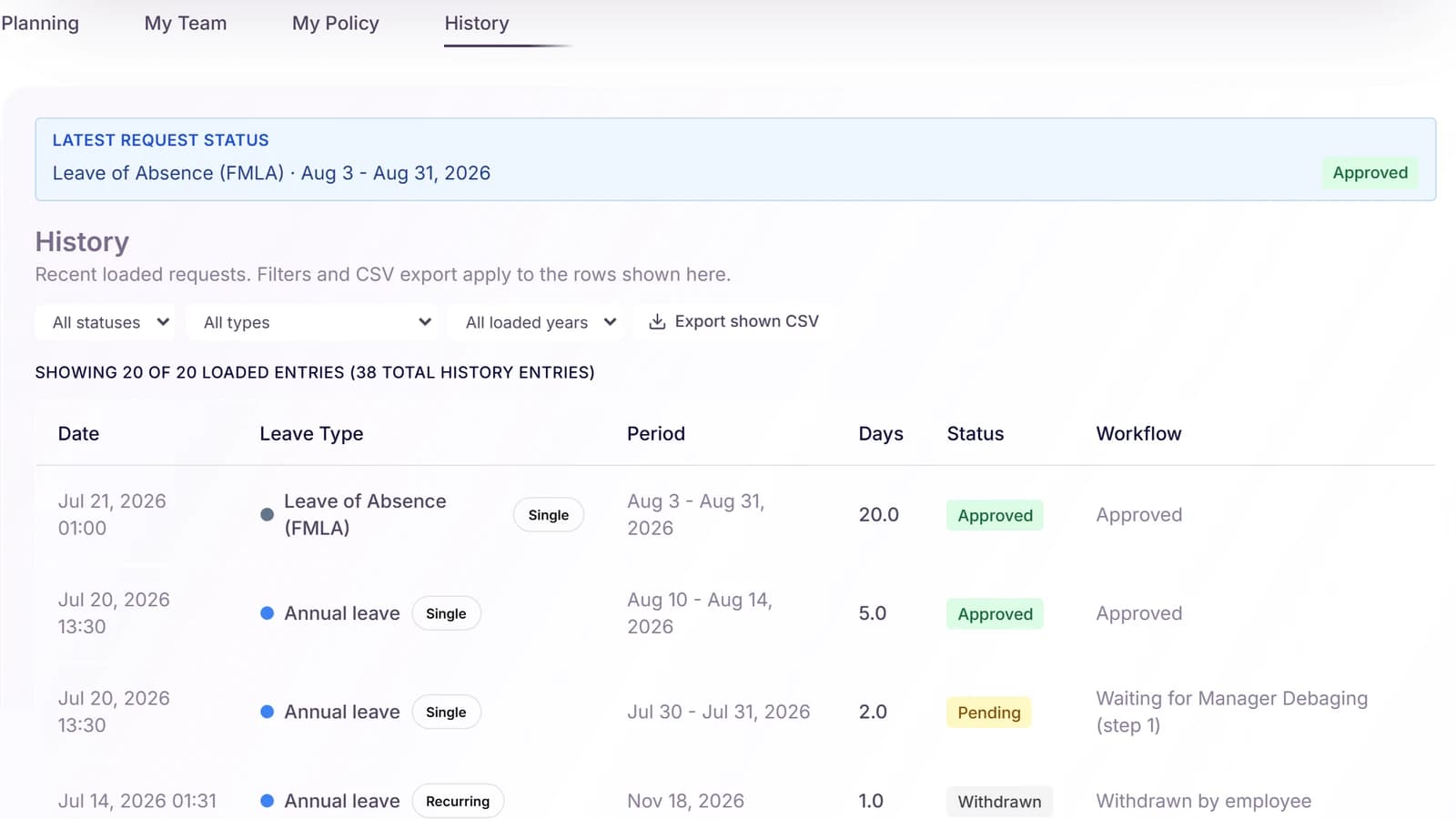
Tracking leaves of absence inside the vacation balance breaks all of this: FMLA time is not PTO, does not draw down the balance, and must be reportable on its own. A dedicated leave type with its own rules and audit trail is the clean setup.
Which guide answers your FMLA question?
This page is the hub of a cluster on US leave of absence law, and the FMLA guides below are its first layer. Start with the plain definition if the letters are new to you: what the law covers, what it deliberately leaves out, and why every leave has a reason layer, a protection layer, and a pay layer with the FMLA occupying only the middle one. If you already know you may need leave, the eligibility guide walks through the three tests, 12 months, 1,250 hours, and 50 employees within 75 miles, with the hour arithmetic for part-time schedules and the definitions of a serious health condition.
The pay question has its own guide, because the most common FMLA surprise is that the law pays nothing and the money comes from PTO, disability insurance, or one of the 13 state paid leave programs. Intermittent FMLA covers leave taken in hours rather than weeks, with the 480-hour and 384-hour arithmetic and the certification cadence. And the FMLA versus short-term disability comparison separates the job protection from the wage replacement and shows how the two run at the same time.
Where does the pay come from?
The second layer of the cluster is the pay layer, and it starts with the state programs. Paid family leave explained covers the 13 jurisdictions that pay family and medical leave benefits in 2026, how the progressive weekly formula works, and what to do in the 36 that have no program. FMLA vs PFML puts the federal protection and the state pay side by side, with the four eligibility combinations that decide whether a leave is protected, paid, both, or neither. For the private-insurance side, the short-term disability guide explains the elimination period, the 60 percent median, and the claim process, the tax guide answers who pays tax on the benefit and why the premium decides, and the pregnancy guide shows how disability, FMLA, and state paid leave stack into a maternity leave in a no-program state and in California.
Behind all of it sits the family and medical leave laws by state grid: one row per state and D.C. with the state leave statute beyond the FMLA, the paid leave status, the disability insurance program, and whether a paid sick leave mandate applies. The paid leave calculator now has a guide for each of the 14 programs that pay in 2026, with the calculator preset to that state. On the paperwork side, the certification guide covers the WH-380 forms, the five, fifteen, and seven day deadlines, what an employer may ask a doctor, and recertification. The employer's side has its own row: the FMLA for employers guide with the coverage test and a 12-row compliance checklist, the four FMLA notices and their five business day clocks, the four 12-month methods and when FMLA resets, how PTO and FMLA run together, the hour-by-hour arithmetic of supplementing disability pay with PTO, and how to track intermittent FMLA hours with a free spreadsheet tracker. The links are in the related row below.
Editorial explainer. Legal references: FMLA (29 U.S.C. § 2601 ff. and 29 CFR Part 825), USERRA, ADA, and the thirteen state paid family and medical leave programs named above, checked against each program agency's page in September 2026. This article explains common US practice at a general level and is not legal advice; state laws and company policies differ, so confirm specifics for your state.
Frequently asked questions
- What does leave of absence mean?
- An extended, event-driven period away from work during which the person stays employed but does not work. It can be legally protected (like FMLA leave) or granted voluntarily by the employer.
- Is a leave of absence paid?
- Often not by default. FMLA leave is unpaid; pay can come from accrued sick or vacation time, disability insurance, state paid family leave programs, or a generous company policy.
- How long can a leave of absence last?
- FMLA protects up to 12 weeks per year (26 for military caregiver leave). Voluntary leaves last whatever the policy allows, commonly 30 days to 6 months.
- What qualifies for FMLA leave?
- A serious health condition of the employee or a close family member, the birth or placement of a child, or qualifying military family needs, at a covered employer after 12 months and 1,250 hours of service.
- Can you take a leave of absence for mental health?
- Yes. A mental health condition treated by a provider can qualify as a serious health condition under the FMLA, including intermittent leave, and may also support ADA accommodation leave.
- Can an employer deny a leave of absence?
- A voluntary personal leave can be denied under the policy's rules. A qualifying FMLA or other legally protected leave cannot be denied for an eligible employee at a covered employer.
About the author
Blasko Sarcevic
Founder, Time-Out Zone
Connect on LinkedIn Connect on LinkedIn
Blasko writes about leave management, policy design, and running time-off operations at scale.
Related
- Learn hub
- Paid leave calculator
- What is FMLA?
- What qualifies for FMLA
- How to apply for FMLA
- Leave management software for FMLA tracking
- FMLA eligibility requirements
- Is FMLA paid?
- Intermittent FMLA
- FMLA vs short-term disability
- Paid family leave explained
- FMLA vs PFML
- What is short-term disability?
- Is short-term disability taxable?
- Short-term disability for pregnancy
- FMLA certification and paperwork
- FMLA for employers
- FMLA notices
- When does FMLA reset?
- FMLA and PTO
- Supplementing disability pay with PTO
- How to track intermittent FMLA hours
- Family and medical leave laws by state
- Types of employee leave
- Sabbatical leave explained
- Bereavement leave explained
- Sick leave laws by state
Every leave type, one system
Time-Out Zone tracks leaves of absence as dedicated leave types with their own rules, approvals, and audit trail, separate from every PTO balance.