Is FMLA Paid? How to Get Paid on FMLA Leave in 2026

Jovana Avramovic
Published
FMLA itself pays nothing: it protects your job and your health insurance for up to 12 weeks. The five sources that can replace your wages while you are out, how they stack, and what your employer can and cannot make you use.
Topic

Topic: the pay layer under FMLA leave.
Is FMLA paid?
No. The Family and Medical Leave Act does not pay wages. It guarantees eligible employees up to 12 workweeks of job-protected leave per year and requires the employer to keep group health insurance running on the same terms, but the time itself is unpaid under federal law. Pay during FMLA leave comes from other sources that run at the same time: accrued paid time off or sick leave, which the employer may require you to use or you may choose to use; short-term disability insurance for your own medical condition, usually 50 to 70 percent of pay after a waiting period; a state paid family and medical leave program in the 13 jurisdictions that run one in 2026; workers' compensation if the injury happened at work; or a company parental or medical leave policy. Which of these apply depends on your state, your employer's benefits, and the reason for the leave. Source: 29 CFR 825.207.
Why is FMLA unpaid?
The FMLA was the compromise that could pass in 1993: a guarantee that taking time off for a birth or a serious illness would not cost you your job or your health insurance, without a federal wage-replacement program to fund. Congress placed the law squarely in what this cluster calls the protection layer and left the pay layer to employers, insurers, and states. Thirty years on, that split is still the structure. The federal law has not gained a pay component; instead, thirteen states and the District of Columbia have built their own paid programs on top of it.
That history explains the answer people find frustrating. Being "on FMLA" describes the legal status of your absence, not the money arriving in your account. Two colleagues can both be on FMLA leave for surgery and have completely different pay: one drawing 60 percent from a disability plan, the other using up vacation days and then receiving nothing. The FMLA is identical for both; the difference is entirely in the sources described below. The what-is-FMLA guide lays out the three-layer model in full.
How do you get paid while on FMLA?
Five sources can replace wages during FMLA leave, and most people are covered by one or two of them. Accrued paid leave is the most common: vacation, PTO, or sick time you have already earned, paid at full rate until the balance runs out. Short-term disability insurance covers your own medical condition, typically after a 7-day waiting period, at 50 to 70 percent of base pay, for anywhere from a few weeks to six months depending on the plan. State paid family and medical leave programs pay a percentage of wages up to a weekly cap for family and medical reasons in the jurisdictions that run them. Workers' compensation pays when the injury or illness arose from the job. And some employers simply pay part or all of the leave under their own parental or medical leave policy.
The sources are not exclusive, but they do not add up to more than your pay. A disability plan will usually offset state benefits; an employer will let you top up a 60 percent disability payment with PTO to reach full pay, but not stack them to 160 percent. The table lays out who decides and what triggers each source.
| Source | What it pays | Who decides | Typical trigger |
|---|---|---|---|
| Accrued PTO or sick leave | Your full rate until the balance is used | You may elect it; the employer may require it (29 CFR 825.207) | Any FMLA reason |
| Short-term disability insurance | Usually 50 to 70 percent of base pay after a waiting period, for a limited number of weeks | The insurer, under the plan's definition of disability | Your own medical condition, including childbirth recovery |
| State paid family and medical leave | A percentage of wages up to a weekly cap set each year | The state agency or approved private plan | Own serious health condition, family care, bonding, in 13 jurisdictions (2026) |
| Workers' compensation | Wage replacement set by state law | The workers' comp insurer or state fund | Injury or illness arising from work |
| Employer paid leave policy | Whatever the policy grants, often full pay for a set number of weeks | The employer | Most often parental leave; sometimes medical leave |
Can my employer make me use PTO during FMLA leave?
Yes, with one important limit. Under 29 CFR 825.207 an employer may require you to substitute accrued paid leave for unpaid FMLA leave, and you may choose to do so if the employer does not require it. The paid leave and the FMLA leave then run concurrently: the same week counts against your PTO balance and against your 12-week entitlement. Using PTO never extends FMLA protection; it only changes whether the week is paid. The employer's normal rules for using that paid leave still apply, so if the vacation policy requires two weeks' notice, the employer can waive it but does not have to.
The limit is disability and workers' compensation. When you are receiving short-term disability benefits or workers' comp during FMLA leave, the employer cannot require you to also burn PTO, because the leave is already partly paid. You and the employer may agree to use PTO to top the benefit up to full pay, and many people do, but it has to be a mutual arrangement. The same rule applies once a state paid leave benefit is being paid: substitution becomes voluntary rather than required.
How much does FMLA pay a week?
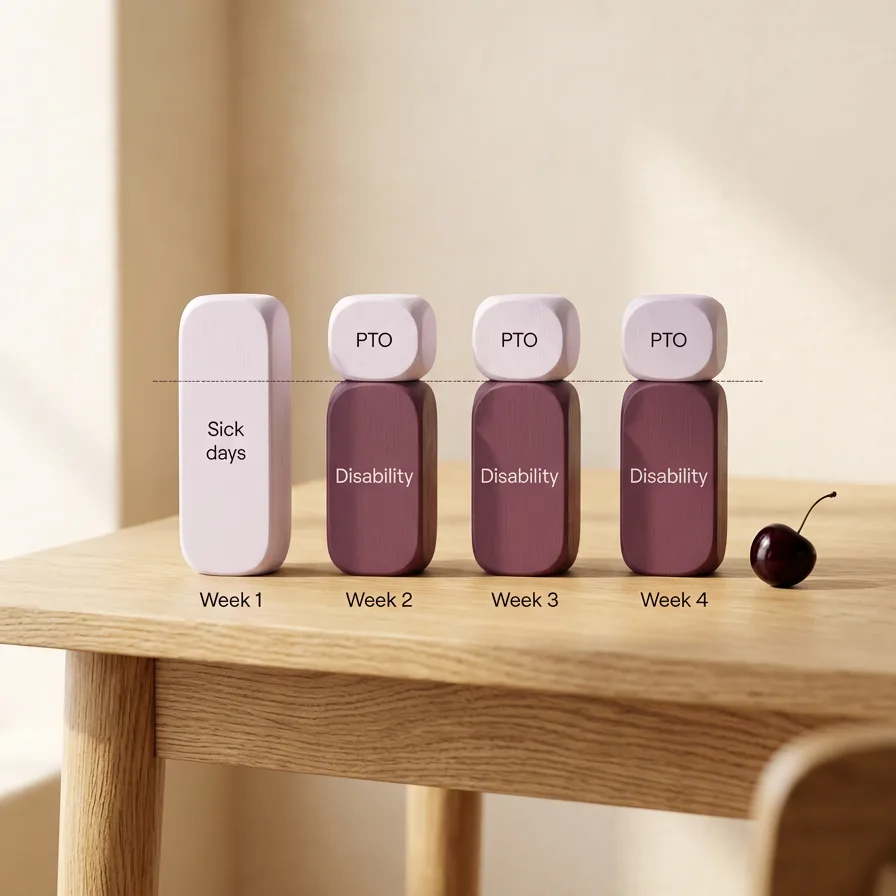
Nothing, because the FMLA is not a benefit program. The useful version of the question is how much the stack pays in a typical week, so take Priya, a lab technician in Texas earning $1,200 a week, whose employer has 90 employees and offers a short-term disability plan paying 60 percent after a 7-day elimination period. Texas has no state paid leave program, so her stack has two sources. She has a gallbladder operation and her surgeon certifies four weeks off.
Week one is the elimination period, so disability pays nothing; Priya uses five accrued sick days and receives her full $1,200. Weeks two through four are paid by the disability plan at $720 each. Her employer allows top-ups, so she uses two vacation days a week to add $480 and reach her normal $1,200; alternatively she could keep the vacation and live on $720. Across the four weeks she receives $4,800 with the top-up, having used five sick days and six vacation days, and her FMLA entitlement drops from 480 hours to 320. The FMLA contributed the part that does not show up on a payslip: her position, and her health insurance, were waiting on the Monday she returned.
Change the state and the numbers move. In one of the thirteen paid leave jurisdictions, the state benefit would replace most of the disability plan's role, at a percentage that in several programs reaches 80 or 90 percent of wages for lower earners, subject to a cap that each program resets in January. The leave of absence hub lists the programs; the state-level guides in this cluster will carry each program's current figures.
Which states pay you while you are on FMLA?
Thirteen jurisdictions run paid family and medical leave programs that pay benefits in 2026: California, Colorado, Connecticut, Delaware, the District of Columbia, Maine, Massachusetts, Minnesota, New Jersey, New York, Oregon, Rhode Island, and Washington. Maryland's program starts paying in January 2028 and Virginia's in December 2028. Each program pays a percentage of your average wage, higher for lower earners in most of them, up to a weekly maximum that is recalculated every year, for a set number of weeks that is usually 12 for a single reason.
When the reason qualifies under both laws, the state benefit and the FMLA run concurrently: the state pays, the FMLA protects, and the employer designates both at the same time. The state programs also reach people the FMLA does not, because most have no 50-employee threshold and much shorter service requirements, so an employee who is not FMLA-eligible can often still be paid under state law. California, Hawaii, New Jersey, New York, and Rhode Island additionally require temporary disability insurance for an employee's own medical condition, which is the pay source for most childbirth recoveries in those states.
What happens to health insurance and benefits during unpaid FMLA leave?
The employer must maintain your group health coverage on the same terms as if you were working, which means the employer keeps paying its share and you keep paying yours. When the leave is unpaid there is no paycheck to deduct from, so the employer has to offer a payment method: paying at the same time it would have been deducted, paying by a set date each month, or paying in advance or on return by agreement. If a payment is more than 30 days late the employer may drop coverage, but only after written notice at least 15 days before it ends. Coverage is restored on the day you return, with no new waiting period.
Other benefits follow the employer's own rules for unpaid leave. Whether PTO keeps accruing during unpaid FMLA weeks depends on the policy, as long as FMLA leave is treated no worse than any other unpaid leave. Seniority does not have to accrue, but nothing earned before the leave can be lost. If you decide not to return, the employer may recover its share of health premiums paid during unpaid leave, unless the reason for not returning is the continuation of the serious health condition or something else outside your control.
When does sick leave turn into FMLA leave?
Most FMLA leaves start as an ordinary sick call. You phone in with the flu on Monday, still cannot work on Wednesday, and by Thursday your doctor is talking about a procedure. Nothing in that sequence requires you to say the letters FMLA. Once the employer has enough information to know that the absence may be for a serious health condition, more than three days of incapacity plus treatment is the usual signal, it must ask whether the leave is FMLA-qualifying and, if so, designate it within five business days. The designation runs from the first day of the absence, which means those Monday sick hours were FMLA hours all along.
For pay, that reclassification changes little: the sick days you used are still paid at your normal rate, and they now also count against the 12-week entitlement. What changes is the protection. From the moment of designation the absence cannot be counted under a no-fault attendance policy, and your position is held. Our guide to calling in sick covers the first phone call and the doctor's note rules; this article covers what happens once that call becomes a leave.
Statutory references: 29 CFR 825.207 (substitution of paid leave; limits when disability or workers' compensation benefits are paid), 825.209 to 825.213 (maintenance of health benefits, premium payments, 30-day grace and 15-day notice, recovery of premiums), 825.215 (equivalent benefits and accrual), 825.216(e) (outside employment policies), 825.300(d) and 825.301 (designation). State program agencies for the 13 paid family and medical leave jurisdictions and the five temporary disability insurance states, checked September 2026. Disability plan percentages describe common private plan terms, not a statutory rate. This article explains US federal and state leave law at a general level and is not legal advice. State program rules, benefit rates and caps change, usually each January, so confirm the current figures with the agency that runs the program or with qualified counsel.
Frequently asked questions
- Does FMLA pay you?
- No. FMLA leave is unpaid under federal law. Pay comes from accrued PTO or sick leave, short-term disability insurance, a state paid family and medical leave program, workers' compensation, or a company policy, and those sources run at the same time as the FMLA protection. Your health insurance continues on the same terms throughout.
- Can I collect unemployment while on FMLA?
- Generally no. Unemployment insurance requires you to be out of work and able and available for work; on FMLA leave you are still employed and, in most cases, medically unable to work. State rules differ, but an approved leave of absence is almost never a qualifying separation.
- Is FMLA paid in California?
- The FMLA itself is not, but California's State Disability Insurance pays for your own medical condition and its Paid Family Leave program pays for family care and bonding, at 70 or 90 percent of wages depending on income since 2025, up to a weekly cap the state resets each January. Both run alongside FMLA and California's CFRA protection.
- Do I keep accruing PTO while on FMLA leave?
- It depends on the employer's policy for unpaid leave. FMLA requires only that FMLA leave be treated at least as well as other unpaid leave, so if PTO does not accrue during other unpaid absences it need not accrue during unpaid FMLA weeks. During weeks where you substitute paid leave, accrual usually continues as normal.
- Can I work a second job while on FMLA leave?
- Only if your employer's policy on outside employment allows it, applied the same way to everyone on leave. An employer with a uniformly enforced policy against moonlighting may enforce it during FMLA leave; without such a policy it generally cannot stop you, though working a job you are certified as unable to perform invites a challenge to the certification.
- How much does short-term disability pay during FMLA?
- Typically 50 to 70 percent of your base pay, with 60 percent the most common figure, after a waiting period of about 7 days and for a plan-defined maximum, often 13 to 26 weeks. The exact figures are in your plan document; the FMLA does not set them. Your employer cannot require you to use PTO at the same time, but you can agree to top the benefit up.
About the author
Jovana Avramovic
Product Excellence, Time-Out Zone
Jovana writes hands-on guides to time-off workflows, calendar tooling, and the rules behind vacation, sick leave, and payouts.
Related
See the pay stack next to the leave
Time-Out Zone keeps FMLA hours, substituted PTO, and the leave case in one record, so employees see what is protected and what is paid without asking HR twice.