How to Call In Sick: What to Say and What Your Employer Can Ask

Blasko Sarcevic
Published · Updated
What to say when you call in sick, with messages you can copy for text, email and Slack, plus whether you have to give a reason and when a doctor's note applies.
Topic
Topic: calling in sick the right way.
What do you say when you call in sick?
Say three things and stop: that you are unwell and cannot work, when you expect to be back, and what is urgent today. "Hi [manager], I'm unwell and won't be able to work today. I expect to be back tomorrow and will let you know if that changes. The [X] deadline is the only urgent item, [colleague] has the context." You do not owe your employer a diagnosis or a description of your symptoms, and a short factual message lands better than a long apology. Send it before your shift or workday starts, through whatever channel your company designates (a phone call, a message to your manager, or the absence system), and update your manager before your last communicated day ends if you need longer. Many US employers ask for a doctor's note only after three or more consecutive days, and several state sick leave laws restrict when a note can be demanded at all.
What to say when calling in sick: copy these
The structure is the same in every channel: the fact, the duration, the handover. Everything else is optional, and most of what people add (apologies, symptom detail, promises to work from bed) makes the message worse. Pick the row that matches your situation.
| Situation | Message |
|---|---|
| One day, text or phone | Hi [manager], I'm unwell and won't be able to work today. I expect to be back tomorrow. [Colleague] has what they need on [task]. |
| Unsure how long | Hi [manager], I'm sick and can't work today. I'll know more after I see a doctor this afternoon and will update you by end of day. |
| Email, more formal workplace | Subject: Sick leave today. Hi [manager], I'm unwell and unable to work today, [date]. I've moved [meeting] and [colleague] is covering [task]. I'll confirm tomorrow morning whether I'm back. Thanks, [name]. |
| Slack or Teams | Morning [manager], out sick today. Back tomorrow unless I say otherwise. Nothing urgent except [item], which [colleague] can pick up. |
| Second or third day | Hi [manager], still unwell, so I'm out again today. Doctor's appointment is [day]; I'll send an update straight after. |
| Child or family member is sick | Hi [manager], my [child] is ill and I need to stay home with them today. I'll be reachable for anything genuinely urgent and will catch up tomorrow. |
When to notify: as early as possible
The single most important rule is timing. Tell your employer as soon as you know you cannot work: before your shift or workday begins, not mid-morning. Early notice is what lets a team arrange coverage, and late notice is what turns a normal sick day into a reliability question.
If you wake up unsure, err on the side of notifying early and updating later. A retracted sick notice costs nothing; a missing one does.
Some employers set the expectation in writing, usually one or two hours before your start time for an office role and longer for shift work where a replacement has to be found. If your handbook names a deadline, that deadline is the answer; if it does not, before your start time is the safe default.
Which channel to use
Follow the company's designated channel: Some workplaces require a phone call, others accept a message or a request in the absence system. If no channel is defined, message your direct manager and log the absence in whatever system the company uses.
Avoid the two extremes: telling only a colleague (the manager finds out at standup) and broadcasting to everyone (unnecessary). One notification to the right person, plus the system entry, covers it.
Do you have to say why you are sick?
No. The employer needs to know that you cannot work and roughly for how long. Nothing in US law obliges you to name the illness, describe symptoms or explain what the doctor said, and several state paid-sick-leave statutes say so in as many words by barring employers from demanding details as a condition of taking the leave.
"I'm unwell and can't work today" is a complete answer. If a manager presses, the honest and sufficient reply is that you would rather not go into detail but you expect to be back on [day]. The exception is narrow: where you ask for an accommodation or for job-protected leave such as FMLA, you will have to give a provider enough medical information to certify the request, and that goes to HR or a third-party administrator rather than to your manager.
Any illness or injury that genuinely prevents you from working is a valid reason, including a mental health day where your policy or local sick leave law covers it. Many state and city laws also cover caring for a sick family member and attending medical appointments.
Can you be fired for calling in sick?
In most US states employment is at will, so an employer can in principle end the relationship for attendance. What changes the picture is whether the day is protected. Leave taken under a state or city paid-sick-leave law, under the FMLA, or as a disability accommodation is protected, and firing or disciplining someone for using it is unlawful retaliation. Roughly a third of states and dozens of cities now have paid-sick-leave mandates with anti-retaliation clauses attached.
What is not protected is the process. An employee who is genuinely ill but never calls, calls hours into the shift, or ignores a documentation rule everyone else follows can be disciplined for that, and courts regularly uphold it. This is the practical reason to send the message early and in the designated channel: it removes the only ground that is usually available.
If you were disciplined within days of using protected leave, or if a note requirement appeared for you alone, that pattern is what retaliation claims are built on. Keep the messages you sent and the dates.
How many days can you call in sick before you need a doctor's note?
Three consecutive days is the usual threshold, but it is a convention rather than a national rule. Common practice is that employers may ask for a doctor's note after three or more consecutive sick days, and policies say so explicitly. Several state and city paid-sick-leave laws restrict note requirements for short absences, and some only allow them after three consecutive days; the state-by-state rules are collected in our sick leave laws by state reference.
For comparison, other countries codify this: in Germany, a medical certificate is legally required from the fourth calendar day (employers may demand it from day one), and since 2023 it flows electronically from the doctor to the employer via the health insurer. The German version of this article covers those rules in detail.
What employers can and cannot ask
The line is practical: employers can ask what they need for planning, not what satisfies curiosity.
| Generally allowed | Generally not allowed |
|---|---|
| Expected duration of the absence | Your diagnosis or detailed symptoms |
| A doctor's note per policy and local law | Requiring work while you are signed off sick |
| Urgent handover questions | Retaliation for using protected sick leave |
| Consistent documentation rules for everyone | Singling out individuals for stricter proof |
Multi-day absences: keep the updates flowing
If you are out more than a day, the follow-up matters as much as the first notice. Update your manager before your last communicated day ends. Silence is what creates friction, not the length of the absence.
If the illness stretches further, documentation rules usually kick in (a doctor's note, short-term disability paperwork, or FMLA for serious conditions). Knowing your company's thresholds in advance makes a stressful week easier.
For employers: make calling in sick easy
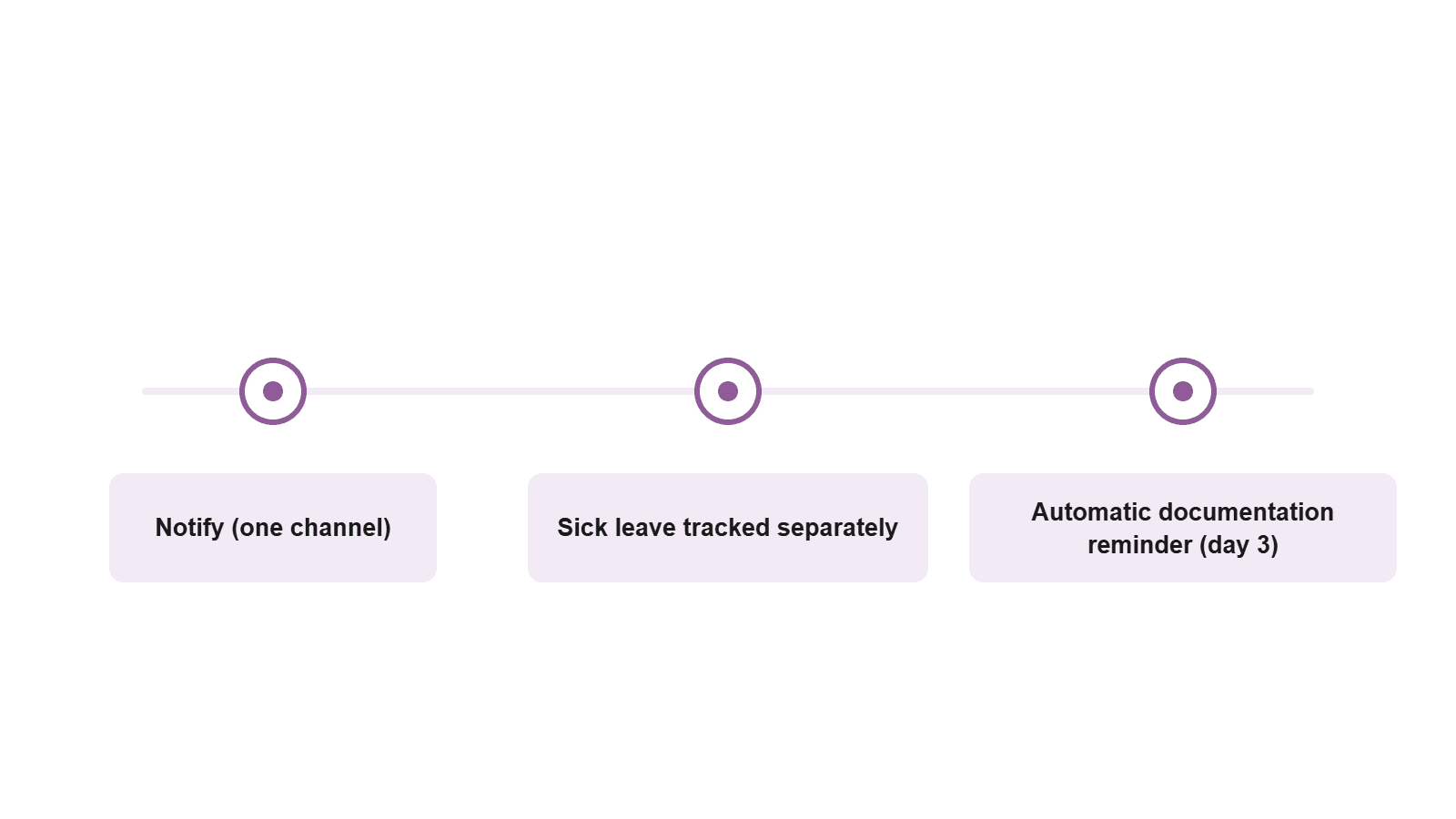
On the company side, the process decides everything: one clear channel, a defined notice expectation, sick days tracked separately from vacation, and automatic reminders for missing documentation.
Confidentiality is part of it: sickness data is sensitive, and who can see which absence type should be explicitly configured, not left to default visibility. A system that handles this removes the awkwardness for everyone.
US sick leave and documentation rules vary by state and city; the guidance here reflects common practice, and the per-state statutes are listed in the sick leave laws by state reference. German statutory rules (§ 5 EFZG, eAU) are covered in the German version. This article explains common US practice at a general level and is not legal advice; state laws and company policies differ, so confirm specifics for your state.
Frequently asked questions
- What should I say when calling in sick?
- That you are unwell and cannot work, your expected return, and anything urgent that needs covering. You generally do not have to share a diagnosis. "Hi [manager], I'm unwell and won't be able to work today. I expect to be back tomorrow. [Colleague] has what they need on [task]."
- What do you say when calling in sick for one day?
- Keep it to one line and name the return date, because a one-day absence needs no plan: "Hi [manager], I'm unwell and won't be able to work today. Back tomorrow." Add a handover sentence only if something is actually due that day.
- Can you get fired for calling in sick?
- Not for using leave that is protected by a state or city sick-leave law, the FMLA, or a disability accommodation; doing that is retaliation. You can be disciplined for how you called in, which is why notifying early through the designated channel matters as much as the reason.
- When do you need to tell your manager that you are sick?
- Before your shift or workday starts, as soon as you know. Many handbooks set a specific deadline, often one or two hours before the start time and longer for shift work where someone has to be found to cover. If yours does not, before your start time is the safe default.
- How early should I call in sick?
- As soon as you know, ideally before your shift or workday starts. Early notice lets the team arrange coverage and keeps a sick day from becoming a reliability issue.
- Do I need a doctor's note to call in sick?
- Usually not for a single day. Many employers require one after three or more consecutive days, and some sick leave laws limit when notes can be demanded. Check your policy and your state's rule.
- Can I call in sick for a mental health day?
- If you are unwell to the point of not being able to work, yes, and many paid-sick-leave laws and company policies explicitly cover mental health. You do not have to specify the nature of the illness.
- Can my employer ask why I am sick?
- They can ask about expected duration and handovers, but you are generally not obligated to share a diagnosis. Detailed medical information stays between you and your doctor.
- When does calling in sick become FMLA leave?
- When the absence turns out to be for a serious health condition, usually more than three consecutive days of incapacity plus treatment by a provider, and you work for a covered employer with 12 months and 1,250 hours behind you. You do not have to say FMLA on the call; once the employer has enough information it must designate the leave, counting from the first sick day, and the days you already used stay paid under your sick leave.
About the author
Blasko Sarcevic
Founder, Time-Out Zone
Connect on LinkedIn Connect on LinkedIn
Blasko writes about leave management, policy design, and running time-off operations at scale.
Related
Sick days without the paperwork
Time-Out Zone tracks sick leave separately from vacation, reminds about missing documentation, and keeps sickness data confidential.