FMLA vs Short-Term Disability: The Difference in 2026

Blasko Sarcevic
Published
FMLA protects your job for up to 12 weeks and pays nothing; short-term disability replaces part of your pay, usually 50 to 70 percent, and protects nothing. Most people who qualify for one qualify for both at the same time. How they differ, how they overlap, and what happens when one runs out before the other.
Topic

Topic: one key holds the job, the other pays the bills.
What is the difference between FMLA and short-term disability?
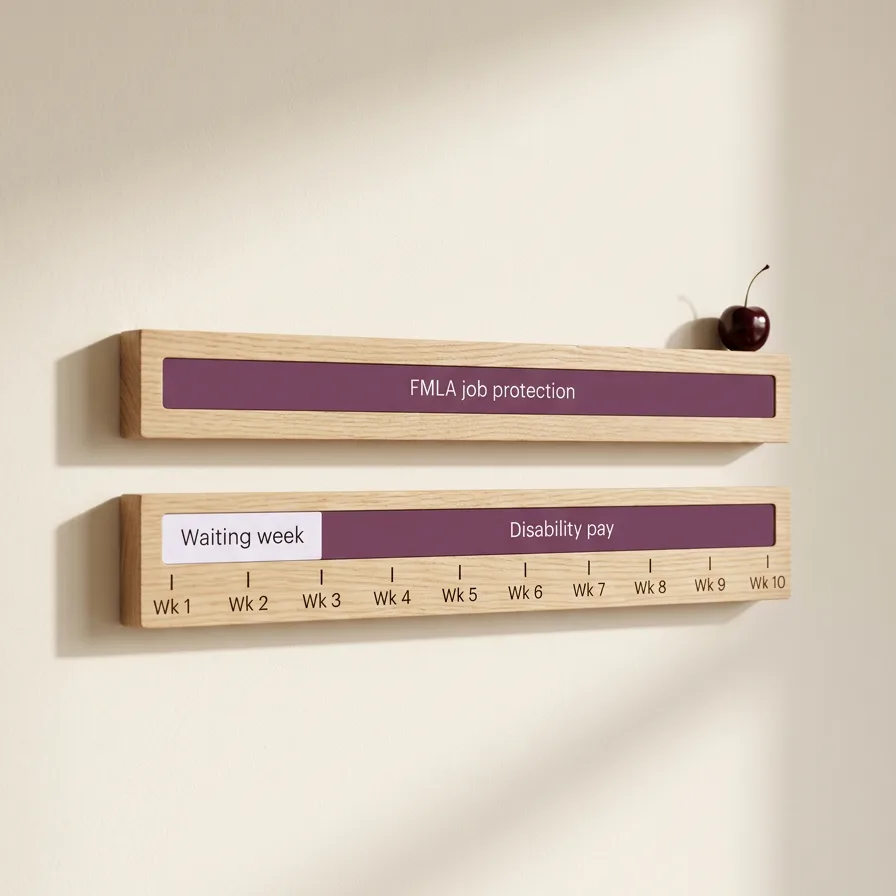
FMLA and short-term disability solve different problems and usually run at the same time. The FMLA is a federal law that protects your job and your health insurance for up to 12 workweeks a year while you are out for a serious health condition, but it pays nothing. Short-term disability (STD) is an insurance benefit, provided by your employer or bought individually, that replaces part of your income, typically 50 to 70 percent of base pay, after a waiting period of about 7 days, for a limited period, commonly 3 to 6 months. STD does not protect your job; FMLA does not pay. When a condition qualifies under both, the employer designates FMLA at the start of the disability claim so the two run concurrently: the insurer pays while the FMLA clock holds the position. Five states, California, Hawaii, New Jersey, New York, and Rhode Island, require employers to provide disability coverage; elsewhere it is a voluntary benefit. Source: 29 CFR Part 825 and individual plan documents.
What does FMLA do that short-term disability does not?
FMLA is a legal guarantee, and its three promises have no equivalent in an insurance policy. The first is restoration: when the leave ends, you return to the same position or one with equivalent pay, benefits, shift, and location, and the employer cannot fill the role permanently while you are out. The second is health insurance: the employer must keep your group coverage running on the same terms, paying its share as if you were at work. The third is protection from retaliation: the absence cannot be counted under an attendance policy or used against you in a promotion or layoff decision, and interfering with the leave is unlawful.
FMLA also covers ground that disability insurance never touches. A disability plan pays only when you are the patient. FMLA protects leave to care for a spouse, child, or parent with a serious health condition, to bond with a new child, and for military family needs, none of which involve your own incapacity. A father taking eight weeks with a newborn is on FMLA leave with no disability claim at all; a daughter caring for a parent after a stroke is in the same position. For those leaves the pay layer, if there is one, comes from a state paid family leave program or a company policy, not from STD.
What does short-term disability do that FMLA does not?
It pays. That single fact makes STD the more valuable of the two for most people during a medical leave, because the FMLA's protections are worth little if you cannot cover rent for eight weeks. A typical group plan replaces 60 percent of base salary, some plans 50 or as much as 70, from the eighth day of disability for accidents and illnesses alike, up to a maximum that is often 13 or 26 weeks. Pregnancy is the most common claim: plans commonly pay six weeks for a vaginal delivery and eight for a caesarean, longer with complications.
STD also reaches people the FMLA does not. It has no 50-employee threshold and no 1,250-hour test; a new hire at a 20-person company can be covered from the first day of the plan year if the plan says so. And it can outlast the FMLA: a 26-week plan keeps paying for three months after the 12 weeks of job protection have expired. What it never does is hold the job. The plan document is silent on your employment; the insurer's only question is whether you meet its definition of disabled, which usually means unable to perform the material duties of your own occupation, and whether the condition is excluded, for example as pre-existing in the first year of coverage.
FMLA vs short-term disability side by side
The comparison is easiest to hold as a table. Read each row as an independent question rather than as a contest; for most medical leaves the correct answer is that both apply.
| Aspect | FMLA | Short-term disability |
|---|---|---|
| What it is | Federal law (29 U.S.C. 2601; 29 CFR Part 825) | Insurance benefit under an employer plan, an individual policy, or a state disability program |
| What it provides | Unpaid, job-protected leave; continued group health insurance; restoration to the same or an equivalent job | Partial wage replacement, typically 50 to 70 percent of base pay |
| Who qualifies | Employees with 12 months and 1,250 hours at an employer with 50+ employees within 75 miles | Whoever the plan covers; often all full-time employees after a short waiting period, regardless of employer size |
| Reasons covered | Own serious health condition, family member's serious health condition, birth and bonding, adoption or foster placement, military family leave | Own non-work-related illness, injury, or pregnancy that meets the plan's definition of disability |
| Duration | Up to 12 workweeks per 12-month period (26 for military caregiver leave) | Plan-defined, commonly 13 to 26 weeks, after an elimination period of about 7 days |
| Pay | None | The plan's percentage, up to a weekly maximum; taxable if the employer paid the premium |
| Job protection | Yes | No |
| Who administers | The employer (HR), with DOL forms WH-380, WH-381, WH-382 | The insurer or third-party administrator; the state agency in CA, HI, NJ, NY, RI |
| Cost to the employee | None, beyond continuing to pay the employee share of health premiums | Premiums are employer-paid, employee-paid, or shared, depending on the plan |
Can you use FMLA and short-term disability at the same time?
Yes, and for an eligible employee with a qualifying condition the employer is expected to make it happen. Once the employer knows that an absence is for a serious health condition, which a disability claim makes obvious, it must designate the leave as FMLA within five business days and the two run concurrently from the first day. The employee does not get to bank the FMLA for later by saying they would rather use only disability; designation is the employer's duty, not the employee's choice. Running the two together is also what protects the employer, because it means the 12 weeks of job protection and the 26 weeks of benefits start on the same day rather than stacking into eight months of held position.
Take Jonas, a software engineer in Texas earning $1,500 a week at a 300-person company, who needs a knee reconstruction with a certified ten-week recovery. His employer's plan pays 60 percent after a 7-day elimination period. Week one: the plan pays nothing, and Jonas uses five accrued sick days to receive his full $1,500. Weeks two through ten: the plan pays $900 a week. Because he is receiving disability benefits, the employer cannot force him to burn PTO on top, but the two agree that he will use one vacation day a week, adding $300, to take home $1,200 in those weeks. Across the leave he receives $12,300 and uses 5 sick days and 9 vacation days. All ten weeks are FMLA leave, 400 of his 480 hours, so his position is held, his health insurance continues with his share paid monthly, and he returns to the same team on the Monday of week eleven with 80 FMLA hours left for the year.
The one restriction to remember is the substitution rule: while disability or workers' compensation benefits are being paid, the employer may not require the employee to use accrued paid leave, because the leave is already partly paid. Top-ups are allowed only by agreement, as in Jonas's case, and where state law permits.
What happens when short-term disability lasts longer than FMLA?
The FMLA guarantee ends when the 12 workweeks are used, and that date can arrive while the disability plan is still paying. At that point the law changes hands. If the condition is a disability under the Americans with Disabilities Act, which applies at employers with 15 or more employees, additional leave can be a reasonable accommodation the employer must consider unless it causes undue hardship; indefinite leave generally is not. Some states extend job-protected medical leave beyond 12 weeks, and California's pregnancy disability leave, up to four months, runs in addition to bonding leave under CFRA. And many employers hold positions longer under their own leave-of-absence policy, which is worth reading before the twelfth week rather than after.
The reverse also happens. A plan that pays for 13 weeks stops a week after FMLA protection does; a plan that excludes a pre-existing condition may deny the claim entirely while the FMLA leave is fully protected. And at the far end, a disability that outlasts the STD maximum moves to long-term disability insurance, if the employer offers it, typically after 90 or 180 days. None of those transitions change the FMLA clock; they change who is paying and whether the job is still held.
Which states require short-term disability insurance?
Five states and Puerto Rico require employers to provide temporary disability coverage for an employee's own non-work-related illness, injury, or pregnancy: California through State Disability Insurance, Hawaii through Temporary Disability Insurance, New Jersey through Temporary Disability Benefits, New York through the Disability Benefits Law, and Rhode Island through Temporary Disability Insurance. In those states the state program, or an approved private plan that matches it, is the pay layer for most medical leaves, and the percentages and weekly caps are set by statute and updated each year.
The thirteen paid family and medical leave jurisdictions overlap with this list. California, New Jersey, New York, and Rhode Island run their family leave programs alongside the disability programs above; Colorado, Connecticut, Delaware, the District of Columbia, Maine, Massachusetts, Minnesota, Oregon, and Washington cover an employee's own serious health condition inside a single paid leave program, which functions like state-run short-term disability. Everywhere else, STD exists only if the employer offers it or the employee buys it, and roughly two in five private-sector workers have access to it through work, according to the Bureau of Labor Statistics' National Compensation Survey.
How should employers coordinate FMLA and short-term disability?
The operational mistake is treating them as one process. They share a medical event and often a single certification, but they answer to different rules: the FMLA is measured in hours of protection under a 12-month method; STD is measured in dollars and weeks under a plan document, usually by an outside insurer. An employer that lets the insurer's approval stand in for FMLA designation ends up without the designation notice the regulations require, and one that waits for the FMLA paperwork before starting the claim delays the employee's pay.
The clean setup opens both on day one from one intake: the leave case records the FMLA designation, the hours, and the certification; the disability claim runs with the insurer and its payments are noted on the case as the pay source; any PTO top-up is recorded as substitution by agreement. Medical documents stay in the confidential file, separate from the personnel record. When the FMLA hours run out, the case flags the transition so that the ADA and policy questions are asked before the twelfth week, not after. Time-Out Zone models leave cases with the protection clock and the pay sources side by side for exactly this reason.
Statutory references: 29 CFR 825.207(d) and (e) (no required substitution of paid leave while disability or workers' compensation benefits are paid; top-ups by agreement), 825.209 to 825.212 (health benefits during leave), 825.214 to 825.215 (restoration to the same or an equivalent position), 825.220 (interference and attendance policies), 825.300(d) and 825.301 (designation is the employer's duty). State disability statutes: California Unemployment Insurance Code (State Disability Insurance), Hawaii Revised Statutes chapter 392, New Jersey Temporary Disability Benefits Law (N.J.S.A. 43:21-25 et seq.), New York Workers' Compensation Law article 9, Rhode Island General Laws chapter 28-41. Access figures from the US Bureau of Labor Statistics National Compensation Survey (employee benefits). Plan percentages, elimination periods, and maximum durations describe common private plan terms, not statutory rates. Checked September 2026. This article explains US federal and state leave law at a general level and is not legal advice. State program rules, benefit rates and caps change, usually each January, so confirm the current figures with the agency that runs the program or with qualified counsel.
Frequently asked questions
- Do I have to use FMLA if I am on short-term disability?
- You do not choose. When an eligible employee's absence qualifies, the employer must designate it as FMLA leave, and the FMLA clock runs concurrently with the disability claim from the first day. Employees cannot decline designation to save FMLA weeks for later; the regulations place the designation duty on the employer.
- Does short-term disability protect your job?
- No. Short-term disability is an insurance benefit that replaces part of your pay; it says nothing about your employment. Job protection during a medical leave comes from the FMLA, from state leave laws, from the ADA's accommodation duty, or from the employer's own policy.
- Is short-term disability paid during FMLA leave?
- Yes, if you have STD coverage and the condition meets the plan's definition of disability. The FMLA does not affect the claim either way. While the plan is paying, your employer cannot require you to use PTO as well, though you can agree to use some to top the benefit up to full pay.
- How long is short-term disability?
- It depends on the plan. Common maximums are 13 weeks and 26 weeks, after an elimination period of about 7 days. Payments stop earlier if you recover or if the insurer decides you no longer meet the definition of disabled. A condition that lasts beyond the maximum moves to long-term disability insurance where the employer offers it.
- Can I be denied short-term disability while approved for FMLA?
- Yes. The two are decided by different parties under different rules. FMLA approval means the employer accepts that you have a serious health condition; the insurer independently decides whether you meet the plan's definition of disability and whether an exclusion applies, for example a pre-existing condition in the first year of coverage. A denied claim does not undo the FMLA protection.
- Is short-term disability taxable?
- Benefits are taxable income when the employer paid the premium or you paid it with pre-tax dollars, and tax-free when you paid the premium with after-tax dollars. If the cost was shared, the benefit is taxable in proportion to the employer-paid share. State disability programs have their own rules.
About the author
Blasko Sarcevic
Founder, Time-Out Zone
Connect on LinkedIn Connect on LinkedIn
Blasko writes about leave management, policy design, and running time-off operations at scale.
Related
Protection clock and pay source, one record
Time-Out Zone opens the FMLA case and notes the disability claim on the same leave record, so HR sees the hours of protection and the pay layer together and knows when week twelve is coming.