FMLA for Employers: Coverage, Obligations, and a Compliance Checklist (2026)

Blasko Sarcevic
Published
Once a company crosses 50 employees the FMLA stops being an employee's right in the abstract and becomes a list of things HR has to do on a clock. Who is covered, what must be posted, which notices are due in five business days, how the 12-month period is chosen, what happens to health insurance and the job, and what a mistake costs.
Topic

Topic: the employer's side of the FMLA.
What does the FMLA require of employers?
A private employer is covered by the Family and Medical Leave Act once it has 50 or more employees on the payroll for 20 or more workweeks in the current or preceding calendar year; public agencies and schools are covered at any size. A covered employer must post the Department of Labor's FMLA notice at every worksite and repeat it in the handbook or at hire, tell an employee whether they are eligible within five business days of learning that leave may be needed, explain their rights and responsibilities in writing, and designate the leave as FMLA within five business days of having enough information. During the leave it keeps group health insurance running on the same terms and counts the time against a 12-month period it applies to everyone; at the end it restores the employee to the same or an equivalent job. It may not interfere with the leave or hold it against the employee, and it keeps the records for three years. Source: 29 U.S.C. 2611 to 2619 and 29 CFR Part 825.
Which employers are covered by the FMLA?
The coverage test is a headcount over time, not a snapshot. A private employer is covered if it employed 50 or more employees for each working day during 20 or more calendar workweeks in the current or the preceding calendar year. Every person on the payroll counts toward the 50: full-time and part-time staff, people on paid or unpaid leave who are expected to return, and employees of a staffing agency placed with the company under the joint employment rules. Independent contractors do not count. The 20 workweeks do not have to be consecutive. Once the threshold is crossed, coverage lasts until the employer has been below 50 for 20 workweeks in both the current and the preceding year, so a company that shrinks does not lose its obligations overnight.
Two doctrines pull related companies together. Under the integrated employer test, separate legal entities are treated as one when they share management, have interrelated operations, run labor relations from one place, and have common ownership, so a group of three 20-person subsidiaries with one HR function is a 60-person employer for FMLA purposes. Under the joint employer rules, a staffing agency and its client both count the placed workers toward their own headcounts. The agency, as the primary employer, owes the notices, the leave, the health benefits, and the restoration; the client, as the secondary employer, may not interfere with the leave and must accept the worker back if it is still using the agency's services.
Public agencies, including federal, state and local government employers, and public and private elementary and secondary schools are covered regardless of headcount. Being a covered employer is not the same as having eligible employees. A covered employer with 55 people spread across three cities may have a worksite where nobody is eligible, because eligibility also requires 50 employees within 75 miles of the employee's own worksite. That distinction drives the worked example below.
What must a covered employer post and put in the handbook?
The general notice is the one obligation that applies even when no employee is eligible yet. Every covered employer must display the Department of Labor's poster, Employee Rights Under the Family and Medical Leave Act (form WH-1420), prominently at each worksite where employees and applicants can see it. The poster is free and may be printed on plain paper. Since 2020 the Department has accepted electronic posting as a substitute where the entire workforce works remotely and customarily receives workplace information electronically; a hybrid office still needs the paper version. Where a significant portion of the workforce is not literate in English, the notice must also be provided in a language they read; the Department publishes Spanish and other translations.
If the employer has any eligible employees, the same information must also go into the employee handbook or other written leave guidance. An employer without a handbook satisfies the rule by giving each new employee a copy of the general notice at hire. Handing the poster text to new hires electronically is fine. A willful failure to post carries a civil money penalty per offense that the Department adjusts for inflation each January (a little over 200 dollars in 2025). The larger cost of a missing notice is that an employer that never told employees about the FMLA has a weak position when it later argues that an employee gave notice too late or in the wrong way.
What notices does the employer owe once leave is requested?
The moment an employee gives enough information to suggest that leave may be for an FMLA reason, a five business day clock starts. Within that window the employer must tell the employee whether they are eligible and, if not, give at least one reason. With the eligibility notice, or in the same window, comes the written rights and responsibilities notice: the 12-month period method, whether certification will be required and the consequences of not providing it, whether paid leave will be substituted, how health premiums are paid during leave, whether the employee is a key employee, and the right to restoration. The Department's form WH-381 carries both.
When the employer has enough information to decide, normally after the certification comes back, it has five more business days to send the designation notice (form WH-382): the leave is designated as FMLA, or it is not and why. The notice states how much leave will be counted if that is known, whether a fitness-for-duty certificate will be required at return, and whether paid leave is being substituted. An employee who is denied gets the same piece of paper with the reason marked. The detail of each notice, the forms, and what happens when a deadline is missed are in the FMLA notices guide; the certification request, the 15 calendar days the employee gets, and the seven-day cure period are in the certification and paperwork guide.
How does the employer choose the 12-month period?
The 12 workweeks of entitlement live inside a 12-month period, and the regulations let the employer pick one of four ways to define it: the calendar year, any fixed leave year such as a fiscal year or the employee's anniversary, 12 months measured forward from the first day of leave, or a rolling 12 months measured backward from each day leave is used. The choice is the employer's, but it must be applied uniformly to all employees, it must be disclosed in the rights and responsibilities notice, and it can only be changed with 60 days' written notice and a transition that leaves every employee with the full benefit of whichever method is more favorable to them during the changeover.
An employer that never chose a method has, in effect, chosen the one most beneficial to the employee for every dispute, which in practice means the calendar year with its stacking risk. The rolling backward method is the only one that prevents an employee from stacking two full entitlements across a year boundary, which is why most employers with an HR system use it and why it is the default in ours. The four methods, the 60-day rule and a dated example are in the guide on when FMLA resets.
What happens to pay and benefits during FMLA leave?
FMLA leave is unpaid. The employer may require, and the employee may elect, that accrued paid leave run concurrently with the FMLA leave, under the terms of the employer's normal paid leave policy; the requirement has to be stated in the rights and responsibilities notice. Where the employee is receiving short-term disability or workers' compensation benefits, the leave is not unpaid, so the employer cannot require paid leave to be used, although both sides can agree to top the benefit up to full pay where state law allows. How substitution, accrual during leave, holidays and bonuses work is in the FMLA and PTO guide; the top-up arithmetic is in the guide on supplementing disability pay.
Group health insurance is the benefit the law protects directly. The employer must maintain coverage on the same terms as if the employee had kept working, including family coverage, and any plan change that applies to active employees applies to the employee on leave too. The employee still pays their share of the premium. During paid leave that share comes out of the paycheck as usual; during unpaid leave the employer sets a method, such as payment on the normal payroll date, a lump sum at return, or any other arrangement the two agree on, and it must be described in the rights and responsibilities notice. If a payment is more than 30 days late, the employer may drop coverage only after giving written notice at least 15 days before coverage ends. When the employee returns, coverage is restored immediately with no new waiting period.
If the employee does not return at the end of the leave, the employer may recover its share of the premiums paid during any unpaid portion, unless the reason for not returning is the continuation, recurrence or onset of a serious health condition, or something else beyond the employee's control. Other benefits follow the employer's policy for comparable unpaid leave: life insurance, disability coverage and pension accrual do not have to continue during unpaid FMLA leave if they would not continue during other unpaid leave, but the leave cannot count as a break in service for vesting or eligibility, and anything accrued before the leave stays intact.
What does job restoration require, and who is a key employee?
At the end of FMLA leave the employee is entitled to the same position or an equivalent one. Equivalent is a demanding word in the regulations: virtually identical pay, benefits and working conditions, including privileges and status, at the same or a geographically proximate worksite, on the same shift or an equivalent schedule, with substantially similar duties and responsibilities. A pay raise or a bonus that everyone received while the employee was out must be extended to them. The employee may be required to bring a fitness-for-duty certification before returning, but only if the requirement was stated in the designation notice, only for the condition that caused the leave, and only with the list of essential functions attached if the employer wants the provider to address them.
The one exception is the key employee. A salaried employee who is among the highest paid 10 percent of the employer's employees within 75 miles of the worksite may be denied restoration if restoring them would cause substantial and grievous economic injury to the operations. The bar is high, and the procedure is strict: the employer must tell the employee they are a key employee at the time leave is requested, must notify them in writing as soon as it decides that restoration will be denied, must give them a reasonable chance to return to work, and must keep health coverage running throughout. A key employee who is denied restoration keeps the FMLA leave and the benefits; what they lose is the guaranteed job at the end. Employers rarely use the exception, because the notice steps are easy to miss and the economic injury standard is hard to prove.
Restoration is not a shield against decisions that have nothing to do with the leave. An employee whose position is eliminated in a layoff that would have reached them anyway has no restoration right, but the employer carries the burden of showing that the layoff was unrelated. An employee who could not perform an essential function of the job at the end of leave has no FMLA right to a different position, although the Americans with Disabilities Act may then require an accommodation.
What counts as interference or retaliation?
The FMLA makes it unlawful to interfere with, restrain or deny the exercise of any right under the law, and to discharge or discriminate against anyone for opposing an unlawful practice or for taking part in a proceeding. Interference is broader than a flat refusal. Discouraging an employee from taking leave, changing the essential functions of a job to defeat the right to leave, counting FMLA absences under a no-fault attendance policy, using the leave as a negative factor in a promotion or a performance review, and requiring an employee to perform more than the occasional brief task while on leave all count. A manager who tells an employee that taking leave now would be bad for their career has created a claim, even if the leave was ultimately granted.
The remedies are the reason compliance is cheaper than litigation. An employee who prevails recovers the wages, benefits and other compensation they lost, with interest, plus liquidated damages equal to that amount, which doubles the award unless the employer shows it acted in good faith on reasonable grounds. Where no wages were lost, the employee can recover actual monetary losses such as the cost of care, up to 12 weeks of wages. Courts can order reinstatement or promotion, and the employer pays the employee's attorney fees and costs. Claims can be filed within two years, or three for a willful violation, and in several federal circuits individual managers at private employers can be personally liable as employers. The Department of Labor's Wage and Hour Division also investigates complaints and can sue on the employee's behalf.
The practical defense is process. An employer that sent the notices on time, kept the medical file separate, tracked the hours the same way for everyone and documented the business reason for every decision that touched an employee on leave is in a strong position. An employer that handled the same leave through a manager's memory and an email thread is not, even if it did nothing wrong.
A worked example: Halden Freight and the 75-mile line
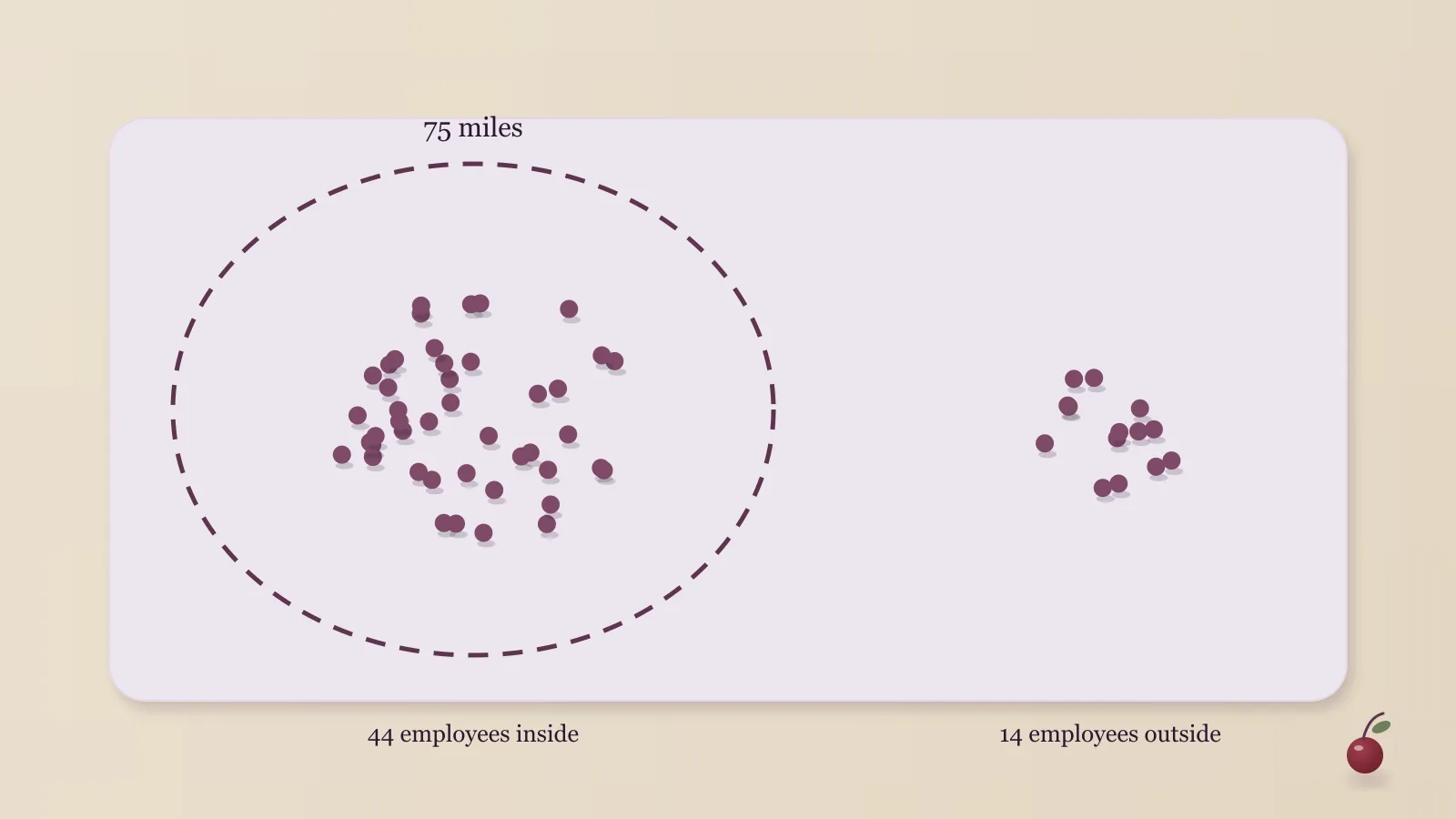
Halden Freight is a private trucking company with 58 employees on the payroll every week of the year: 44 at the headquarters and main terminal in Toledo, Ohio, and 14 at a cross-dock depot in Fort Wayne, Indiana, which is about 100 road miles away. The company crossed 50 employees in March of the previous year and has stayed there, so it has been a covered employer since it reached 20 workweeks at that size. It must display the FMLA poster in Toledo and in Fort Wayne, and its handbook must carry the general notice.
Coverage and eligibility now part ways. The eligibility test counts employees within 75 miles of the employee's own worksite, measured by road. Toledo has 44 employees and nothing else of Halden's within 75 miles, since Fort Wayne is about 100 miles away, so the Toledo count is 44 and no Toledo employee is eligible, however long they have worked. The Fort Wayne count is 14. Halden's 58 employees make it a covered employer with the poster and handbook duties and full exposure to interference claims, but for now no employee at either site meets the 50-within-75-miles test. If the company opened a 10-person maintenance shop 30 miles from Toledo, the Toledo circle would hold 54 and every Toledo employee with 12 months of service and 1,250 hours would become eligible; the Fort Wayne staff still would not.
Suppose the shop opens and a Toledo dispatcher, Renata, tells her supervisor on Monday, June 8, 2026 that she needs surgery in July and about six weeks off. The supervisor passes it to HR the same day, which is when the clock starts. By Monday, June 15, five business days later, HR must send her the eligibility notice and the rights and responsibilities notice, and may request certification at the same time. Renata has until at least June 30 to return the form. If it comes back complete on June 26, HR must send the designation notice by July 3. Renata's leave, six weeks at her 40-hour schedule, is 240 of her 480 hours, tracked against the rolling 12-month period Halden disclosed in the notice. Her health plan continues; her premium share is collected on the normal payroll dates because she is substituting the 80 hours of PTO the policy requires for the first two weeks. She returns to the dispatch desk on the same shift, and the July cost-of-living raise she missed while out is applied from the date it took effect for everyone else. Halden keeps the notices, the certification (in the confidential medical file), the payroll record of the 240 hours, and the premium records for three years.
Where does state law change the picture?
The FMLA is a floor. Twenty states and the District of Columbia have a leave statute of their own beyond the FMLA, from full family and medical leave acts in California, Connecticut, Oregon, Wisconsin and D.C. to pregnancy-only or adoption-only laws elsewhere, and several reach much smaller employers: California's CFRA covers employers with five or more employees, Connecticut's FMLA applies from a single employee, Vermont's from ten. Fourteen jurisdictions now pay wage replacement through a state program that runs on its own eligibility rules. Where state and federal leave cover the same absence, they usually run concurrently and the employer follows whichever rule is more generous to the employee on each point. Where the state covers a relative the FMLA does not, such as a sibling or a grandparent, the state leave runs alone and the federal entitlement is untouched.
For a multi-state employer this means one federal process and a state overlay per worksite. The family and medical leave laws by state grid lists the statute, the employer size threshold, the paid program and the disability insurance mandate for all 50 states and D.C., and each paying state has its own guide behind the paid leave calculator.
The compliance checklist
Every obligation in this article, with the deadline or standard the regulations attach to it and the section of 29 CFR Part 825 that owns it. An HR team that can point to a dated record for each row is compliant; a team that cannot has a gap, whether or not anyone has noticed yet.
| Obligation | Deadline or standard | Regulation |
|---|---|---|
| Determine coverage | 50+ employees for 20+ workweeks in the current or preceding calendar year; integrated and joint employers counted | 825.104 to 825.106 |
| Post the general notice | Poster WH-1420 at every worksite; in the handbook or given at hire; other languages where a significant portion of staff need them | 825.300(a) |
| Eligibility notice | Within 5 business days of learning leave may be FMLA-qualifying; state a reason if not eligible | 825.300(b) |
| Rights and responsibilities notice | In writing, with the eligibility notice; names the 12-month method, certification, substitution, premiums, key employee status, restoration | 825.300(c) |
| Certification request | Within 5 business days of the leave request; employee gets at least 15 calendar days; 7 calendar days to cure an incomplete form | 825.305 |
| Designation notice | Within 5 business days of having enough information; states hours counted if known, fitness-for-duty requirement, substitution | 825.300(d) |
| 12-month period | One of four methods, applied to all employees, disclosed in the notice; 60 days' written notice to change | 825.200 |
| Track entitlement in hours | 12 workweeks at the employee's schedule; smallest payroll increment of one hour or less for intermittent leave | 825.200, 825.205 |
| Maintain group health coverage | Same terms as active employment; 15 days' written notice before dropping coverage for a premium more than 30 days late | 825.209 to 825.212 |
| Restore the employee | Same or equivalent position: pay, benefits, shift, location, duties; key employee exception with written notices | 825.214 to 825.219 |
| No interference or retaliation | No negative factor in attendance, reviews, promotion; no discouraging leave; no more than occasional brief contact | 825.220 |
| Keep records | 3 years: dates and hours of leave, notices, policies, premium payments, disputes; medical records in a separate confidential file | 825.500 |
Statutory references: 29 U.S.C. 2611(4) (covered employer), 2614 (benefits and restoration), 2615 (interference and retaliation), 2617 (enforcement, damages and limitations), 2619 (posting); 29 CFR 825.104 to 825.106 (covered employer, integrated employer, joint employment), 825.110 to 825.111 (eligibility and the 50-within-75-miles test), 825.200 (12-month period methods and the 60-day change notice), 825.205 (increments), 825.207 (substitution of paid leave), 825.209 to 825.213 (group health benefits, premium payments, recovery of premiums), 825.214 to 825.219 (restoration, equivalent position, key employees), 825.220 (interference and attendance policies), 825.300 to 825.301 (general, eligibility, rights and responsibilities and designation notices), 825.305 to 825.313 (certification), 825.400 to 825.404 (enforcement), 825.500 (recordkeeping). Department of Labor poster WH-1420 and Field Assistance Bulletin 2020-7 (electronic posting). Employer size and paid program figures for the state overlay come from the family and medical leave laws by state grid on this site. Checked September 2026. This article explains US federal and state leave law at a general level and is not legal advice. State program rules, benefit rates and caps change, usually each January, so confirm the current figures with the agency that runs the program or with qualified counsel.
Frequently asked questions
- Does a company with 45 employees have to post the FMLA notice?
- No. Only covered employers must post, and a private employer is covered once it has had 50 or more employees for 20 or more workweeks in the current or the preceding calendar year. A company at 45 should watch the count, though: the moment it has 50 people on the payroll for 20 weeks, including part-time staff and agency workers under the joint employment rules, the poster, handbook and notice obligations attach, and they do not wait for the first leave request.
- Can we require employees to use their PTO during FMLA leave?
- Yes, under federal law, provided the requirement is stated in the rights and responsibilities notice and applied under the terms of your normal paid leave policy. The paid time runs concurrently with the FMLA leave and counts against the 12 weeks. You cannot require it while the employee is receiving short-term disability or workers' compensation benefits, and several state paid leave laws restrict or forbid requiring PTO before the state benefit is paid, so check the state overlay for the worksite.
- Can we contact an employee while they are on FMLA leave?
- Occasional, brief contact is fine: asking where a file is saved, passing on a password, or confirming a return date. Requiring the employee to work, attend meetings, answer emails on a schedule or train a replacement while on leave is interference. If the business needs the work done, it needs someone else to do it. Contact about the leave itself, such as a recertification request or a reminder of the return date, is expected and lawful.
- Can we deny FMLA leave because we are short-staffed?
- No. Operational hardship is not a ground for denying FMLA leave to an eligible employee with a qualifying reason. The law gives you tools around the edges: you may ask an employee to make a reasonable effort to schedule planned treatment so it does not unduly disrupt operations, you may temporarily transfer an employee on foreseeable intermittent or reduced schedule leave to an alternative position with equivalent pay and benefits, and the key employee exception applies to the top 10 percent of earners under strict conditions. The leave itself cannot be refused.
- Do we have to hold the exact same job open?
- You must restore the employee to the same position or an equivalent one, and equivalent means virtually identical pay, benefits, working conditions, shift, location and duties. Moving a returning employee to a different role because the replacement worked out well is a violation even if the pay is unchanged. The exceptions are a layoff that would have reached the employee anyway, which you must be able to prove, and the key employee procedure, which requires notices you must have sent at the time of the request.
- What records must we keep, and for how long?
- Three years. Basic payroll and identifying data, the dates FMLA leave was taken and the hours where leave was taken in less than full days, copies of the notices you gave and any written notices you received from employees, documents describing your leave policies and benefit arrangements, records of premium payments, and any record of a dispute about designation. Medical certifications and related records must be kept in a separate confidential file, not in the personnel file, and the FMLA hours must be identifiable as FMLA in the payroll record.
About the author
Blasko Sarcevic
Founder, Time-Out Zone
Connect on LinkedIn Connect on LinkedIn
Blasko writes about leave management, policy design, and running time-off operations at scale.
Related
Every obligation with a date on it
Time-Out Zone keeps each leave case with its notices, deadlines, hours and restoration date on one timeline, applies the same 12-month method to everyone, and holds the medical file apart from the personnel record.