FMLA Notices Explained: General, Eligibility, Rights and Responsibilities, Designation (2026)

Jovana Avramovic
Published
The FMLA is administered through four notices, and three of them run on a five business day clock. What each one says, which Department of Labor form carries it, when it is due, what a denial looks like, and why an employer that skips a notice can end up owing damages for leave it actually granted.
Topic

Topic: the four letters the FMLA requires.
What are the FMLA notices?
The FMLA regulations require an employer to give four kinds of notice. The general notice is the Department of Labor poster (WH-1420), displayed at every worksite and repeated in the handbook or given to new hires. The eligibility notice tells an employee, within five business days of the employer learning that leave may be for an FMLA reason, whether they meet the 12-month, 1,250-hour and 50-within-75-miles tests, and gives at least one reason if they do not. The rights and responsibilities notice, in writing at the same time, explains the 12-month period method, certification, substitution of paid leave, health premiums, key employee status, and the right to be restored. The designation notice, due within five business days of the employer having enough information, states whether the leave counts as FMLA, how much will be counted if known, and whether a fitness-for-duty certificate is needed at return. A denial is either of the last two with the reason marked. Forms WH-381 and WH-382 carry them. Source: 29 CFR 825.300.
What is the general notice and where does it go?
The general notice is the only one of the four that does not wait for a leave request. Every covered employer, whether or not any of its employees is currently eligible, must display the Department of Labor's poster, Employee Rights Under the Family and Medical Leave Act, where employees and job applicants can readily see it, at each worksite. The poster explains the entitlements, the eligibility tests, the employee's notice duties and how to file a complaint. It may be printed from the Department's website on plain paper, and a large-format version is not required. Electronic posting alone satisfies the rule only where every employee works remotely and normally receives workplace information electronically, a position the Department took in Field Assistance Bulletin 2020-7; a workplace with any on-site staff still needs the paper copy.
If the employer has eligible employees, the same information must also appear in the employee handbook or in whatever written guidance the employer gives about leave and benefits. Where there is no handbook, the employer gives a copy of the general notice to each new employee at hire, on paper or electronically. Where a significant portion of the workforce is not literate in English, the notice must be provided in a language they read; the Department publishes translations. The penalty for a willful failure to post is a civil money penalty per offense, adjusted for inflation each January, but the real exposure is that an employer who never told its people about the FMLA has little standing to fault an employee for giving late or informal notice of their own.
What is the FMLA eligibility notice?
The eligibility notice answers one question: does this employee qualify for FMLA leave at all? The clock starts when the employee requests leave, or when the employer learns that leave may be for an FMLA-qualifying reason, whichever comes first, and it does not require the employee to say the letters FMLA. A manager who hears that an employee's mother has been admitted to hospital and that the employee will be out for a while has received enough to start the five business day count. Within those five days the employer must tell the employee whether they are eligible, and if they are not, state at least one reason: less than 12 months of service, fewer than 1,250 hours in the past 12 months, or fewer than 50 employees within 75 miles of the worksite.
The eligibility notice may be given orally or in writing, though almost every employer uses the written form so there is a record. It is required once per 12-month period for each qualifying reason; a second absence for the same reason in the same leave year does not need a fresh eligibility notice unless the employee's eligibility status has changed, for example because the worksite's headcount dropped below 50. A new reason in the same year does require a new notice. Part A of form WH-381 carries it, with checkboxes for eligible or not eligible and the reasons.
If the employer fails to send the notice within five business days, it cannot use that failure against the employee. The most common consequence is that an employer that wanted to treat an employee as ineligible has lost the argument, because an employer that led the employee to believe leave was available, or simply said nothing while the employee arranged it, may be estopped from denying eligibility afterwards.
What is the rights and responsibilities notice?
The rights and responsibilities notice is the contract-like document of the four. It must be in writing, it goes out with the eligibility notice or within the same five business days, and its job is to tell the employee, before the leave begins, exactly what the employer expects and what the employee can expect back. The regulation lists what it must contain, and each item is a decision the employer has already made or a fact the employee needs. It states the 12-month period the employer uses to count the entitlement. It says whether the employer will require a medical certification, a periodic status report, or a fitness-for-duty certificate at return, and what happens if the employee does not provide them. It says whether accrued paid leave will be substituted for unpaid FMLA leave, whether by the employer's requirement or the employee's election, and what conditions the paid leave policy attaches.
On money and benefits it explains how the employee's share of the health premium will be collected during leave, and that the employee may be liable for the employer's share if they do not return to work for a reason other than a serious health condition or other circumstances beyond their control. It says whether the employee is a key employee and, if so, that restoration may be denied under the substantial and grievous economic injury standard. It confirms the right to maintain benefits during leave and to be restored to the same or an equivalent job at the end. Part B of form WH-381 carries all of this, and an employer with a well-written handbook may attach the relevant pages instead of restating them, as long as every required item is covered.
When any of this information changes, the employer has five business days from the next notice of need for leave to tell the employee about the change. An employer that switched its 12-month method during the year, for example, must say so in the next rights and responsibilities notice it sends. The notice is also where the employer names its usual and customary call-in procedures, which matters because an employee who ignores them without an unusual circumstance can have their leave delayed or denied.
What is the FMLA designation notice?
The designation notice is the decision. Once the employer has enough information to determine whether the leave qualifies, which is normally the day a complete medical certification arrives, it has five business days to tell the employee in writing whether the leave is designated as FMLA leave or not. Form WH-382 has three boxes: approved, not approved, and additional information needed. Only one designation notice is required per qualifying reason per 12-month period, so an employee on intermittent leave for a chronic condition does not receive a new letter for every absence, although the employer must tell them how much leave has been counted when they ask, a request the employee may make once in any 30-day period in which leave was taken.
An approved designation must say how much leave will be counted against the entitlement if the amount is known, for example 240 hours for a six-week continuous absence. For unforeseeable intermittent leave the amount is not known in advance, so the notice says so and the running count is provided on request. The notice also says whether the employee will need a fitness-for-duty certification to return; if the employer wants the health care provider to address the employee's ability to perform the essential functions of the job, the list of those functions must be attached to this notice, not sent later. It confirms whether paid leave is being substituted and, where the employer is counting leave the employee has already taken, that the designation is retroactive.
The employer may designate leave as FMLA even if the employee does not want it counted. The Department of Labor confirmed in a 2019 opinion letter that an employer may not delay designation, and an employee may not decline FMLA protection for an absence that qualifies, even to save the entitlement for later. Once the employer knows the leave qualifies, it designates it. The employee's choice is whether to take the leave, not whether the leave counts.
What does an FMLA denial notice say?
There is no separate denial form. A denial is either an eligibility notice marked not eligible with the reason, or a designation notice marked not designated as FMLA leave. The reasons fall into a short list: the employee is not eligible; the reason for leave is not one the FMLA covers, such as caring for a sibling or a condition that does not meet the definition of a serious health condition; the medical certification was not returned after the 15-day period and the seven-day cure period, or was insufficient after the employee was given the chance to fix it; the second and third medical opinions did not support the leave; or the employee has already used the full entitlement for the 12-month period.
An exhausted entitlement deserves a written notice as much as any other denial, because the paper trail is what shows that the employee was told before the unprotected absences began. It is also the moment to look at what else might apply. A California employee who has used 12 weeks of FMLA may still have leave under the state statute for a reason the FMLA did not cover, and an employee whose own condition continues may be entitled to further leave as a reasonable accommodation under the Americans with Disabilities Act. The denial should say what it denies, not what the employee's options are, but the HR team that sends it should already be checking those options.
What happens if the employer misses a notice deadline?
The regulations say that a failure to follow the notice requirements may constitute interference with, restraint of, or denial of the exercise of an employee's FMLA rights, and that an employer may be liable for compensation and benefits lost by reason of the violation, for other actual monetary losses sustained as a direct result, and for appropriate equitable or other relief. The key words are by reason of. In Ragsdale v. Wolverine World Wide (2002) the Supreme Court struck down an earlier rule that automatically gave an employee 12 extra weeks whenever the employer failed to designate leave, holding that the employee has to show they were harmed by the missing notice. The regulations were rewritten around that decision.
Harm is not hard to show in some situations. An employee who would have spread intermittent leave differently, delayed a non-urgent surgery, or arranged for a family member to share the caregiving had they known the leave was counting against a fixed entitlement has a claim. An employee who was told nothing, took 14 weeks, and was then dismissed for exhausting an entitlement they did not know they were using is the classic case. On the other hand, an employee who received every benefit of the leave, returned to the same job and lost nothing has no damages, even though the employer broke the rule.
Retroactive designation is allowed as a repair. An employer that realizes late that a period of absence qualified may designate it as FMLA leave after the fact, provided it gives the employee notice of the designation and the delay does not cause harm or injury to the employee. Employer and employee can also agree to a retroactive designation, which is how most late designations are actually handled: HR sends the designation notice covering the earlier absence, the employee acknowledges it, and the running count is corrected. What retroactive designation cannot do is undo a decision the employee made in reliance on not knowing.
What notice does the employee owe the employer?
Notice runs both ways. For foreseeable leave, such as a scheduled surgery, an expected birth or planned treatment, the employee must give at least 30 days' notice, or as much notice as is practicable if 30 days is not possible, and must make a reasonable effort to schedule planned treatment so it does not unduly disrupt the employer's operations. For unforeseeable leave the standard is as soon as practicable under the facts and circumstances, which in most cases means within the time the employer's usual call-in procedure allows, or the same or next business day when the employee learns of the need. An employee who could have called on Monday and calls on Thursday may have their FMLA leave delayed accordingly.
The content of the employee's notice is deliberately undemanding. The employee does not have to mention the FMLA. They must give enough information for the employer to know that the leave may be for a qualifying reason and roughly how long it will last: that they are having surgery, that a parent is in hospital, that they are pregnant and the baby is due in May. For a condition already certified and designated, the employee must reference either the qualifying reason or the earlier FMLA leave when calling in; a bare I am sick is not enough on the second absence, but I am out with my back again is. The employer is expected to ask for more information where the notice is unclear, and cannot deny leave because the first call was vague if it never asked.
A worked example: Marcus and the five-day clocks
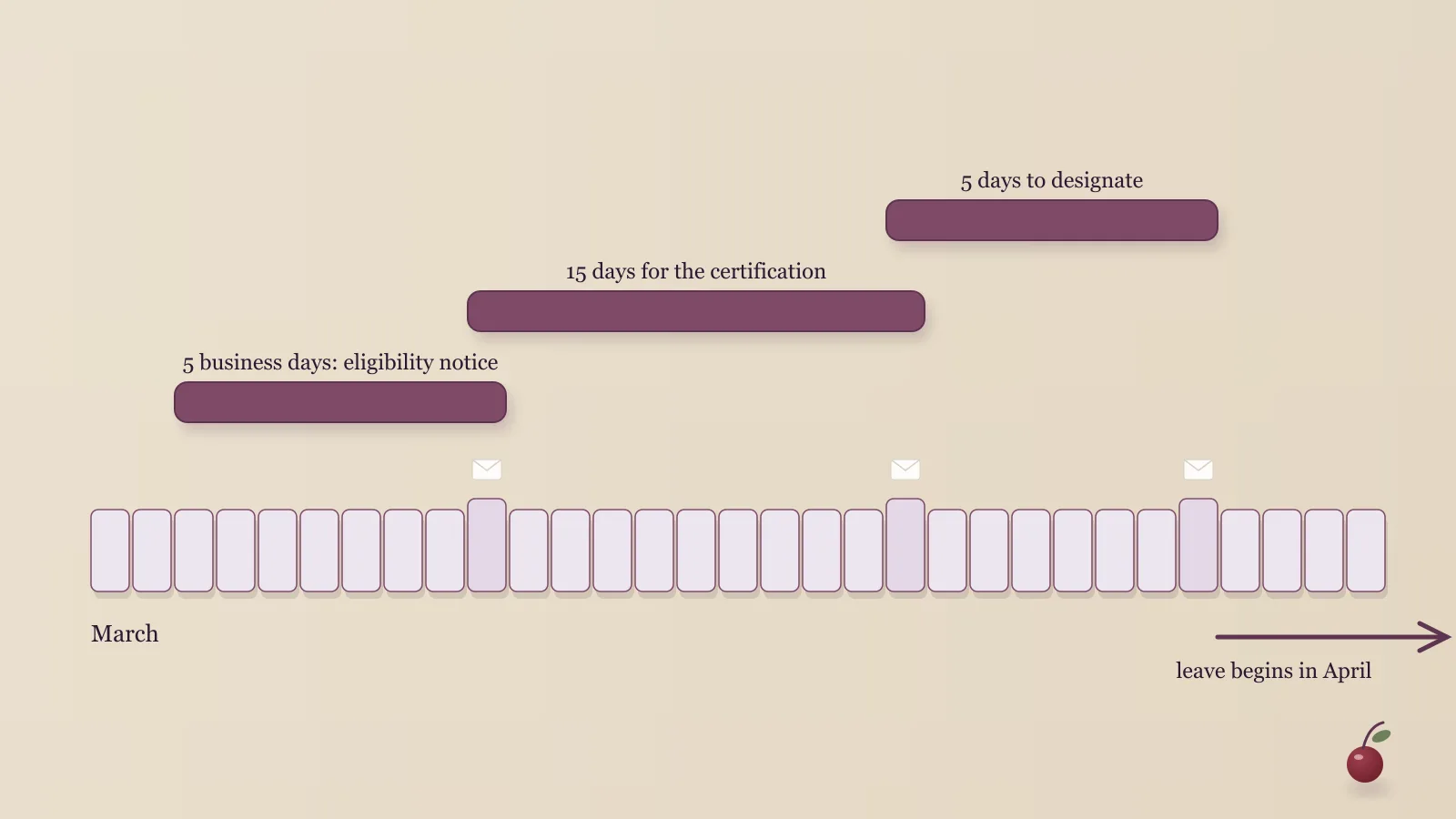
Marcus is a warehouse lead at a 220-person distributor. On Tuesday, March 3, 2026 he tells his supervisor that he has knee surgery scheduled for Monday, April 6 and expects to be out about six weeks. That is more than 30 days' notice, and the supervisor emails HR the same afternoon, so the employer's clock starts on March 3. Five business days later is Tuesday, March 10. By then HR sends Marcus form WH-381: Part A marked eligible, Part B stating that the company uses a rolling 12-month period, that medical certification is required on WH-380-E and due in 15 calendar days, that Marcus must use his accrued PTO for the first two weeks under company policy, that his health premium share will be deducted from those paid weeks and then billed monthly, that he is not a key employee, and that a fitness-for-duty certificate from his surgeon will be required before he returns.
The certification is requested the same day, so Marcus has until March 25 to return it. His surgeon's office sends it back on Friday, March 20, complete. HR now has five business days, to Friday, March 27, to send the designation notice. It goes out March 25: approved, 240 hours to be counted against his 480-hour entitlement, PTO substituted for the first 80 hours, fitness-for-duty certificate required, with the essential functions of the warehouse lead job attached. Marcus has his surgery on April 6, his surgeon clears him on May 13, and he returns on Monday, May 18, having used exactly the six weeks the notice named.
Now run the same facts with an employer that sends nothing. Marcus takes his six weeks on the strength of a conversation with his supervisor. In August his knee flares up and he needs another four weeks. Only then does HR tell him that the spring absence was FMLA leave, that he has 240 hours left, and that the August absence uses 160 of them. Marcus has no claim yet: he got his leave, kept his job and lost nothing. But if the flare-up needed eight weeks instead of four, he would exhaust his entitlement in the eighth week with no protection left, and he could argue that had he known in March that the clock was running he would have used PTO for part of the spring recovery and saved hours. That is the harm Ragsdale requires, and the employer's silence in March is what created it.
The four notices at a glance
The table lists each notice with its form, its deadline and what the regulation requires it to contain. The forms are optional; an employer may use its own letters as long as every required element is present. Electronic delivery is acceptable for all of them where the employee normally receives workplace communications that way.
| Notice | Form | Deadline | Must state | Regulation |
|---|---|---|---|---|
| General notice | WH-1420 poster | Always displayed; in the handbook or given at hire | Entitlements, eligibility, employee notice duties, how to complain; other languages where needed | 825.300(a) |
| Eligibility notice | WH-381 Part A | 5 business days from the request or from learning leave may be FMLA-qualifying | Eligible or not; at least one reason if not; once per reason per 12-month period | 825.300(b) |
| Rights and responsibilities notice | WH-381 Part B | With the eligibility notice; changes within 5 business days of the next request | 12-month method, certification and consequences, substitution of paid leave, premium payments and liability, key employee status, restoration right | 825.300(c) |
| Designation notice | WH-382 | 5 business days from having enough information | Designated or not; hours counted if known; fitness-for-duty requirement with essential functions; substitution; retroactive if applicable | 825.300(d), 825.301 |
| Denial | WH-381 or WH-382 with the reason marked | Same clocks as above | Not eligible (reason), not qualifying, certification not provided, entitlement exhausted | 825.300(b), (d); 825.313 |
How does this look inside a leave management system?
Each notice is an event with a due date, a sent date and a recipient, and each depends on the one before it: the request opens the case and sets the five-day eligibility deadline, the certification arrival sets the five-day designation deadline, the designation sets the return date and the fitness-for-duty requirement. A system that holds the case rather than a scattering of emails can show a leave team which deadlines fall due today, generate the letter from the case data, record the moment it was sent, and confirm to the employee that a document was received or a determination issued without repeating the medical detail. That confirmation is the part employees notice: knowing that the form arrived on March 20 and that a decision is due by March 27 removes most of the anxiety that surrounds a leave.
Statutory references: 29 U.S.C. 2619 (posting); 29 CFR 825.300(a) (general notice, electronic posting, other languages), 825.300(b) (eligibility notice, five business days, one per reason per leave year), 825.300(c) (rights and responsibilities notice, required contents, changes), 825.300(d) (designation notice, hours counted, fitness-for-duty and essential functions), 825.300(e) (consequences of failing to provide notice), 825.301 (designation, retroactive designation), 825.302 to 825.303 (employee notice for foreseeable and unforeseeable leave), 825.304 (delayed employee notice), 825.305 (certification timing), 825.313 (failure to provide certification). Ragsdale v. Wolverine World Wide, Inc., 535 U.S. 81 (2002). Department of Labor opinion letter FMLA2019-1-A (March 14, 2019) and Field Assistance Bulletin 2020-7 (electronic posting). Forms WH-1420, WH-381, WH-382 at dol.gov/agencies/whd/fmla/forms. Checked September 2026. This article explains US federal and state leave law at a general level and is not legal advice. State program rules, benefit rates and caps change, usually each January, so confirm the current figures with the agency that runs the program or with qualified counsel.
Frequently asked questions
- Is a designation notice required if the employee never asked for FMLA?
- Yes, if the employer knows the absence is for a qualifying reason. The employee does not have to use the words FMLA or request the protection. Once the employer has enough information to determine that the leave qualifies, it must designate it within five business days and tell the employee in writing. An employer that waits for the employee to raise the FMLA has misread the rule; the burden of designation is on the employer.
- Can FMLA notices be sent by email?
- Yes. The regulations allow electronic delivery for the eligibility, rights and responsibilities and designation notices where the employee customarily receives workplace communications that way, and the general notice may be distributed electronically to new hires. Keep proof of sending and, where possible, of receipt. The poster itself still has to be physically displayed unless the entire workforce is remote.
- Does the eligibility notice have to be repeated for every absence?
- No. One eligibility notice per qualifying reason per 12-month period is enough, so an employee on intermittent leave for a chronic condition receives it once for the leave year. A new notice is needed if the employee's eligibility changes, for example because the worksite falls below 50 employees within 75 miles, or if the employee needs leave for a different qualifying reason in the same year.
- Do we send a designation notice if the employee never returns the certification?
- Yes, marked not designated, with the reason that the certification was not provided. The employee has at least 15 calendar days to return the form and seven more to cure an incomplete one; after that the employer may deny the leave, and the absences are not FMLA-protected. The written notice is what documents that the employee was told the leave was denied and why, which matters if the absences later lead to discipline.
- Can an employee refuse to have leave counted as FMLA?
- No. The Department of Labor's 2019 opinion letter (FMLA2019-1-A) states that once an eligible employee communicates a need to take leave for an FMLA-qualifying reason, the employer may not delay designating it and the employee may not decline FMLA protection for that absence, even to preserve the entitlement for later. The employee can choose whether to take the leave at all, and can choose whether to substitute paid leave where the employer does not require it, but the qualifying absence counts.
- What language do the notices have to be in?
- The general notice must be provided in a language other than English where a significant portion of the workforce is not literate in English, and the Department of Labor publishes translations of the poster and forms. The individual notices are not subject to a specific language rule, but an employer that knows an employee does not read English and sends the rights and responsibilities notice only in English will struggle to show that the employee was actually informed of the certification deadline or the substitution requirement.
About the author
Jovana Avramovic
Product Excellence, Time-Out Zone
Jovana writes hands-on guides to time-off workflows, calendar tooling, and the rules behind vacation, sick leave, and payouts.
Related
Four notices, three clocks, one case
Time-Out Zone opens a leave case at the first request, sets the eligibility and designation deadlines from the dates on the file, and confirms each step to the employee without repeating a word of medical detail.