FMLA and PTO: Using Paid Time Off During Leave, Accrual, and What Employers Can Require (2026)

Jovana Avramovic
Published
FMLA protects the job; PTO pays for some of the time. Whether the two run together, who decides, what happens to accrual while you are out, why a holiday in the middle of leave sometimes counts and sometimes does not, and the one situation where an employer cannot make you use your paid time no matter what the handbook says.
Topic

Topic: two balances that run together.
Can you use PTO while on FMLA?
Yes. FMLA leave is unpaid, and the regulations let an employee elect, or an employer require, that accrued paid leave such as vacation, PTO or sick time be substituted for the unpaid leave. Substituted means the two run at the same time: the days are paid from the PTO balance and they count against the 12-week FMLA entitlement, so using PTO does not save FMLA time. The employer's normal paid leave policy governs which balances can be used and on what conditions; an employee who does not meet them can still take the leave unpaid. One hard exception: while an employee is receiving short-term disability or workers' compensation benefits the leave is not unpaid, so neither side may require substitution, though they may agree to top the benefit up to full pay where state law allows. PTO need not keep accruing during unpaid FMLA leave unless it accrues during other unpaid leave under the same policy. Source: 29 CFR 825.207 and 825.215.
What does substitution of paid leave mean?
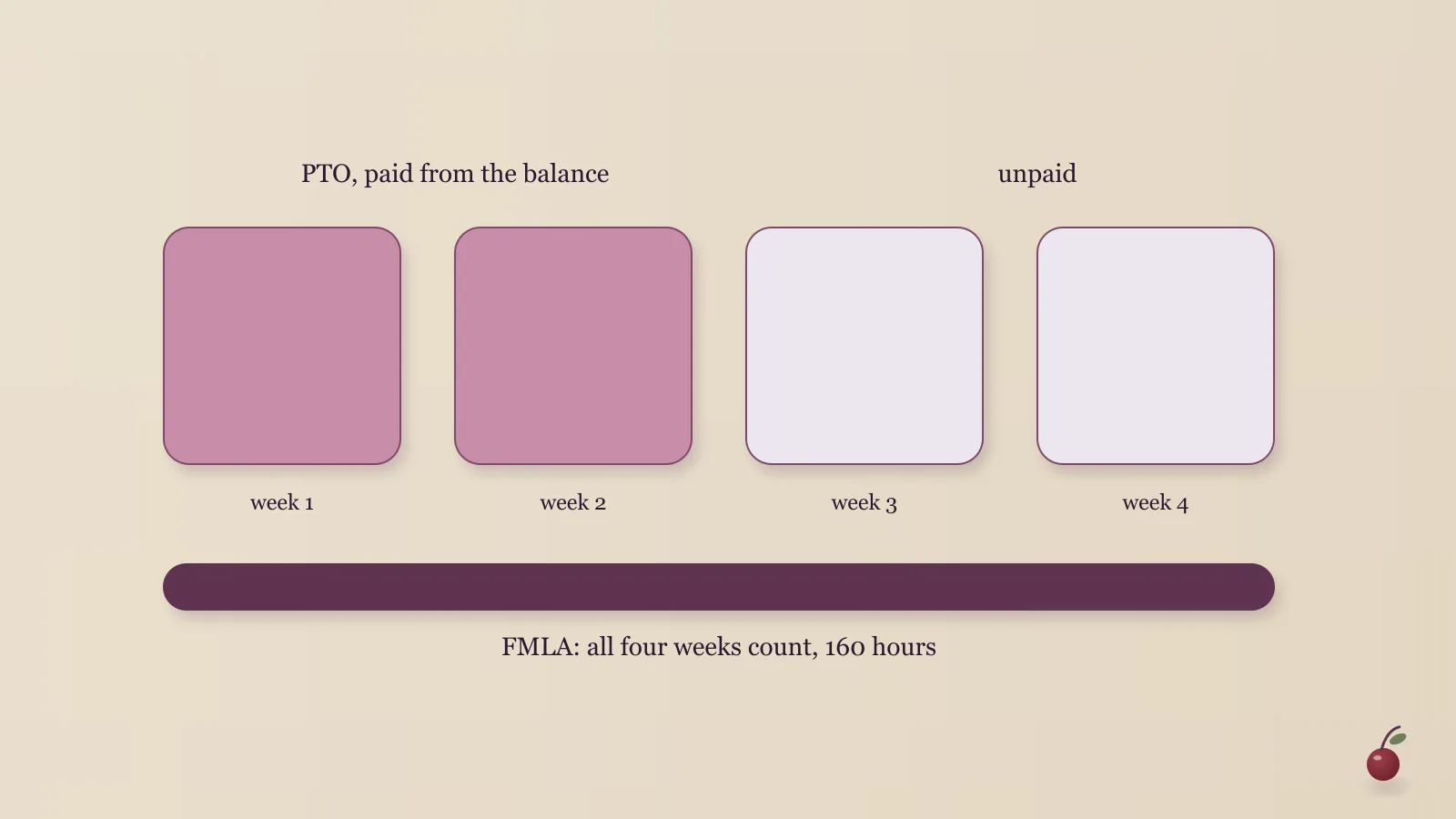
The FMLA gives an eligible employee up to 12 workweeks of leave and says nothing about pay. The regulations then add a mechanism called substitution: accrued paid leave that the employee has earned under the employer's policies may be used during the FMLA leave, so that the employee is paid for some or all of the time. The word is misleading if you read it as replacement. Substituted paid leave does not replace FMLA leave, it overlays it. Every hour paid from the PTO balance is also an hour of FMLA leave, protected by the law and counted against the entitlement. An employee with four weeks of PTO who takes eight weeks of FMLA leave has four paid weeks and four unpaid weeks, and has used eight weeks of the twelve.
Which paid leave can be substituted follows the employer's normal policy. If the sick leave policy only allows sick time for the employee's own illness, an employee caring for a parent can substitute vacation but not sick time. If the vacation policy requires two weeks' notice for scheduled time off, that procedural requirement applies to getting paid, but the regulation is explicit that it applies only to the payment: an employee who does not satisfy the paid leave policy's conditions is not entitled to the pay but remains entitled to the unpaid FMLA leave. The employer must tell the employee, in the rights and responsibilities notice, whether paid leave will be substituted and what the paid leave policy requires.
Substitution is the reason the accounting has to be done in both systems at once. The PTO balance goes down by the paid hours; the FMLA entitlement goes down by all the hours, paid and unpaid alike. An HR team that records the leave only as PTO, because that is what payroll sees, has lost the FMLA count, which is the one the law will ask about later.
Can your employer force you to use PTO during FMLA leave?
Under federal law, yes. The regulation gives the employer the right to require substitution, and most employers with a written FMLA policy use it, because otherwise an employee could take 12 weeks unpaid and then take four weeks of paid vacation on return, for 16 weeks out. The requirement has to be disclosed in the rights and responsibilities notice sent within five business days of the leave request, and it has to be applied according to the paid leave policy's own terms. An employer that requires PTO substitution for FMLA leave but not for other unpaid leaves is on safe ground under the FMLA; it is treating FMLA leave the way the regulation expressly allows.
The federal rule stops where a benefit payment starts. When the employee is receiving short-term disability benefits under an employer plan, or workers' compensation for a work injury, the time off is not unpaid, and the substitution provision does not apply at all: the employer cannot require PTO and the employee cannot insist on it. What the two can do, where state law permits, is agree that accrued paid leave will supplement the benefit, for instance to lift a 60 percent disability payment to full pay. That arrangement, how it is computed in hours and which balances pay first, is the subject of the guide on supplementing disability pay with PTO.
State paid leave programs add a second limit. In the 14 jurisdictions that pay family or medical leave benefits, the state statute decides whether the employer can require paid time off around the state benefit, and most say no. New York lets the employee choose to use accrued PTO for full pay during Paid Family Leave and forbids the employer from requiring it. Washington, Massachusetts and Colorado allow the employee to add employer-provided paid leave on top of the state benefit and treat the choice as the employee's. California ended the last employer-side requirement on January 1, 2025, when AB 2123 removed an employer's ability to make an employee use up to two weeks of vacation before Paid Family Leave begins. Where FMLA and a state program run concurrently, the state rule governs the paid time and the FMLA still counts the weeks.
Do you keep accruing PTO while on FMLA leave?
Not necessarily, and the answer is in the employer's policy rather than the law. The regulations say an employee on unpaid FMLA leave is not entitled to accrue seniority or employment benefits during the leave, but must be treated at least as well as employees on other forms of unpaid leave. If PTO accrues for employees on an unpaid personal leave, it must accrue for employees on unpaid FMLA leave; if the policy pauses accrual during any unpaid leave, it may pause during FMLA leave too. Where paid leave is substituted, most policies keep accrual running for the paid hours, because payroll treats them as hours paid, and stop it for the unpaid remainder. The rule to apply is consistency: FMLA leave may never be treated worse than a comparable leave.
What the law does protect is everything the employee had before the leave began. Accrued PTO, seniority and benefits earned up to the first day of leave cannot be forfeited because the employee took FMLA leave, and the period of unpaid FMLA leave cannot be treated as a break in service for vesting or eligibility under a pension or retirement plan. An employee who returns after 12 weeks is where they were when they left, plus whatever the policy let them accrue in the meantime, and any pay increase or unconditional bonus the rest of the workforce received while they were out.
What happens with holidays and bonuses during FMLA leave?
A holiday that falls during FMLA leave counts against the entitlement if the employee is on leave for the entire week in which it falls: the week is a workweek of leave, and the holiday is part of it. If the employee is on leave for less than a full week, the holiday does not count as FMLA leave unless the employee was scheduled and expected to work that day. Whether the holiday is paid is a separate question, decided by the employer's policy for employees on comparable leave; many policies pay holidays that fall in a substituted paid week and do not pay those that fall in an unpaid week. That policy choice is also the default setting for our own top-up logic, where a holiday in a leave period is unpaid unless the company configures otherwise.
Bonuses follow a similar split. A bonus that is not conditioned on achieving a goal, such as a discretionary holiday bonus paid to everyone, must be paid to the employee on leave as well. A bonus that depends on meeting a goal the employee did not meet because of the leave, such as a production target, a sales quota or perfect attendance, may be withheld, but only if the employer also withholds it from employees on an equivalent non-FMLA leave. An employer that pays the attendance bonus to someone who was out for two weeks on unpaid personal leave cannot deny it to someone who was out for two weeks on FMLA leave.
Does using PTO make the time count against FMLA?
Yes, always, as long as the absence is for an FMLA-qualifying reason and the employer knows it. Employees sometimes ask to use vacation first and start FMLA later, to keep the protected weeks in reserve. The regulations do not allow it and the Department of Labor confirmed the point in a 2019 opinion letter: once an eligible employee communicates a need for leave for a qualifying reason, the employer must designate it as FMLA leave, may not delay the designation, and the employee may not decline the protection, even to preserve entitlement for later. Paid or unpaid, the qualifying absence is FMLA leave from its first day.
The practical consequence is that the FMLA entitlement is not a resource an employee can manage by choosing what to call the time off. What the employee can manage is pay: whether to substitute PTO where the employer leaves it optional, how much of the balance to use, and whether to save some PTO for the return. The employer, for its part, must count the time correctly whether or not the payroll code says vacation, which is why the FMLA hours have to be recorded as FMLA hours in the leave record and not inferred from the pay code later.
Can PTO cover intermittent FMLA hours?
Yes, and it is the situation where the two accounting systems most often diverge. FMLA leave taken intermittently is counted in the smallest increment the employer uses for other leave, and never more than one hour, so a two-hour absence for an infusion appointment is two hours of FMLA leave. The paid leave policy may have its own increments: a vacation policy that can only be taken in half days means the employee either substitutes four hours of PTO for a two-hour FMLA absence, if the policy allows charging the larger increment, or takes the two hours unpaid. The regulation lets the paid leave policy's increments govern the pay, while the FMLA increment governs the count. Whichever way the pay falls, the FMLA record shows two hours.
Intermittent leave is also where the running balances need to be visible to the employee. Someone using four hours every second Thursday for treatment wants to know how many paid hours are left and how many FMLA hours are left, and those numbers move at different speeds if the PTO balance is smaller than the entitlement. The tracking guide in this cluster and its spreadsheet template keep the FMLA side; the PTO side is whatever the payroll or leave system already shows.
A worked example: Naomi's four weeks
Naomi works 40 hours a week and has 80 hours of PTO accrued when she needs four weeks off for surgery and recovery. Her employer's FMLA policy requires substitution of all accrued PTO, and its PTO policy accrues 4.6 hours for every 40 hours paid, with accrual paused during unpaid leave. She gives notice, receives her eligibility and rights and responsibilities notices within five business days, returns her certification, and the designation notice states that 160 hours will be counted against her 480-hour entitlement and that PTO will be substituted for the first 80.
Weeks one and two are paid from her PTO balance: 80 hours at her normal rate, her health premium share deducted as usual, and 9.2 hours of new PTO accrued because the policy accrues on paid hours. Weeks three and four are unpaid; she pays her premium share by check under the arrangement the notice described, and nothing accrues. On her return she has 9.2 hours of PTO, all 80 of the old hours having been used, and 320 hours of FMLA entitlement left in the 12-month period. Had her employer left substitution optional and she had chosen to keep her PTO for later, the four weeks would have been unpaid, she would have returned with 80 hours of PTO intact, and the FMLA count would have been exactly the same 160 hours.
Her colleague Theo has the same surgery but is covered by the company's short-term disability plan, which pays 60 percent of salary after a 14-day waiting period. For his first two weeks he is on unpaid FMLA leave and the employer can, and does, require his PTO. From day 15 he receives disability benefits, and the requirement stops: the regulation treats his leave as paid by the plan, and the only way his remaining PTO can be used is by agreement to top the 60 percent up toward full pay. All four of his weeks are FMLA leave regardless of who paid for them.
The rules at a glance
Each situation with what the employer may require and whether the time counts against the FMLA entitlement. The count column is the one to remember: under the FMLA the source of the pay never changes whether the time counts.
| Situation | Can the employer require PTO? | Counts against FMLA? | Source |
|---|---|---|---|
| Unpaid FMLA leave, employee has accrued PTO | Yes, under the paid leave policy's terms and with notice | Yes | 29 CFR 825.207(a) |
| Employee elects PTO where the employer does not require it | Employee's choice; employer must allow it under the policy terms | Yes | 29 CFR 825.207(a) |
| Paid leave policy conditions not met (wrong leave type, notice rule) | Employee gets no pay for that time but may still take unpaid FMLA leave | Yes | 29 CFR 825.207(a) |
| Employee receiving short-term disability benefits | No; only a voluntary agreement to top up, where state law permits | Yes | 29 CFR 825.207(d) |
| Employee receiving workers' compensation | No; same top-up agreement rule | Yes | 29 CFR 825.207(e) |
| Employee receiving a state paid family or medical leave benefit | Usually no; the state statute decides (NY, WA, MA, CO: employee's choice; CA: no vacation requirement since 2025) | Yes, if FMLA-qualifying | State statutes; 29 CFR 825.701 |
| Holiday in a week the employee is fully on leave | Pay follows the policy for comparable leave | Yes | 29 CFR 825.200(h) |
| Holiday in a week the employee is partly on leave | Pay follows the policy for comparable leave | No, unless the employee was scheduled to work | 29 CFR 825.200(h) |
Statutory references: 29 U.S.C. 2612(d)(2) (substitution of paid leave), 2614(a)(2) to (3) (accrued benefits preserved; no accrual required during leave), 2651 (state laws providing greater rights); 29 CFR 825.207(a) (substitution, concurrent running, paid leave policy terms), 825.207(d) to (e) (disability plans and workers' compensation: substitution inapplicable, top-up by agreement where state law permits), 825.200(h) (holidays during leave), 825.209(h) (non-health benefits follow the policy for other leave), 825.215(c)(2) (bonuses conditioned on goals), 825.215(d)(2) and (d)(4) (no required accrual during unpaid leave; no break in service for vesting), 825.300(c)(1)(iv) (substitution disclosed in the rights and responsibilities notice), 825.701 (interaction with state laws). Department of Labor opinion letter FMLA2019-1-A (March 14, 2019). California AB 2123 (2024), amending Unemployment Insurance Code 3303.1, effective January 1, 2025. New York Workers' Compensation Law 206 and the Paid Family Leave regulations at 12 NYCRR Part 380 (accrued paid time off during Paid Family Leave at the employee's option). Checked September 2026. This article explains US federal and state leave law at a general level and is not legal advice. State program rules, benefit rates and caps change, usually each January, so confirm the current figures with the agency that runs the program or with qualified counsel.
Frequently asked questions
- Can I use sick leave instead of vacation for FMLA leave?
- If the employer's sick leave policy covers the reason for your leave, yes: sick time can be substituted like any other accrued paid leave. If the policy limits sick leave to your own illness and you are caring for a family member, you can substitute vacation or PTO but not sick time, because substitution follows the paid leave policy's own terms. Several state paid sick leave laws widen the reasons sick time can be used, which then widens what can be substituted.
- Can my employer make me use all my PTO before FMLA starts?
- No. FMLA leave begins on the first day of a qualifying absence, and the employer must designate it from that day. What the employer can do is require PTO to be substituted during the FMLA leave, so the first weeks are paid from your balance while the FMLA clock runs. It cannot postpone the FMLA designation until the PTO is gone, because that would give you PTO weeks plus 12 protected weeks, which is not how the regulation works.
- Do I lose my PTO if I do not use it during FMLA leave?
- No. PTO you had accrued before the leave is protected and is still yours when you return, subject to the normal carryover and expiry rules of the policy. If your employer requires substitution you will have used some or all of it during the leave; if substitution is optional and you decline, the balance is untouched. Either way, the leave itself cannot be a reason to forfeit accrued time.
- Does the FMLA time still count if my certification came in late?
- Yes, if the leave is ultimately designated. Absences taken before the certification arrives are provisionally FMLA leave, and once the employer has enough information it designates them, retroactively if necessary, with a notice to you. If the certification is never returned after the 15-day period and the seven-day cure period, the employer may treat the absences as non-FMLA, and whether they are paid then depends purely on the PTO policy.
- Does using PTO change my job protection?
- No. Job protection comes from the FMLA designation, not from the pay source. A week paid from PTO and designated as FMLA leave is exactly as protected as an unpaid week. The reverse is also true: a week of vacation that is not for a qualifying reason, or that the employer does not know is for a qualifying reason, is just vacation, and the FMLA protections do not attach to it.
- Do state paid leave rules override the FMLA rule on PTO?
- Where they are more protective of the employee, yes, for the paid time. The FMLA sets a floor and expressly allows state laws that provide greater rights. If a state paid family leave statute says the employer cannot require you to use PTO around the state benefit, the employer cannot, even though the FMLA alone would have allowed it. The FMLA continues to count the weeks of any absence that qualifies under it, whatever the state says about the pay.
About the author
Jovana Avramovic
Product Excellence, Time-Out Zone
Jovana writes hands-on guides to time-off workflows, calendar tooling, and the rules behind vacation, sick leave, and payouts.
Related
Two balances, one absence
Time-Out Zone records each leave day once and moves both counters: the PTO bucket that paid for it and the FMLA hours it consumed, with accrual rules that follow your policy for paid and unpaid time.