Supplementing Disability Pay With PTO: How a Top-Up Works, Hour by Hour (2026)

Blasko Sarcevic
Published
Short-term disability pays a percentage of salary after a waiting period. Accrued paid time off can fill the waiting period and the percentage gap, but only if someone does the arithmetic in hours, decides which balance pays first, and writes the covered remainder as unpaid so payroll does not pay twice. One employee's six weeks, worked through to the payroll file.
Topic

Topic: filling the gap above 60 percent.
Can you use PTO to supplement short-term disability pay?
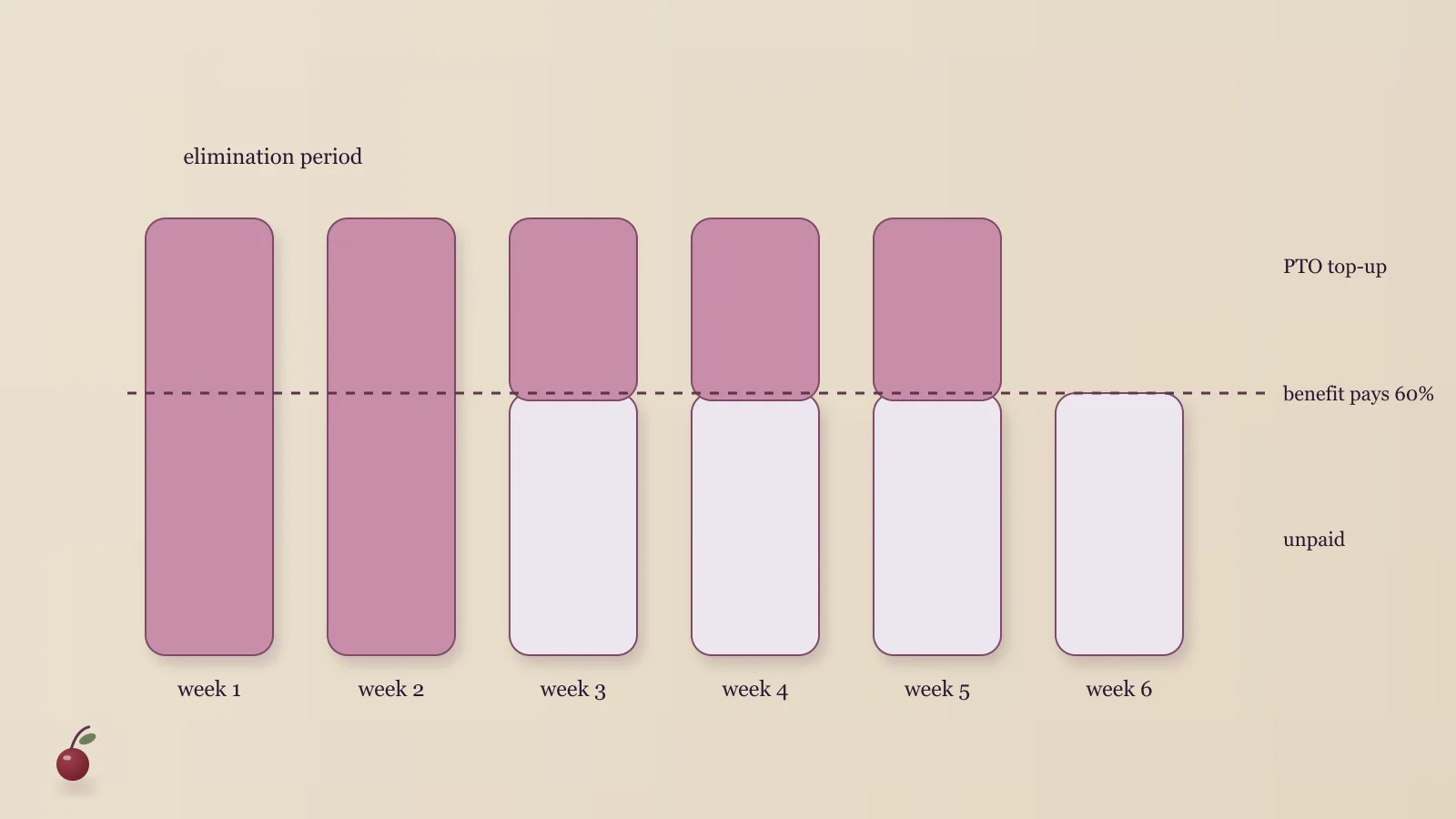
Usually yes, by agreement between employee and employer. Short-term disability typically pays 60 to 70 percent of wages after an elimination period of 7 to 14 days. Accrued paid leave can cover the elimination period at full pay and then top the benefit up to 100 percent, which is called supplementing or integrating. Under the FMLA regulations, leave paid by a disability plan is not unpaid, so the employer cannot require PTO and the employee cannot insist on it; the two may agree to a top-up where state law permits. The arithmetic runs in hours per scheduled day: on an 8-hour day at a 60 percent benefit, 4.8 hours are covered by the insurer and 3.2 hours are paid from the employee's accrual, and payroll records the 4.8 hours as unpaid so nobody is paid twice. Which balance pays first (commonly sick, then personal, then vacation, then floating holidays) is the employer's policy, and in California the accruals cannot be applied without the employee's consent. Source: 29 CFR 825.207(d).
Why is there a gap to fill?
A short-term disability plan is insurance against lost wages, not a continuation of salary. Two design features create the gap. The first is the elimination period, the waiting time before benefits begin, usually 7 days for an accident and 7 or 14 for an illness, and set by statute in the states that mandate disability insurance, where it is 7 days in California, New York, New Jersey and Hawaii. During those days the employee is off work and no benefit is paid. The second is the replacement rate. Employer plans typically pay 60 percent of pre-disability earnings, some 66.67 percent, a few 50 or 70, often with a weekly cap. An employee earning 1,200 dollars a week on a 60 percent plan receives 720 dollars and is short 480 every week the claim runs.
Accrued paid leave is the natural filler because it is already the employee's money. Sick leave was accrued for exactly this; vacation and personal days were accrued for time off the employee now cannot take. The question is not whether the balances can be used but how, and the how has four parts: the legal permission, the hour arithmetic, the order of the balances, and the payroll record. Getting any of the four wrong produces an employee who is overpaid, underpaid, or paid the right total from the wrong bucket, and every one of those becomes a correction three pay periods later.
What does the FMLA say about paid leave on top of disability benefits?
The FMLA regulations treat leave paid under a disability plan as FMLA leave for a serious health condition, counted against the entitlement, but not as unpaid leave. That single classification changes the rules. The general substitution provision, which lets an employer require accrued paid leave to run concurrently with unpaid FMLA leave, does not apply while disability benefits are being paid: the employer may not require the employee to use PTO, and the employee may not require the employer to let them. What remains is agreement. Employers and employees may agree, where state law permits, to have paid leave supplement the disability plan benefits, and the regulation itself gives the example of a plan that replaces only two-thirds of salary.
The elimination period sits outside this rule, because no benefit is being paid yet. Those days are ordinary unpaid FMLA leave if the condition qualifies, and the employer may require substitution of accrued paid leave for them under its normal policy. So a single six-week absence has two legal regimes: the first one or two weeks, where the employer can require PTO, and the remainder, where PTO is used only by agreement. The rights and responsibilities notice should say both, and the FMLA and PTO guide covers the substitution half in detail.
Workers' compensation follows the same logic. While an employee receives wage-loss benefits for a work injury, substitution is off the table and a top-up is by agreement. The one twist is that an employee who declines a light-duty position the employer offers may lose the workers' compensation benefit, at which point the leave becomes unpaid FMLA leave again and the substitution rule returns.
How does a top-up work in hours?
The benefit is a percentage of pay; the accrual balances are in hours. The bridge is the employee's scheduled hours for each day of leave. On an 8-hour day with a 60 percent benefit, the insurer is covering the equivalent of 4.8 hours and the gap is 3.2 hours. Those 3.2 hours are paid from the employee's accrual at their normal rate, and the 4.8 hours are recorded in payroll as unpaid, with a pay code that marks them as covered by the disability benefit, so the employee's pay stub shows 3.2 paid hours, the insurer's payment arrives separately, and the total is 8 hours of pay. A 7.5-hour day at the same rate splits 3.0 and 4.5; a 10-hour day on a compressed schedule splits 4.0 and 6.0. At a 66.67 percent benefit the 8-hour day splits 2.67 paid and 5.33 unpaid.
The reason to compute per day rather than per week is that schedules are not flat. An employee on a 4-by-10 schedule has four 10-hour days and a day off; a part-time employee works three 8-hour days. A weekly top-up figure of 3.2 hours times five would overpay both. Per-day computation also handles the boundaries correctly: the first partial week, the week the benefit begins mid-week when the elimination period is 14 calendar days rather than 10 working days, and the week the employee returns on a Wednesday.
The unpaid record matters as much as the paid one. If payroll simply pays 3.2 hours and says nothing about the other 4.8, a later audit sees an employee paid for 16 hours in a 40-hour week with no explanation, and a benefits administrator reconciling the insurer's payments has nothing to reconcile against. Writing the covered remainder explicitly as unpaid hours with the reason is what stops the double payment when a well-meaning payroll clerk notices the short week and fixes it.
| Scheduled day | Benefit rate | Covered by the benefit (unpaid on payroll) | Gap paid from accruals |
|---|---|---|---|
| 8.0 hours | 60% | 4.8 hours | 3.2 hours |
| 8.0 hours | 66.67% | 5.33 hours | 2.67 hours |
| 8.0 hours | 70% | 5.6 hours | 2.4 hours |
| 7.5 hours | 60% | 4.5 hours | 3.0 hours |
| 10.0 hours | 60% | 6.0 hours | 4.0 hours |
| 4.0 hours (half day) | 60% | 2.4 hours | 1.6 hours |
Which balance pays first?
Most employees have more than one accrual: sick leave, vacation, personal days, sometimes floating holidays or compensatory time. A top-up policy sets the order in which they are consumed, and the order encodes a view about what each balance is for. The common ladder is sick first, because that is what sick leave exists for and it usually carries no cash value at termination; then personal days; then vacation, which does carry cash value in many states and which the employee may want to keep; then floating holidays. Each bucket drains to zero before the next starts, and a bucket with a negative floor, where the policy allows going a few hours into deficit, drains to the floor and then shifts to the next.
The order can change with the calendar. Vacation that does not carry over into the new year is worth less to the employee in December than sick leave that does, so a policy may put vacation first from November 1 to December 31 and revert to sick first in January. The reordering is a policy setting, not an exception handled by hand, and it should be visible to the employee in advance. What the ladder must never do is reach into a balance the employee has not agreed to use, or apply a bucket in a way the paid leave policy itself forbids, such as using sick leave for a day the employee was not sick.
Who decides: the employer or the employee?
Because a top-up is by agreement, the employee has real choices, and a good process presents them rather than assuming. The employee may want the full top-up for the whole claim. They may want it only through a certain date, keeping a reserve of vacation for the recovery weeks after they return. They may want only certain buckets touched, or the gap spread thinner across the leave so the accruals last longer at a lower percentage of pay. And at any point they may decide that the accruals should stop from a given date and the remainder of the leave should run at the benefit rate alone. Each of those is a legitimate instruction, and each changes the payroll file, so the instruction needs to be recorded with its date.
California is the state where consent matters most. Its regulations let an employer require accrued vacation only during unpaid leave, and once an employee is receiving State Disability Insurance or Paid Family Leave, employer-provided paid leave is added on top by agreement, not by requirement; since January 1, 2025 an employer may not even require two weeks of vacation before Paid Family Leave begins. California also treats the two main balances differently against the state benefit: vacation pay does not reduce SDI, while sick pay counts as wages and reduces the benefit unless the employer integrates it, paying only the difference between the benefit and full pay. The practical rule we apply is that for a California employee no accrual hour is used without the employee's recorded consent, and without it the uncovered hours are simply unpaid.
What about the elimination period?
The elimination period is the easy part of the arithmetic and the expensive part of the leave. No benefit is paid, so the employee is either paid from accruals at 100 percent or not paid at all. On an 8-hour day the full 8 hours come from the ladder. Two weeks at 40 hours consume 80 hours of accruals before the insurer pays a cent, which for many employees is most of the balance they have. That is why the order of buckets matters from day one and why the employee's instruction about how far to run the accruals is usually about the weeks after the elimination period, not during it.
The elimination period is also where the FMLA clock has already started. Those days are FMLA leave from the first day the condition qualifies, whether paid from accruals or unpaid, and the certification, the notices and the 12-month count all run from the start of the absence, not from the day the disability benefit begins. A leave case that opens when the insurer's first payment arrives has missed two weeks of deadlines.
How do statutory benefits change the math?
In the 14 jurisdictions with a state paid family or medical leave program, and the five with mandatory disability insurance, the statutory benefit is usually the first layer and the employer plan or the top-up sits above it. Most employer short-term disability plans offset: the plan pays the difference between its own percentage and what the state pays, so a 60 percent plan in a state paying 55 percent pays 5 percent. The top-up then fills what remains above the combined benefit, and the per-day hours are computed against the combined rate rather than the plan's headline percentage. The state guides behind the paid leave calculator give the 2026 weekly benefit for each program, which is the number the offset starts from.
State programs also cap what a top-up can reach. California's integration rule allows employer-paid leave to bring the employee to full pay but reduces SDI where the combination would exceed regular wages. Washington and Massachusetts let the employer add supplemental benefits on top of the state payment without reducing it, at the employee's election. New Jersey and New York treat employer-paid leave during the state benefit under their own rules. The design principle is the same everywhere: identify each payer, compute the combined rate for each day, top up to 100 percent and not beyond, and keep each payer's contribution visible.
Tax follows the payer. The portion paid from accruals is ordinary wages, taxed and withheld like any paycheck. The disability benefit is taxable or not depending on who paid the premium and whether it was paid pre-tax, which the guide on whether short-term disability is taxable works through. An employee comparing a top-up to going without one should look at the after-tax total, and an employer designing the plan should know that an employer-paid premium makes the whole benefit taxable income to the employee.
A worked example: Daniel's six weeks, week by week
Daniel earns 30 dollars an hour on an 8-hour, Monday to Friday schedule: 240 dollars a day, 1,200 a week. He has surgery on Monday, March 2, 2026 and his surgeon clears him to return on Monday, April 13, six weeks and 30 working days later. His employer's short-term disability plan has a 14-day elimination period and pays 60 percent with no cap that affects him: 720 dollars a week, or 144 a day, once benefits begin on Monday, March 16. His accruals on March 2 are 64 hours of sick leave, 56 hours of vacation and 8 hours of floating holiday. The company's ladder is sick, then vacation, then floating holiday, and Daniel agrees in writing to a full top-up for the whole claim.
The elimination period runs March 2 to 15, ten working days and 80 hours, all at 100 percent from accruals. Sick leave covers the first eight days, March 2 to 11, and is exhausted; vacation covers March 12 and 13. Daniel's first two paychecks are normal 1,200-dollar weeks. From March 16 the insurer covers 4.8 hours of each day and the top-up is 3.2 hours, 16 hours a week. Vacation has 40 hours left, which covers two and a half weeks: all of March 16 to 20 and March 23 to 27, and the first two and a half days of the week of March 30. The floating holiday's 8 hours then cover the rest of that week, 1.6 hours on April 1 and 3.2 on each of April 2 and 3. By the close of Friday, April 3 every balance is at zero. The final week, April 6 to 10, runs at the benefit alone: 720 dollars from the insurer, 40 hours recorded as unpaid.
Daniel receives 1,200 dollars a week for five weeks and 720 for the sixth, 6,720 in total against 7,200 of normal pay, and he comes back with no accruals. Had he instead asked for accruals only during the elimination period and none after, he would have received 1,200, 1,200 and then four weeks of 720, 5,280 in total, and returned with 48 hours of vacation and floating holiday intact. Either instruction is reasonable; the point is that it was his to give. All 240 hours of the absence are FMLA leave, leaving 240 of his 480-hour entitlement, regardless of who paid for which hour. One footnote: April 3 is Good Friday, and if the company observes it as a paid holiday the policy decides whether that day is paid as a holiday rather than topped up. By default our engine treats a holiday inside a leave as not payable unless the company configures it; under the FMLA the day counts against the entitlement either way, because Daniel was out the whole week.
| Week | Insurer pays | Paid from accruals | Unpaid hours on payroll | Daniel receives | Balances at week end (sick / vacation / floating) |
|---|---|---|---|---|---|
| Mar 2 to 6 (elimination) | 0 | 40h sick, $1,200 | 0 | $1,200 | 24 / 56 / 8 |
| Mar 9 to 13 (elimination) | 0 | 24h sick + 16h vacation, $1,200 | 0 | $1,200 | 0 / 40 / 8 |
| Mar 16 to 20 | $720 | 16h vacation, $480 | 24h | $1,200 | 0 / 24 / 8 |
| Mar 23 to 27 | $720 | 16h vacation, $480 | 24h | $1,200 | 0 / 8 / 8 |
| Mar 30 to Apr 3 | $720 | 8h vacation + 8h floating, $480 | 24h | $1,200 | 0 / 0 / 0 |
| Apr 6 to 10 | $720 | 0 | 40h | $720 | 0 / 0 / 0 |
What does payroll need at the end of each pay period?
One line per pay code per employee: the hours paid from each accrual bucket, the hours recorded as unpaid and covered by the benefit, the hours of any holiday pay, and the leave case reference so the entries can be traced back. For Daniel's week of March 16 that is 16 hours of vacation at his rate, 24 hours coded as unpaid disability-covered leave, and the case number. The insurer's 720 dollars does not appear as wages unless the employer administers the plan and pays the benefit through payroll, in which case it appears under its own code, taxed according to the plan's premium arrangement. Everything else about the top-up, the ladder, the employee's instruction and the daily arithmetic exists so that this handful of numbers is right the first time.
Statutory references: 29 CFR 825.207(a) (substitution during unpaid FMLA leave), 825.207(d) (leave paid under a disability plan: substitution inapplicable, supplement by agreement where state law permits, the two-thirds example), 825.207(e) (workers' compensation and the light-duty offer), 825.200(h) (holidays during a full week of leave), 825.205 (counting leave in hours against the schedule); California Unemployment Insurance Code 2601 ff. (SDI) and 3300 ff. (PFL), EDD guidance on integration of employer-paid leave with Disability Insurance, AB 2123 (2024) amending Unemployment Insurance Code 3303.1 effective January 1, 2025; 2 Cal. Code Regs. 11092 (CFRA: use of accrued paid leave); Washington RCW 50A.15.060 (supplemental benefit payments); Massachusetts M.G.L. c. 175M as amended in 2023 (topping off with accrued paid leave); New York Workers' Compensation Law 200 ff. (DBL, 7-day waiting period); Hawaii Rev. Stat. 392-24 (TDI, 7-day waiting period). Elimination periods and replacement rates for employer plans are typical market terms, not statutory figures. Checked September 2026. This article explains US federal and state leave law at a general level and is not legal advice. State program rules, benefit rates and caps change, usually each January, so confirm the current figures with the agency that runs the program or with qualified counsel.
Frequently asked questions
- Can my employer force me to use PTO while I am on short-term disability?
- Not while the disability benefit is being paid. The FMLA regulations treat that leave as paid by the plan, so the substitution rule that lets employers require PTO during unpaid leave does not apply; a top-up is by agreement. During the elimination period, before benefits start, the leave is unpaid and the employer may require PTO under its normal policy. State law can narrow this further, and in California the accruals are applied only with your consent.
- Will using PTO reduce my disability check?
- Under most private employer plans, no: the plan pays its percentage and the top-up is paid separately by the employer from your accruals. Under state disability programs the answer depends on the state and the type of pay. California's SDI is not reduced by vacation pay but is reduced by sick pay unless the employer integrates it so that the combination does not exceed your regular wages. Check the plan document or the state agency before agreeing to a top-up that could exceed full pay.
- Can a top-up take me above 100 percent of my pay?
- A top-up is designed to reach full pay and stop. Most disability plans and all the state programs reduce their benefit where combined income would exceed regular wages, so anything above 100 percent is usually clawed back from the benefit rather than kept. The per-day hour arithmetic exists to prevent it: the gap hours are the scheduled hours minus the hours the benefit covers, never more.
- Can I keep my PTO and just take the 60 percent?
- Yes, while the benefit is being paid. Because the top-up is by agreement, you can decline it, limit it to certain buckets, run it only through a certain date, or stop it from a date you choose. The elimination period is different: there the leave is unpaid and your employer may require PTO under its policy, so ask what the policy says before assuming the first two weeks will preserve your balance.
- Does the topped-up time count against my FMLA entitlement?
- Yes. The FMLA counts the absence, not the pay. Every scheduled day you are out for a qualifying serious health condition is FMLA leave whether it was paid from accruals, covered by the disability benefit, or unpaid. Six weeks off is 240 hours of a 480-hour entitlement regardless of how the money was arranged.
- Is the top-up taxed differently from the disability benefit?
- The top-up is ordinary wages: it is paid from your accruals at your normal rate and taxed and withheld like any paycheck. The disability benefit is taxable if your employer paid the premium or you paid it with pre-tax dollars, and tax-free if you paid the premium with after-tax dollars. On a 60 percent plan with an employer-paid premium, your whole week of income is taxable, just from two sources; on an after-tax employee-paid plan, only the top-up portion is.
About the author
Blasko Sarcevic
Founder, Time-Out Zone
Connect on LinkedIn Connect on LinkedIn
Blasko writes about leave management, policy design, and running time-off operations at scale.
Related
3.2 paid, 4.8 unpaid, every day, automatically
Time-Out Zone computes the top-up per scheduled day, drains the buckets in the order your policy sets, records the employee's instruction and consent, and hands payroll the hours per code with the covered remainder written as unpaid.