Paid Leave Calculator: Estimate Your State PFML Benefit (2026)

Blasko Sarcevic
Published
Enter your weekly wage, pick your state, and see what the state paid family and medical leave program would pay per week, for how many weeks, and in total, using the formula and cap each agency published for 2026.
Topic
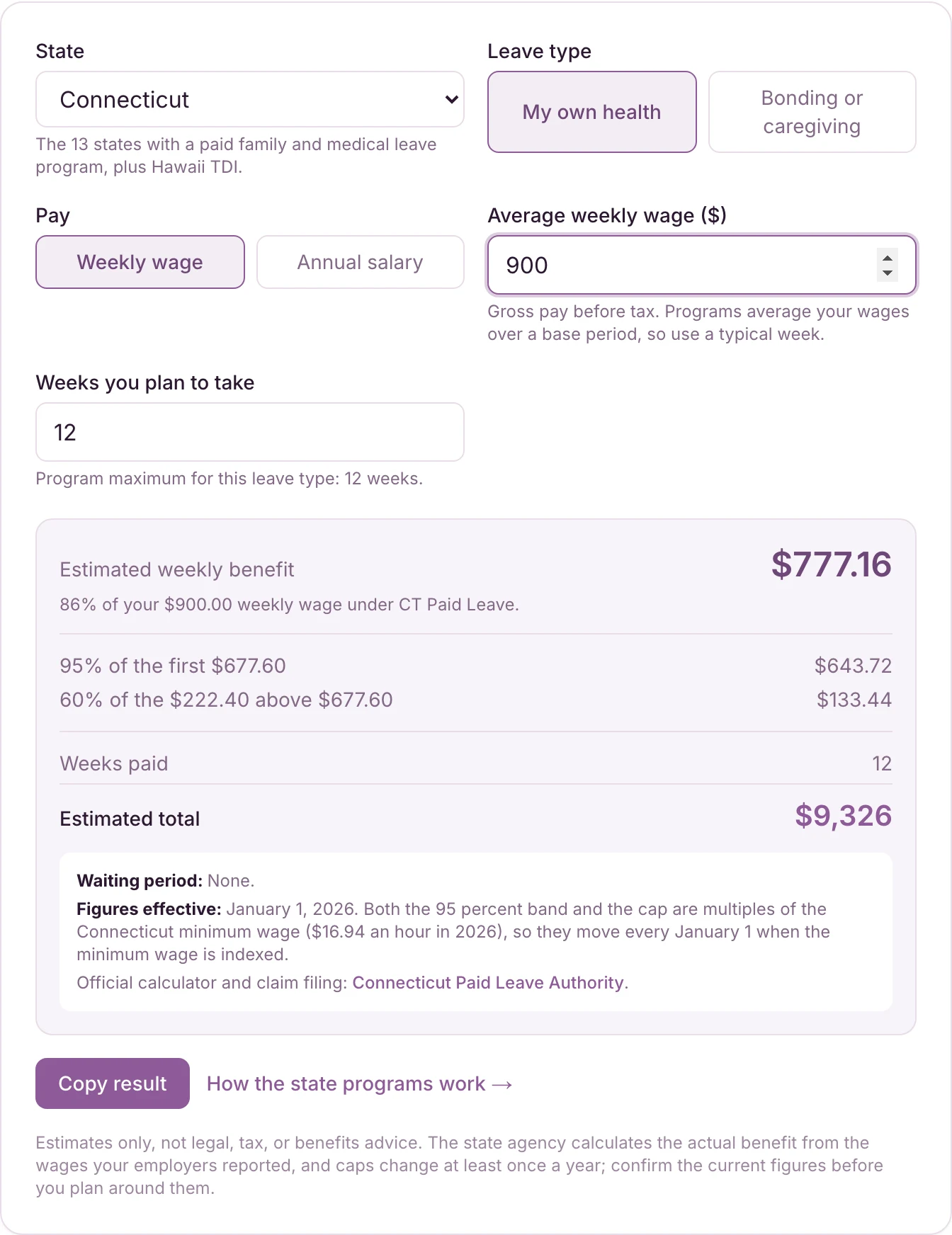
Paid leave calculator: your state's weekly benefit, weeks, and total.
Select a state to see the estimated weekly benefit, the weeks the program pays, and the total.
Estimates only, not legal, tax, or benefits advice. The state agency calculates the actual benefit from the wages your employers reported, and caps change at least once a year; confirm the current figures before you plan around them.
How much does paid family and medical leave pay?
A state paid family and medical leave benefit replaces part of your weekly wage while you are on leave, and the share depends on the state and on how much you earn. In 2026, 14 jurisdictions pay one: California, Colorado, Connecticut, Delaware, the District of Columbia, Maine, Massachusetts, Minnesota, New Jersey, New York, Oregon, Rhode Island, and Washington run family and medical programs, and Hawaii pays disability only. Most use a progressive formula that replaces 80 to 100 percent of a low wage and 50 to 66 percent of the part above a threshold tied to the state average weekly wage; New York, New Jersey, and Delaware use one flat rate (67, 85, and 80 percent). Every program caps the weekly amount, from $871 in Hawaii to $1,765 in California, and pays for a fixed number of weeks, most often 12. The calculator applies your state's exact 2026 formula, cap, and floor to the wage you enter. There is no federal paid leave program; the federal FMLA protects the job but pays nothing.
How is a paid leave benefit calculated?
Every program starts from your average weekly wage, but they measure it differently. Connecticut takes your two highest-earning quarters in the base period and divides by 26; Massachusetts and Minnesota look at your highest quarter; Delaware averages the 52 weeks before your claim; California and Rhode Island work from the highest quarter but express the benefit as a share of the quarter rather than the week. The calculator asks for a typical weekly wage because that is what all of these approximate when your pay is steady. If your hours swing a lot, run the estimate twice, once with a good week and once with a lean one, and expect the agency's figure to land between them.
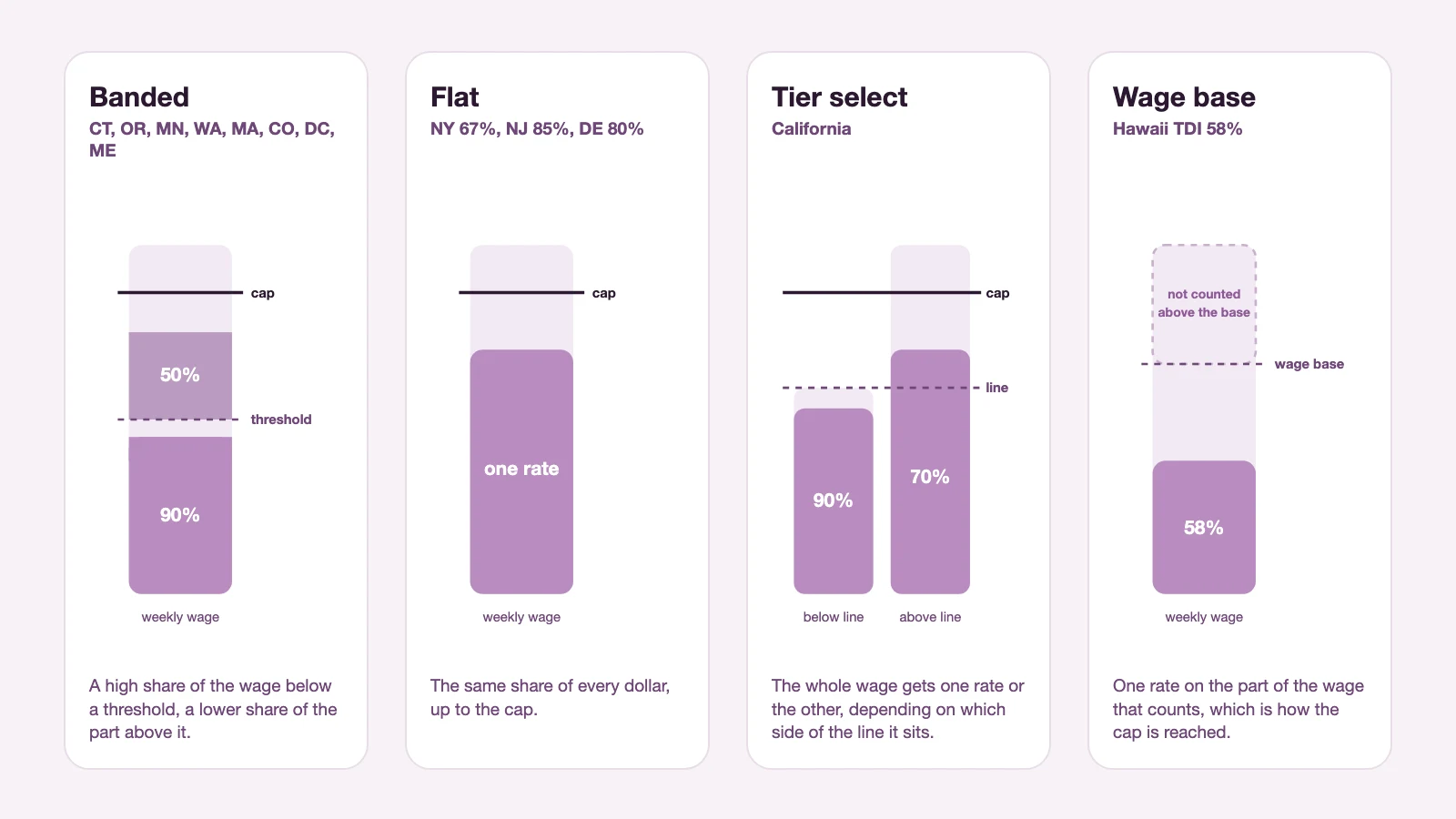
Most of the newer programs then apply a progressive formula: a high replacement rate on the part of your wage below a threshold, a lower rate above it, and a cap. Connecticut is the clearest example. On a $900 wage in 2026 you get 95 percent of the first $677.60, which is $643.72, plus 60 percent of the remaining $222.40, which is $133.44, for $777.16 a week, or 86 percent of your pay. Someone on $2,500 a week would hit the $1,016.40 cap and keep about 41 percent. Minnesota adds a third band: 90 percent to $711.50, 66 percent to $1,423, then 55 percent, so a $2,000 wage produces $1,423. The design is deliberate; the worker who can least afford unpaid leave loses the smallest share.
Three programs skip the bands. New York pays a flat 67 percent, New Jersey 85 percent, and Delaware 80 percent, each up to its cap. California sits between the two models: the whole wage is replaced at 90 percent if your weekly wage is at or below 70 percent of the state average, and at 70 percent otherwise, with a flat stretch in between so that crossing the line never lowers the benefit. Hawaii's disability program pays 58 percent but only counts wages up to a weekly base, which is how it reaches its $871 maximum.
Which states pay, and how much?
The table lists every program that pays benefits in 2026 with its current weekly maximum, the most weeks any single leave type can run, and whether the first week is unpaid. Maryland and Virginia have passed laws but do not start paying until 2028, so they are not here yet. Seven states have their own guide with the formula, eligibility test, job protection, and the calculator preset to that state; the other seven follow in the next update. The dates in the maximum column matter: seven programs reset on January 1 (California, Connecticut, Hawaii, Massachusetts, New Jersey, New York, Washington), Delaware's cap is fixed through 2027, four reset around July 1 (Colorado, Maine, Oregon, Rhode Island), Minnesota resets in late October, and the District of Columbia on October 1.
| State | Program | Weekly maximum | Maximum weeks | Waiting period |
|---|---|---|---|---|
| California | State Disability Insurance (SDI) and Paid Family Leave (PFL) | $1,765 (from January 1, 2026) | 52 | None for PFL |
| Colorado | Colorado Family and Medical Leave Insurance (FAMLI) | $1,448.02 (from July 1, 2026) | 12 | None |
| Connecticut | CT Paid Leave | $1,016.40 (from January 1, 2026) | 12 | None |
| Delaware | Delaware Paid Leave (Healthy Delaware Families Act) | $900 (from January 1, 2026) | 12 | None |
| District of Columbia | DC Paid Family Leave (Universal Paid Leave) | $1,190 (from July 1, 2026) | 12 | None; the former one-week waiting period was removed in 2022 |
| Hawaii | Hawaii Temporary Disability Insurance (TDI) | $871 (from January 1, 2026) | 26 | 7 days under the statutory plan; benefits start on the eighth day of disability |
| Maine | Maine Paid Family and Medical Leave | $1,249.12 (from July 1, 2026) | 12 | 7 consecutive calendar days, unpaid, for medical leave only |
| Massachusetts | Massachusetts Paid Family and Medical Leave (PFML) | $1,230.39 (from January 1, 2026) | 26 | 7 calendar days, unpaid, at the start of each new application; the days count against the yearly allowance |
| Minnesota | Minnesota Paid Leave | $1,423 (from January 1, 2026) | 20 | None, but the qualifying condition must last at least 7 days and benefits are paid in arrears |
| New Jersey | Temporary Disability Insurance (TDI) and Family Leave Insurance (FLI) | $1,119 (from January 1, 2026) | 26 | None for FLI |
| New York | New York Paid Family Leave (PFL) | $1,228.53 (from January 1, 2026) | 12 | None for PFL |
| Oregon | Paid Leave Oregon | $1,692.16 (from June 28, 2026) | 12 | None |
| Rhode Island | Temporary Disability Insurance (TDI) and Temporary Caregiver Insurance (TCI) | $1,150 (from July 1, 2026) | 30 | None since 2012, but you must be certified out of work for at least 7 consecutive days |
| Washington | Washington Paid Family and Medical Leave | $1,647 (from January 1, 2026) | 16 | One unpaid waiting week per claim, except for bonding leave, leave in the postnatal period, and military exigency leave |
How do I use the estimate?
Treat the weekly figure as the ceiling of what the state will send you, not the floor. Agencies calculate from wages your employers reported on quarterly filings, so a raise you received last month is usually not in the base period yet, and tips, bonuses, or a second job may or may not count depending on the state. The total assumes you take every week you entered continuously; intermittent leave is paid pro rata for the hours or days you miss, and several programs pay nothing for a week in which you miss fewer than a set number of hours.
Two things the calculator cannot know are worth checking with your employer. First, whether you may top up the benefit with PTO: Massachusetts, Minnesota, and Washington allow it up to your normal pay, Oregon and Colorado allow it if the employer agrees, and California lets you draw PTO alongside PFL but not SDI in a way that pushes you above your wage. Second, whether the benefit is taxable. Under IRS Revenue Ruling 2025-4, family leave benefits are taxable income everywhere, while the medical portion is taxable only in proportion to what your employer contributed, so the after-tax picture differs by state and by who paid the premium.
What if my state is not on the list?
Then no state program pays you, and your options are the ones that predate PFML. Your own serious health condition is covered by short-term disability insurance if your employer offers it or you bought a policy, typically 60 percent of pay after a one to two week elimination period. Bonding and caregiving have no wage replacement at all outside the 14 programs above, apart from employer-paid parental leave and the federal FMLA's job protection, which is unpaid. Nine states, from Alabama to Virginia, have authorized insurers to sell voluntary PFML policies to employers who choose to buy them; if yours did, the benefit follows the policy, not a state formula. The state grid linked below shows where each of the 51 jurisdictions stands.
If you are an employer with staff in several states, the calculator is a quick way to see why a single national leave policy is hard to write: the same $1,500 earner would receive about $1,100 a week in Colorado, $1,038 in Massachusetts, $957 in Connecticut, and nothing from the state in Texas. Most multi-state employers set a company top-up that brings everyone to the same share of pay and let the state benefit offset it where one exists.
State guides with the calculator preset
Each guide explains the state's formula with worked examples, the weeks per leave type, the eligibility test, who pays the premium, whether the program protects your job, and when the figures change. The calculator on each page opens with that state selected.
- Californiaup to $1,765/wk
- Coloradoup to $1,448/wk
- Connecticutup to $1,016/wk
- Delawareup to $900/wk
- District of Columbiaup to $1,190/wk
- Hawaiiup to $871/wk
- Maineup to $1,249/wk
- Massachusettsup to $1,230/wk
- Minnesotaup to $1,423/wk
- New Jerseyup to $1,119/wk
- New Yorkup to $1,229/wk
- Oregonup to $1,692/wk
- Rhode Islandup to $1,150/wk
- Washingtonup to $1,647/wk
Estimates only, not legal, tax, or benefits advice. Each state agency calculates the actual benefit from wages your employers reported, and caps, formulas, and contribution rates change at least once a year. Confirm the current figures with the agency named on the page before you plan around them. Sources: the state agencies and statutes named on each state page, checked September 2026; IRS Revenue Ruling 2025-4 for tax treatment.
Frequently asked questions
- How much is paid family leave per week?
- It depends on your state and wage. In 2026 the weekly maximums range from $871 in Hawaii to $1,765 in California, and most programs replace 80 to 100 percent of a low wage and 50 to 66 percent of earnings above a threshold near half the state average weekly wage. New York pays a flat 67 percent, New Jersey 85 percent, and Delaware 80 percent, each up to its cap.
- Is there a federal paid leave calculator?
- No, because there is no federal paid leave program. The federal FMLA provides up to 12 weeks of unpaid, job-protected leave. Wage replacement comes only from the 13 state PFML programs, Hawaii's disability insurance, employer benefits, or private disability policies.
- How many weeks does paid leave last?
- Most programs pay 12 weeks per benefit year, with combined caps of 16 weeks in Washington, 20 in Minnesota, and 26 in Massachusetts when medical and family leave are both used. California's PFL pays 8 weeks, Rhode Island's TCI 8 weeks, and the disability sides run longer: 26 weeks in New Jersey, New York, and Hawaii, 30 in Rhode Island, and up to 52 in California.
- Why is my estimate different from the state's calculator?
- State calculators use the wages your employers reported for your base period, which usually ends one or two quarters before your leave. If your pay changed recently, or you have more than one employer, the official figure will differ. The estimate here uses one steady weekly wage and the current published formula, which is the right order of magnitude for planning.
- Do I have to wait before benefits start?
- In Massachusetts and Hawaii, yes, 7 days per claim; in Washington, one week except for bonding and postnatal leave; in Maine and Minnesota, medical leave has a 7-day condition while family leave does not. California SDI, New Jersey TDI, and New York DBL have a 7-day wait on the disability side only. Colorado, Connecticut, Oregon, Delaware, the District of Columbia, and Rhode Island pay from the first day of an approved leave.
About the author
Blasko Sarcevic
Founder, Time-Out Zone
Connect on LinkedIn Connect on LinkedIn
Blasko writes about leave management, policy design, and running time-off operations at scale.
Related
Tracking leave across several states?
Time-Out Zone keeps balances, carryover, and approvals in one place, so state leave and company PTO stay consistent without spreadsheets.
Questions about paid leave?
See how Time-Out Zone tracks absences, balances, and approvals for teams in more than one state.