What Is Short-Term Disability? How It Works, How Long It Lasts, How Much It Pays

Jovana Avramovic
Published
Short-term disability insurance replaces part of your pay when your own illness, injury, or pregnancy keeps you from working for weeks rather than days. The waiting period, the percentage, the benefit period, and the offsets that decide the check, plus how a claim actually moves from the doctor's office to your bank account.
Topic

Topic: the weeks between the waiting period and the return.
What is short-term disability?
Short-term disability (STD) is an insurance benefit that pays a percentage of your salary, most often 60 percent, for a limited period, most often up to 26 weeks, when a non-work-related illness, injury, surgery, or pregnancy leaves you medically unable to do your job. Benefits begin after an elimination period, typically 7 days for illness and 0 to 7 days for accidents, and stop when you are cleared to return, when the plan's maximum period runs out, or when a long-term disability plan takes over. It is usually employer-sponsored: 45 percent of private-industry workers had access to an employer-supported plan in March 2024, and among plans that pay a fixed percentage the median is 60 percent with a median weekly maximum of $1,000. Five states (California, Hawaii, New Jersey, New York, Rhode Island) run mandatory versions. STD pays for your own condition only; it does not cover caring for someone else, and it does not by itself protect your job, which is the FMLA's role.
How does short-term disability work?
The plan is a contract, and four numbers in it decide almost everything. The elimination period is the number of days you must be disabled before benefits start, and it is why the first week of a medical leave is usually covered by sick days rather than insurance. The benefit percentage is the share of your pre-disability earnings the plan replaces, applied to base salary in most plans and excluding bonuses and overtime unless the certificate says otherwise. The maximum weekly benefit is a dollar cap that bites for higher earners. The benefit period is the maximum number of weeks the plan will pay for one disability, counted from the end of the elimination period, and it is the number that determines when a long-term disability plan, if you have one, needs to be ready.
Around those four numbers sit the definitions. Disability under an STD plan usually means you cannot perform the material duties of your own occupation because of sickness or injury and you are under a physician's regular care. Pre-existing condition clauses, common in plans you join mid-year, exclude conditions treated in the three to twelve months before your coverage started, for the first twelve months of coverage. And work-related injuries are excluded entirely, because workers' compensation covers them. The plan is a private arrangement between your employer and an insurer (or a self-funded employer), so none of these terms are set by federal law; they are set by the certificate of coverage, which HR must give you on request.
How long does short-term disability last?
The plan's benefit period sets the ceiling, and the Bureau of Labor Statistics puts the median at 26 weeks for private-industry plans, with 13 weeks the next most common design and a few plans stretching to 52. The ceiling is rarely reached. The plan pays only for as long as your physician certifies that you cannot work, and insurers hold that certification against published duration guidelines for the diagnosis: six weeks for an uncomplicated vaginal delivery, eight for a cesarean, six to twelve for a knee replacement, two to eight for many abdominal surgeries. If your recovery runs longer than the guideline, the insurer will ask your doctor to explain why, and the claim continues if the explanation holds.
Two clocks complicate the count. The elimination period is not paid but is usually counted inside the benefit period in some plans and outside it in others; a 26-week plan with a 7-day elimination period pays 25 or 26 weeks depending on the wording. And when a condition recurs, most plans treat a return to work of less than two to four weeks as a continuation of the original disability, so you do not serve a new elimination period but you also do not reset the benefit period. If you are still unable to work when the period ends, the STD claim closes and a long-term disability claim opens if your employer offers LTD; that plan typically has its own elimination period of 90 or 180 days, designed to end exactly where the STD benefit period does.
When does short-term disability start?
Benefits start on the day after the elimination period ends, counted from the first day your doctor says you were unable to work, not from the day you filed the claim. A 7-day elimination period for illness is the most common design; many plans use 0 days for an accident, so a broken arm is paid from day one and pneumonia from day eight. A few plans use 14 or 30 days, which pushes more of the leave onto sick days and PTO. During the elimination period you are unpaid by the plan and paid by whatever else applies: accrued sick leave, PTO, or in the five state-disability states the state program's own waiting week rules.
The claim itself starts earlier. You or your employer notify the insurer as soon as the absence is expected to run past the elimination period, the insurer sends the claim form in three parts (your statement, your employer's statement of job and earnings, your physician's statement of diagnosis, restrictions, and expected duration), and a decision usually follows within one to two weeks of receiving all three. For a planned surgery, filing two to four weeks ahead means the first payment lands shortly after the elimination period ends. For an unplanned illness, the first check often arrives around week three or four and covers the weeks since the elimination period ended, so budgeting for a short gap is realistic.
How much does short-term disability pay?
A percentage of your pre-disability earnings, capped. The BLS finds that 72 percent of covered private-industry workers are in plans paying a fixed percentage, and the median fixed percentage is 60; the rest pay a flat weekly amount or a percentage that varies with earnings or service. Among plans with a weekly maximum, the median cap is $1,000. So the typical covered employee earning $1,200 a week receives $720, and the typical employee earning $2,500 a week receives $1,000, not $1,500. Whether that amount is taxable depends entirely on who paid the premium and with what kind of dollars, which our short-term disability tax guide covers; for a plan the employer pays for, expect income tax withholding and, in the first six months, Social Security and Medicare deductions.
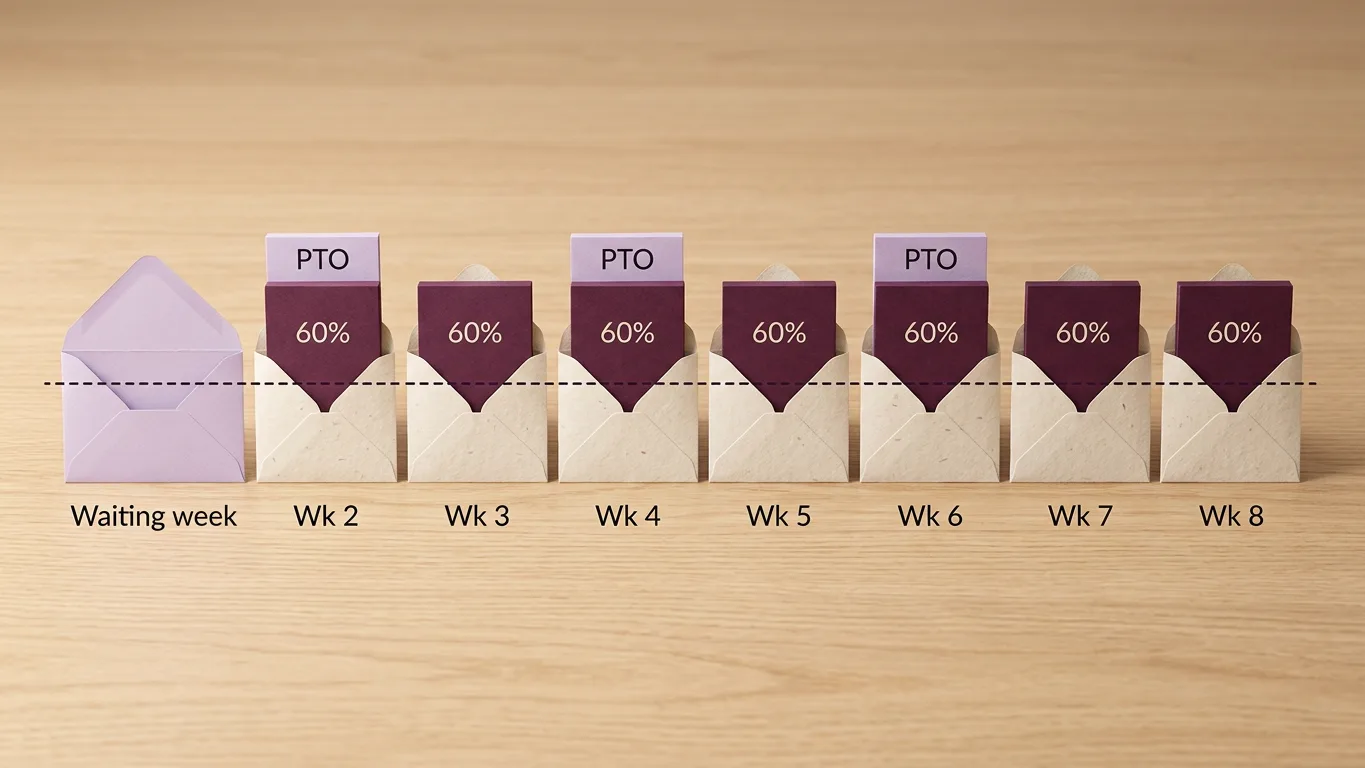
The stated percentage is before offsets. Most plans reduce the benefit by other income you receive for the same disability: state disability or paid medical leave benefits in the states that pay them, Social Security disability if it starts, and in some plans employer-paid sick leave or salary continuation. A 60 percent plan in Massachusetts, where PFML medical leave pays first, may end up paying only the difference between the state benefit and 60 percent of your wage. Offsets almost never apply to PTO you choose to use, which is why the top-up (using a PTO day or two a week to lift 60 percent toward 100) is the standard way people close the gap, and why an employer's leave policy needs to say whether it is allowed.
What qualifies for short-term disability?
Any non-work illness or injury that your physician certifies prevents you from doing your own job for longer than the elimination period. In claim volume the largest categories are pregnancy and childbirth, musculoskeletal conditions and surgeries (back, knee, shoulder), injuries outside work, cancer treatment, cardiovascular events, and mental health conditions such as major depression or anxiety severe enough to prevent work, provided the plan does not limit them (some do, to a shorter benefit period). Elective cosmetic surgery is usually excluded; medically necessary surgery is covered. Complications of a normal pregnancy are covered, and a normal pregnancy itself is covered for the recovery period, which is why STD is the main source of paid maternity leave in the 46 jurisdictions without a state medical leave benefit.
What does not qualify is as important. Caring for a sick child or parent is not a disability of yours, so STD never pays for family leave; that is what state paid family leave and, unpaid, the FMLA are for. Injuries at work go to workers' compensation. Conditions excluded as pre-existing during the first year of coverage, self-inflicted injuries, and disabilities arising from committing a crime are standard exclusions. And the plan pays for inability to work, not for a diagnosis: an employee who can work with restrictions the employer accommodates is not disabled under most plans, even with a serious condition, though the employee may have FMLA or ADA rights in that situation.
Short-term disability vs FMLA, LTD, workers' comp, and state paid leave
Five things can be in play during one medical leave, and they answer different questions. The table sorts them by what each one does. The FMLA and STD are the pair people most often confuse, and the rule is simple: FMLA protects the job and pays nothing, STD pays and protects nothing, and when both apply they run at the same time. Our FMLA vs short-term disability guide walks through that pairing week by week.
| What it does | Who pays | Triggered by | Duration | |
|---|---|---|---|---|
| Short-term disability | Replaces part of pay | Employer-sponsored insurer or self-funded employer | Your own non-work illness, injury, or pregnancy | After 0 to 14 days, up to 13 to 26 weeks (median 26) |
| FMLA | Protects the job and health insurance | Nobody (unpaid) | Serious health condition, new child, family care | 12 workweeks per year |
| Long-term disability | Replaces part of pay after STD ends | Employer-sponsored insurer | Continuing inability to work | After 90 or 180 days, for years or to retirement age |
| Workers' compensation | Replaces part of pay and covers medical costs | Employer's workers' comp insurer or state fund | Injury or illness arising from work | Set by state law |
| State paid medical leave or TDI | Replaces part of pay | State fund financed by payroll contributions | Your own serious health condition, in 13 PFML jurisdictions and 5 TDI states | Typically 12 to 26 weeks; California SDI up to 52 |
How do you file a short-term disability claim? A worked example
Marcus is a warehouse supervisor in Ohio earning $1,300 a week. His employer, with 140 staff, offers a group STD plan through an insurer: 7-day elimination period, 60 percent of base pay, $1,000 weekly maximum, 26-week benefit period. Ohio has no state disability or paid medical leave program, so the plan and his PTO are the whole pay layer. In March his surgeon schedules a hernia repair and estimates six weeks off. Marcus tells HR three weeks ahead; HR gives him the FMLA eligibility notice and the insurer's claim packet the same week. He completes his statement, HR completes the employer statement with his earnings and job description, and the surgeon's office completes the physician statement after the operation with a return date six weeks out.
The insurer approves the claim in nine days. Week one is the elimination period: Marcus uses five sick days and is paid his normal $1,300. Weeks two through six are paid by the plan at $780 a week, taxable because the employer pays the premium, so the deposits arrive net of withholding. His employer's policy allows top-ups, and he uses two PTO days a week to add $520 and reach his usual gross. At week five the surgeon extends the return by two weeks; the office sends an updated statement, the insurer checks it against its duration guideline for the procedure, and the claim continues to week eight. Marcus returns in the ninth week having received $780 for seven weeks from the plan, used five sick days and 14 PTO days, and used eight of his twelve FMLA weeks, which ran concurrently from the first day of the absence. His job and his health insurance were never in question, and that part was the FMLA's doing, not the plan's.
Access and plan medians: US Bureau of Labor Statistics, National Compensation Survey, Employee Benefits in the United States, March 2024 (45 percent access; 72 percent of covered workers in fixed-percentage plans; median 60 percent; median weekly maximum $1,000; median benefit period 26 weeks) and March 2025 (access by establishment size: 31 percent under 100 workers, 53 percent at 100 to 499, 68 percent at 500 or more). Substitution rules: 29 CFR 825.207. Elimination periods, exclusions, and offsets describe common group plan terms, not a statutory standard; the certificate of coverage governs. Checked September 2026. This article explains US federal and state leave law at a general level and is not legal advice. State program rules, benefit rates and caps change, usually each January, so confirm the current figures with the agency that runs the program or with qualified counsel.
Frequently asked questions
- Is short-term disability the same as FMLA?
- No. Short-term disability is insurance that pays part of your salary when you cannot work because of your own medical condition. The FMLA is a federal law that protects your job for up to 12 weeks and pays nothing. When both apply to the same absence they run at the same time, and most medical leaves at FMLA-covered employers with an STD plan use both.
- Does short-term disability cover pregnancy?
- Yes, in almost every group plan: typically six weeks of recovery after a vaginal delivery and eight after a cesarean, plus any prenatal period your doctor certifies you cannot work. Plans you join while already pregnant may treat the pregnancy as a pre-existing condition and exclude it for the first months of coverage, so check the enrollment rules before conception if you can. Our pregnancy guide covers the full stack.
- Can you get short-term disability for mental health?
- Yes, if a treating provider certifies that the condition prevents you from working and you are under regular care. Major depression, severe anxiety, and post-traumatic stress are among the most common claim reasons. Some plans limit mental health claims to a shorter benefit period than physical conditions, so read the certificate.
- Can I be fired while on short-term disability?
- The STD plan itself gives you no job protection; it is only a pay benefit. Your protection comes from the FMLA (if you and your employer are covered), state leave laws, and the ADA where the condition is a disability. An employer may not fire you for taking FMLA leave, but an employee on STD who has no FMLA rights and is not protected by the ADA or a state law can lawfully be replaced in most states.
- How much does short-term disability pay per week?
- The plan percentage times your weekly pre-disability earnings, up to the plan's cap. The BLS median is 60 percent with a median cap of $1,000 a week, so someone earning $1,000 a week typically receives $600 and someone earning $2,000 receives $1,000. Offsets for state disability or paid medical leave benefits can reduce it further; a PTO top-up can lift it.
- Do I have to use PTO before short-term disability starts?
- Often you will want to, because the elimination period is unpaid by the plan, but whether you must depends on your employer's policy, not on the insurance. Under the FMLA an employer may require you to substitute accrued paid leave for unpaid weeks, but not for weeks when you are receiving disability benefits; during those weeks a PTO top-up has to be by agreement.
About the author
Jovana Avramovic
Product Excellence, Time-Out Zone
Jovana writes hands-on guides to time-off workflows, calendar tooling, and the rules behind vacation, sick leave, and payouts.
Related
See the disability weeks and the PTO top-up on one case
Time-Out Zone records the elimination week, the insurer-paid weeks, the PTO used to top them up, and the FMLA hours running alongside, so the return date and the balances are never a surprise.