Paid Family Leave Explained: How PFML Works in the States That Pay (2026)

Jovana Avramovic
Published
Paid family and medical leave is a state insurance program, not a federal right. Thirteen jurisdictions pay it in 2026, two more start in 2028, and nine only let employers buy a policy. How the programs are funded, how the weekly benefit is calculated, who qualifies, and what to do where there is none.
Topic

Topic: the states that pay family and medical leave.
What is paid family leave?
Paid family leave (PFL), or paid family and medical leave (PFML) where the program also covers your own health, is a state-run insurance benefit that replaces part of your wages while you are off work to bond with a new child, care for a seriously ill family member, or, in the medical version, recover from your own serious health condition. It is funded by payroll contributions from employees, employers, or both, and paid by a state agency or an approved private plan rather than by your employer. As of 2026, thirteen jurisdictions pay benefits: California, Colorado, Connecticut, Delaware, the District of Columbia, Maine, Massachusetts, Minnesota, New Jersey, New York, Oregon, Rhode Island, and Washington. Maryland starts paying in January 2028 and Virginia in December 2028. Most programs pay 12 weeks per reason, replace a higher share of wages for lower earners, and cap the weekly benefit at or near the state average weekly wage. There is no federal paid family leave; the federal FMLA protects the job but pays nothing.
Which states have paid family and medical leave?
The paying list has grown from one state to thirteen jurisdictions in twenty years, and the shape of the programs has changed along the way. California started in 2004 by bolting family leave onto its existing disability insurance, so Californians draw own-health pay from SDI and bonding or caregiving pay from PFL. New Jersey, New York, and Rhode Island followed the same disability-first pattern, which is why those four states appear in both the paid leave and the disability columns of our state grid. Washington in 2020 was the first to build a standalone program that covers medical and family leave in one fund, and every program since (Massachusetts, Connecticut, Oregon, Colorado, Minnesota, Delaware, Maine) has copied that design.
The table lists the programs by benefit start, the maximum weeks for a single reason, and how the weekly benefit is calculated. The percentages describe the formula; the dollar caps that sit on top of them are reset each January and belong on the individual state pages, which we link from the grid as they publish.
| Jurisdiction | Program | Paying since | Weeks (single reason) | Weekly benefit formula |
|---|---|---|---|---|
| California | Paid Family Leave (within SDI) | 2004 | 8 (PFL); own health under SDI up to 52 | 70 or 90 percent of wages by income band, capped |
| New Jersey | Family Leave Insurance (with TDI) | 2009 | 12 (FLI); own health under TDI up to 26 | 85 percent of wages, capped |
| Rhode Island | Temporary Caregiver Insurance (within TDI) | 2014 | 8 (TCI, from 2026); own health under TDI up to 30 | 4.62 percent of highest-quarter wages per week, capped |
| New York | Paid Family Leave (with DBL) | 2018 | 12 (PFL); own health under DBL up to 26 | 67 percent of wages, capped at 67 percent of the state average wage |
| Washington | Paid Family and Medical Leave | 2020 | 12 family or medical, 16 combined, plus 2 pregnancy | 90 percent up to half the state average wage, 50 percent above, capped |
| District of Columbia | DC Paid Family Leave | 2020 | 12 across parental, family, medical, plus 2 prenatal | 90 percent up to a threshold tied to the D.C. minimum wage, 50 percent above, capped |
| Massachusetts | Paid Family and Medical Leave | 2021 | 12 family, 20 medical, 26 combined | 80 percent up to half the state average wage, 50 percent above, capped |
| Connecticut | CT Paid Leave | 2022 | 12, plus 2 for pregnancy incapacity | 95 percent up to 40 times the minimum wage, 60 percent above, capped at 60 times the minimum wage |
| Oregon | Paid Leave Oregon | 2023 | 12, plus 2 for pregnancy-related conditions | 100 percent up to 65 percent of the state average wage, 50 percent above, capped |
| Colorado | FAMLI | 2024 | 12, plus 4 for pregnancy or childbirth complications | 90 percent up to half the state average wage, 50 percent above, capped |
| Delaware | Delaware Paid Leave | 2026 | 12 parental; 6 per 24 months medical or family; 12 combined | 80 percent of wages, capped |
| Minnesota | Minnesota Paid Leave | 2026 | 12 medical plus 12 family, 20 combined | 90, 66, and 55 percent tiers by wage band, capped at the state average wage |
| Maine | Maine Paid Family and Medical Leave | 2026 (May) | 12 | 90 percent up to half the state average wage, 66 percent above, capped |
| Maryland | FAMLI | January 2028 | 12 (enacted) | Progressive formula, capped; contributions start January 2027 |
| Virginia | Virginia PFML | December 2028 | 12 (enacted April 2026) | Progressive formula, capped; contributions start April 2028 |
How is paid family leave funded?
Every program is social insurance: a small percentage of wages goes into a state fund, and the fund pays claims. The percentage is set by statute or recalculated each year, and the split between employer and employee is the main design choice states make differently. California, New Jersey's family leave, New York, and Rhode Island are funded entirely by employee payroll deductions. Washington, Massachusetts, Oregon, Colorado, Minnesota, Delaware, and Maine split the premium, typically with the employee paying roughly half to three-fifths, and most of them exempt small employers from the employer share while still requiring the employee share to be collected. The District of Columbia is the outlier in the other direction: the program is funded by an employer-only payroll tax, and nothing is deducted from employees.
Employers with an existing generous benefit can usually apply to run a private plan instead of paying into the state fund, on condition that the plan matches or exceeds the state benefit on every term and is approved by the agency. Large employers with self-insured disability plans often go this route; the employee experience is the same benefit paid by a different check. Whichever route the employer takes, the wage-replacement money never comes from the employer's operating budget the way a company parental leave policy does. That is the structural difference between a state program and an employer policy, and it is why the programs can cover a 3-person business and a 30,000-person one on identical terms.
How much does paid family leave pay?
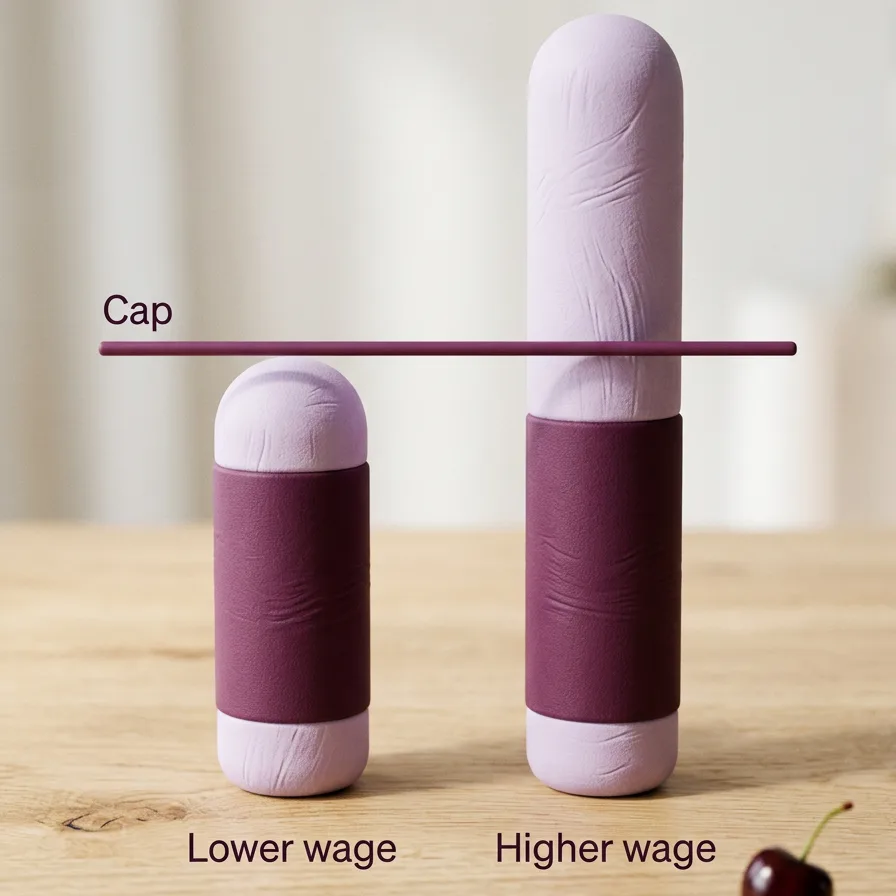
Most of the newer programs use a progressive formula with two or three bands, so lower earners get a higher share of their wages replaced than higher earners. The pattern that Washington introduced and Massachusetts, Colorado, Maine, and Minnesota adopted runs like this: up to half the state average weekly wage, the benefit replaces 80 or 90 percent of your own average weekly wage; above that line, it replaces 50 to 66 percent of the rest; and the total is capped, usually at or just below the state average weekly wage itself. The older disability-based programs use a flat percentage instead: New York pays 67 percent, New Jersey 85 percent, California 70 or 90 percent depending on your income band, each with its own cap.
Take an illustrative state whose average weekly wage is $1,600 and whose formula is 90 percent up to half that figure and 50 percent above it, capped at $1,600. Priya earns $1,000 a week. The first $800 of her wage is replaced at 90 percent, which is $720; the remaining $200 at 50 percent, which is $100; her weekly benefit is $820, or 82 percent of her pay. Her colleague Tom earns $3,000 a week: $720 on the first $800, plus $1,100 on the remaining $2,200, which is $1,820, but the cap cuts that to $1,600, or 53 percent of his pay. The formula is deliberately built so that the person who can least afford unpaid leave loses the smallest share. Once we publish the paid leave calculator you will be able to run your own wage through each state's current figures; until then, the agency for your state publishes the year's cap every autumn.
Who is eligible for paid family leave?
Eligibility is where state programs differ most sharply from the federal FMLA, and mostly in the employee's favor. The FMLA asks three questions: has your employer 50 or more employees, have you worked there 12 months, and have you worked 1,250 hours in the last year. The state programs instead ask whether you have earned enough in covered wages during a base period, typically the first four of the last five completed quarters, and the thresholds are low: a few thousand dollars over the year in most states, or a minimum number of hours (820 in Washington). Very few programs have an employer-size threshold at all, and where one exists it usually limits the employer's contribution duty rather than the employee's benefit. Delaware is the notable exception, covering employers with 10 or more staff and asking for a year and 1,250 hours of service, which mirrors the FMLA.
Because the test is earnings rather than tenure with one employer, people the FMLA misses are often covered: part-timers, workers at small companies, people who changed jobs six months ago, and in several states the self-employed, who can opt in. The flip side is that state programs are portable insurance, not employment rights. Whether your job is held while you take the benefit depends on either the FMLA, a state leave act, or a job-protection clause in the paid leave law itself. Most of the newer programs include one, usually after 90 or 180 days with the employer; the older disability-based programs generally rely on the FMLA or a separate state statute. The FMLA vs PFML guide walks through the four combinations.
Is paid family leave the same as FMLA?
No, and mixing them up causes most of the confusion in this area. The FMLA is a federal employment right: it guarantees eligible employees up to 12 weeks of unpaid leave and a job to come back to, and it pays nothing. Paid family leave is a state insurance benefit: it pays a share of wages and, depending on the state, may or may not hold your job. When the same absence qualifies under both, they run at the same time, the state pays while the FMLA protects, and the employer designates both from the same start date. When only one applies, you get whichever one you qualify for, which is why a new parent at a 20-person company in Oregon is paid but not FMLA-protected, and a new parent at a 200-person company in Texas is protected but not paid.
The two systems also disagree on who counts as family. The FMLA covers a spouse, parent, and child. Every state program covers at least those and most add siblings, grandparents, grandchildren, parents-in-law, and domestic partners; several (Colorado, Connecticut, New Jersey, Oregon, Washington, Minnesota) extend to any person with whom you have a relationship equivalent to family. That means an absence to care for a grandmother can be paid under state law and outside the FMLA entirely, which affects whether your job is held and whether the employer may count the weeks against your federal entitlement.
What if my state has no paid family leave?
In 36 jurisdictions there is no state benefit to claim in 2026, and the answer depends on what your employer offers. Nine of those states (Alabama, Arkansas, Florida, Kentucky, New Hampshire, South Carolina, Tennessee, Texas, and Vermont) have passed laws allowing insurers to sell paid family leave policies, and New Hampshire and Vermont run a state-sponsored version with a partner insurer, but the policy only exists if your employer bought one. Nothing is deducted from your pay and nothing is owed to you by default. Ask HR whether the company holds a group family leave policy; if it does, the terms are in the certificate, usually six weeks at 60 percent of wages in the state-sponsored plans.
Without a state program or a purchased policy, the pay layer is built from what already exists. Short-term disability insurance covers your own medical condition, including childbirth recovery, if your employer offers it; the Bureau of Labor Statistics found 45 percent of private-industry workers had access to an employer-supported plan in March 2024. Company parental leave policies cover bonding for the 27 percent of private workers whose employer offers paid family leave as a distinct benefit. Accrued PTO and sick leave fill the gaps at full pay until the balance runs out. For caring for a relative, which no disability plan covers, the honest answer in a no-program state is that the leave is unpaid unless the employer chooses otherwise. Our is-FMLA-paid guide lays out the five sources and how they stack.
How do employers handle paid family leave?
For an employer in a program state the work falls into three parts. Payroll withholds the employee share (and remits the employer share where one is due) every quarter, exactly like unemployment insurance, and the rate change each January has to land in the payroll system. When an employee gives notice of a qualifying event, the employer has to hand over the program notice within the statutory window, confirm the employee's wages and dates to the agency when asked, and decide whether the same absence is also FMLA leave, in which case both designations start on the same day. And while the employee is out, the employer tracks the entitlement, keeps health insurance running where the law requires it, and plans the return.
The pay coordination is where policies need a sentence or two. Most programs let the employee top up the state benefit with accrued PTO to reach full pay, and several have an unpaid waiting week at the start that PTO can fill. What an employer cannot do in most states is require the employee to exhaust PTO instead of claiming the state benefit, or count the paid leave weeks against a no-fault attendance policy. A leave record that shows the state weeks, the FMLA weeks, and the PTO hours side by side is the simplest way to keep those rules straight, and it is what the case view in Time-Out Zone is built to show.
Program agencies: California EDD, New Jersey Department of Labor (TDI/FLI), Rhode Island DLT (TDI/TCI, 8 weeks from January 2026), New York PFL, Washington ESD, DC Office of Paid Family Leave, Massachusetts DFML, CT Paid Leave Authority, Paid Leave Oregon, Colorado FAMLI Division, Delaware Department of Labor, Minnesota Paid Leave, Maine Department of Labor, Maryland FAMLI (Lab. & Empl. Title 8.3), Virginia Employment Commission (Va. Code 60.2-801, enacted April 2026). Voluntary insurance states: NCSL and National Partnership for Women & Families, 2025. Access figures: BLS National Compensation Survey, March 2023 (paid family leave, 27 percent) and March 2024 (short-term disability, 45 percent). Tax treatment: IRS Rev. Rul. 2025-4. Checked September 2026. The worked example uses an illustrative state average weekly wage, not a specific state's figure. This article explains US federal and state leave law at a general level and is not legal advice. State program rules, benefit rates and caps change, usually each January, so confirm the current figures with the agency that runs the program or with qualified counsel.
Frequently asked questions
- Is paid family leave the same as maternity leave?
- Not quite. Maternity leave is a reason; paid family leave is one of the programs that can pay for it. A birthing parent in a program state typically draws medical leave (or state disability) for the weeks of physical recovery, then family leave for bonding. A non-birthing parent draws family leave for bonding only. In a state without a program, maternity pay comes from short-term disability, a company policy, or PTO.
- Is paid family leave taxable?
- Under IRS Revenue Ruling 2025-4, family leave benefits (bonding, caregiving) are taxable federal income and are reported on a Form 1099. Medical leave benefits for your own condition are split: the share attributable to your own after-tax contributions is tax-free, the share attributable to employer contributions is taxable wages. States report the split on the benefit statement. Our short-term disability tax guide covers the same rule for private plans.
- Can I get paid family leave if I work part-time?
- Usually yes. The programs test earnings or hours over a base period, not full-time status, and the thresholds are low enough that most regular part-time workers qualify. The benefit is a percentage of your own average weekly wage, so it is proportionally smaller, but the eligibility door is open in a way it is not under the FMLA's 1,250-hour rule.
- Does my employer have to hold my job while I am on paid family leave?
- It depends on which law applies. If the absence is also FMLA leave, yes. If your state's paid leave law carries its own job protection (Colorado, Connecticut, Delaware, Massachusetts, Minnesota, New York, Oregon, Rhode Island, Washington above 50 employees) and you meet its tenure rule, yes. In California and New Jersey job protection comes from the state leave act (CFRA, NJFLA) or the FMLA rather than the paid benefit itself. Check the row for your state in our family and medical leave grid.
- Can I use PTO and paid family leave at the same time?
- In most states you can top up the state benefit with PTO to reach your normal pay, and several programs have an unpaid waiting week at the start that PTO can fill. You generally cannot receive full PTO pay and the full state benefit for the same days, and a few programs reduce the benefit by any employer pay received. Your employer's leave policy should state how the top-up works.
- Which states are adding paid family leave next?
- Maryland's FAMLI starts contributions in January 2027 and benefits on January 1, 2028. Virginia enacted its program in April 2026 with contributions from April 1, 2028 and benefits from December 1, 2028. Both will bring the paying list to fifteen. Several other legislatures have bills pending; we update the grid when a program is signed into law, not when it is proposed.
About the author
Jovana Avramovic
Product Excellence, Time-Out Zone
Jovana writes hands-on guides to time-off workflows, calendar tooling, and the rules behind vacation, sick leave, and payouts.
Related
One record for the state benefit, the FMLA clock, and the PTO top-up
Time-Out Zone tracks paid family leave weeks, concurrent FMLA hours, and substituted PTO on a single leave case, so payroll and HR see the same picture the employee does.