FMLA vs PFML: Job Protection vs Paid Leave, and How They Run Together

Blasko Sarcevic
Published
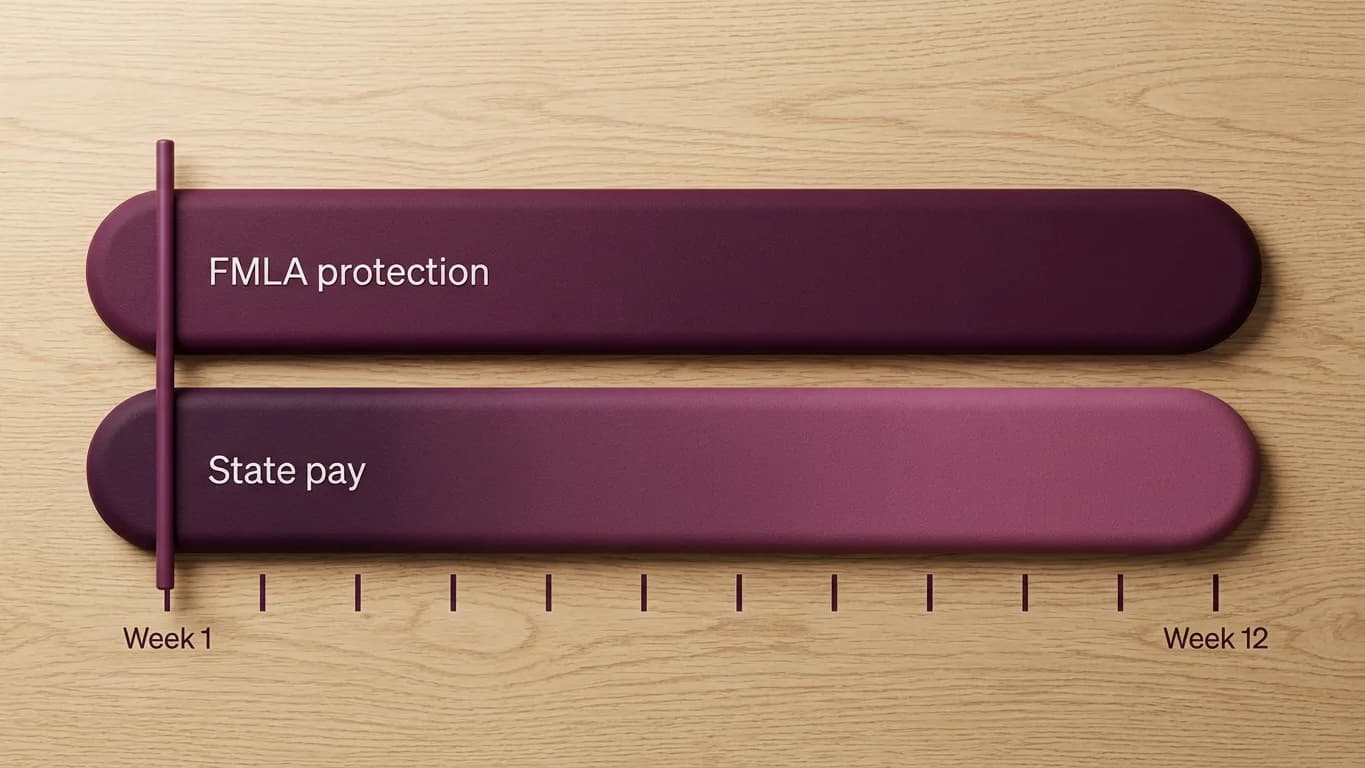
The FMLA holds your job and pays nothing. A state PFML program pays part of your wages and may or may not hold your job. The two laws answer different questions, cover different people, and run at the same time when both apply. Side by side, with the four combinations that come up in practice.
Topic

Topic: the protection layer and the pay layer, overlapping.
What is the difference between FMLA and PFML?
The FMLA is a federal law that protects your job: eligible employees of employers with 50 or more staff get up to 12 workweeks of unpaid leave per year for a serious health condition, a new child, or care of a spouse, parent, or child, with health insurance continued and the same or an equivalent position on return. PFML (paid family and medical leave) is a state insurance program that replaces part of your wages: in the 13 jurisdictions that pay benefits in 2026 it typically covers 12 weeks per reason at a progressive percentage of your wage, funded by payroll contributions and paid by a state agency, and it reaches part-timers and employees of small companies the FMLA does not. Where the same absence qualifies under both, the two run concurrently: the state pays, the FMLA protects, and the employer designates both from the same first day. Where only one applies, you get that one, which is why an employee can be paid but not job-protected, or protected but unpaid.
FMLA vs PFML side by side
The cleanest way to hold the two apart is to remember what each was built to do. Congress in 1993 could pass a guarantee that taking leave would not cost you your job, but not a fund to pay for it, so the FMLA is an employment right enforced against the employer. The states that built paid leave programs twenty years later were solving the pay problem, so they built insurance: a fund, a contribution rate, a claims process, and a benefit formula. Some of them added job protection to the insurance law and some left it to the FMLA and their own leave acts. The result is two systems that overlap in the middle and differ at every edge.
| FMLA (federal) | State PFML (13 jurisdictions, 2026) | |
|---|---|---|
| What it gives | Unpaid, job-protected leave; health insurance continued | Partial wage replacement; job protection only where the state law adds it |
| Who pays | Nobody. The employee is unpaid unless PTO or another benefit runs alongside | A state fund financed by employee and/or employer payroll contributions, or an approved private plan |
| Employer size | 50 or more employees within 75 miles | Usually all employers; a few programs exempt very small employers from contributions |
| Employee eligibility | 12 months with the employer and 1,250 hours in the last 12 months | Minimum covered wages or hours over a base period, often with any employer; no tenure with the current one in most states |
| Amount | 12 workweeks per 12 months (26 for military caregiver leave) | Typically 12 weeks per reason; combined caps of 12 to 26 weeks depending on the state |
| Family covered | Spouse, parent, child (and next of kin for military caregiver leave) | Broader: usually adds siblings, grandparents, grandchildren, in-laws, domestic partners, and in several states anyone with a family-like relationship |
| Intermittent use | Yes, in the smallest increment the employer uses for other leave, up to one hour | Yes in most programs, often in daily or weekly blocks with a minimum claim period |
| Who administers | The employer (eligibility, designation, tracking, reinstatement) | The state agency or private plan (eligibility, benefit amount, payment); the employer confirms wages and gives notices |
| Where it applies | Every state, territory, and D.C. | CA, CO, CT, DE, DC, ME, MA, MN, NJ, NY, OR, RI, WA; MD and VA from 2028 |
Can you use FMLA and PFML at the same time?
Yes, and when both apply you usually do not get a choice: they run concurrently by default. The FMLA regulations let an employer designate leave as FMLA leave whenever the reason qualifies, regardless of what else is paying for it (29 CFR 825.301), and every state paid leave law either requires or permits the state benefit to run at the same time as FMLA leave for the same reason. So an eligible employee in Massachusetts who has surgery uses 12 weeks of FMLA and 12 weeks of PFML medical leave in the same 12 weeks, not 24 weeks in sequence. The state pays the benefit; the FMLA holds the job and the health plan; the employer notes both on the leave record with the same start date.
Concurrency cuts both ways. It stops an employee from stacking two 12-week entitlements into six months off for one condition, which is the outcome employers worry about. It also means an employer that fails to designate FMLA leave promptly while the employee is drawing state benefits can lose the ability to count those weeks against the federal entitlement later, which is the outcome employers should worry about more. The practical rule is that the day the employer learns an absence may qualify under both, it issues the FMLA eligibility and designation notices on the federal timeline (five business days each) and points the employee to the state claim, and the two clocks start together.
What if you qualify for one but not the other?
Because the eligibility tests are different, four combinations exist and three of them are common. The employee who meets both tests is the textbook case above. The employee who qualifies for PFML but not the FMLA is the most frequent gap: someone at a company with 30 employees, or in their eighth month at a large one, or working 20 hours a week. The state pays them; whether their job is held depends on whether the state law carries job protection (Colorado after 180 days, Connecticut through its own FMLA at any employer size, Massachusetts, Minnesota after 90 days, New York, Oregon after 90 days, Rhode Island for caregiver leave, Washington at 50 or more employees) or a separate state leave act does. In California and New Jersey the paid benefit itself holds nothing; CFRA (5 or more employees) and the New Jersey Family Leave Act (30 or more) fill part of the gap.
The employee who qualifies for the FMLA but not PFML is the norm in the 36 jurisdictions without a program, and it also happens inside program states when the reason is outside the state law (for example, a condition the state fund does not treat as serious) or the employee has not met the base-period earnings test after moving from another state. Their job is protected and their pay comes from PTO, short-term disability, or nothing. The fourth combination, eligible for neither, is a new hire at a small employer in a no-program state, whose only fallbacks are the ADA (if the condition is a disability and leave is a reasonable accommodation) and the employer's own policy.
| Situation | Job protected? | Paid? | Typical example |
|---|---|---|---|
| Eligible for both | Yes (FMLA, often state law too) | Yes (state benefit) | Two years at a 200-person employer in Washington, surgery |
| PFML only | Only if the state law adds it or a state leave act applies | Yes | Eight months at a 40-person employer in Colorado, new child |
| FMLA only | Yes | No, unless PTO, disability insurance, or a company policy pays | Five years at a 500-person employer in Texas, caring for a parent |
| Neither | No, unless the ADA or a company policy applies | No | Three months at a 15-person employer in Georgia, own illness |
How does FMLA and PFML work in practice? A worked example
Daniel is a project coordinator in Denver at a firm with 65 employees. He has been there 14 months, works full time, and his partner is due in October. He is eligible under both laws: the FMLA because the firm has more than 50 employees and he has the tenure and hours, and Colorado FAMLI because he has earned well over the $2,500 base-period minimum. He asks for 12 weeks off from the birth. The employer issues the FMLA eligibility notice within five business days of his request, then the designation notice confirming that the 12 weeks are FMLA leave for bonding. Daniel files a FAMLI claim through the state portal; the employer confirms his wages and leave dates when the Division asks.
From the first day, both clocks run. FAMLI pays Daniel 90 percent of his wage up to half the state average weekly wage and 50 percent of the rest, subject to the annual cap, for 12 weeks. The FMLA holds his position and requires the firm to keep his health insurance on the same terms, with Daniel paying his usual share by the method the firm sets for unpaid leave. His employer's policy allows a PTO top-up, so Daniel uses one PTO day a week to lift the FAMLI benefit to roughly his normal net pay, which draws down 12 PTO days over the leave rather than 60. On the Monday he returns, his FMLA entitlement for the rolling year is exhausted, his FAMLI entitlement for the benefit year is exhausted, and he is back in the same role.
Change one fact and the picture changes. If the firm had 40 employees, Daniel would have no FMLA rights. FAMLI would still pay, and because he has been employed more than 180 days, FAMLI's own job-protection clause would require reinstatement. If instead he had started in June, four months before the birth, FAMLI would still pay (the earnings test looks back across employers) but neither the FMLA nor FAMLI's job protection would apply, and his return would rest on the firm's goodwill and its written policy. The pay layer and the protection layer are separate, and a leave record has to show both.
What do employers have to do differently for PFML?
Under the FMLA the employer runs the whole process: it decides eligibility, issues notices, requests certification, designates the leave, tracks the hours, and reinstates. Under a state program the agency decides eligibility and pays the benefit, and the employer's role narrows to four duties: withholding and remitting contributions, giving the statutory notice when an employee reports a qualifying event, responding to the agency's wage and leave verification, and honoring whatever job protection and health insurance continuation the state law adds. Where the employer runs an approved private plan, it takes the agency's role back, which is the trade-off for keeping the premium in-house.
The mistakes cluster in two places. The first is treating the state claim as the whole process and forgetting the FMLA designation, so the federal weeks are never counted and become available again later. The second is the pay coordination: requiring PTO to be exhausted before the state benefit where the state law forbids it, or counting state-paid weeks under a no-fault attendance policy. Both are avoided by a leave record that shows the FMLA hours, the state benefit weeks, and the PTO used on one timeline, which is how the leave case in Time-Out Zone is laid out. The employer-side details, notices and deadlines included, are covered in the FMLA for employers guide in a later wave of this cluster.
Federal: 29 U.S.C. 2611 to 2614 (eligibility, entitlement, restoration), 29 CFR 825.110 (eligible employee), 825.300 and 825.301 (notices and designation, five business days), 825.207 (substitution of paid leave). State: Colorado FAMLI Act (C.R.S. 8-13.3-501 ff., 180-day job protection; $2,500 base-period earnings), the 12 other program statutes as summarized on each agency's page, checked September 2026. This article explains US federal and state leave law at a general level and is not legal advice. State program rules, benefit rates and caps change, usually each January, so confirm the current figures with the agency that runs the program or with qualified counsel.
Frequently asked questions
- Is PFML the same as FMLA?
- No. The FMLA is a federal law that gives eligible employees up to 12 weeks of unpaid, job-protected leave. PFML is a state insurance program, in 13 jurisdictions in 2026, that pays part of your wages during family or medical leave. One protects, the other pays. They cover different employees and run at the same time when both apply.
- Does PFML run concurrently with FMLA?
- Yes, when the absence qualifies under both. The employer designates FMLA leave from the first day and the state benefit is paid for the same weeks, so 12 weeks of PFML and 12 weeks of FMLA are the same 12 weeks, not 24. If the employer fails to designate the FMLA leave on time, it may not be able to count those weeks later.
- Can I get PFML if I am not eligible for FMLA?
- Usually yes. State programs test earnings or hours over a base period, not employer size or tenure with your current employer, so employees of small companies, new hires, and part-timers who are outside the FMLA are often inside PFML. Whether your job is held then depends on the state law's own job-protection clause or a state leave act.
- Does PFML protect my job?
- Only if the state law says so. Colorado, Connecticut, Delaware, Massachusetts, Minnesota, New York, Oregon, Rhode Island (caregiver leave), and Washington (employers with 50 or more) include job protection in or alongside the paid leave law, usually after a short tenure. California and New Jersey rely on the FMLA and their own leave acts (CFRA, NJFLA). Our state grid has the row for each jurisdiction.
- Which is better, FMLA or PFML?
- They are not alternatives. If you qualify for both, you get both at once: pay from the state and protection from the FMLA. If you qualify for one, that is the one you get. The only real choice arises in states that let you decline the state benefit, and declining it never adds FMLA weeks, so there is rarely a reason to.
- Do I have to apply separately for FMLA and PFML?
- Yes. FMLA leave is requested from your employer, who issues the notices and may ask for a medical certification. The state benefit is claimed from the state agency (or the employer's approved private plan), usually online, with its own forms and its own medical certification. Tell your employer you are doing both so the designations start on the same day.
About the author
Blasko Sarcevic
Founder, Time-Out Zone
Connect on LinkedIn Connect on LinkedIn
Blasko writes about leave management, policy design, and running time-off operations at scale.
Related
Two clocks, one leave record
Time-Out Zone shows FMLA hours and state paid leave weeks on the same case timeline, with the PTO top-up beside them, so nobody has to reconcile three spreadsheets when the employee comes back.