Is Short-Term Disability Taxable? Who Paid the Premium Decides

Blasko Sarcevic
Published
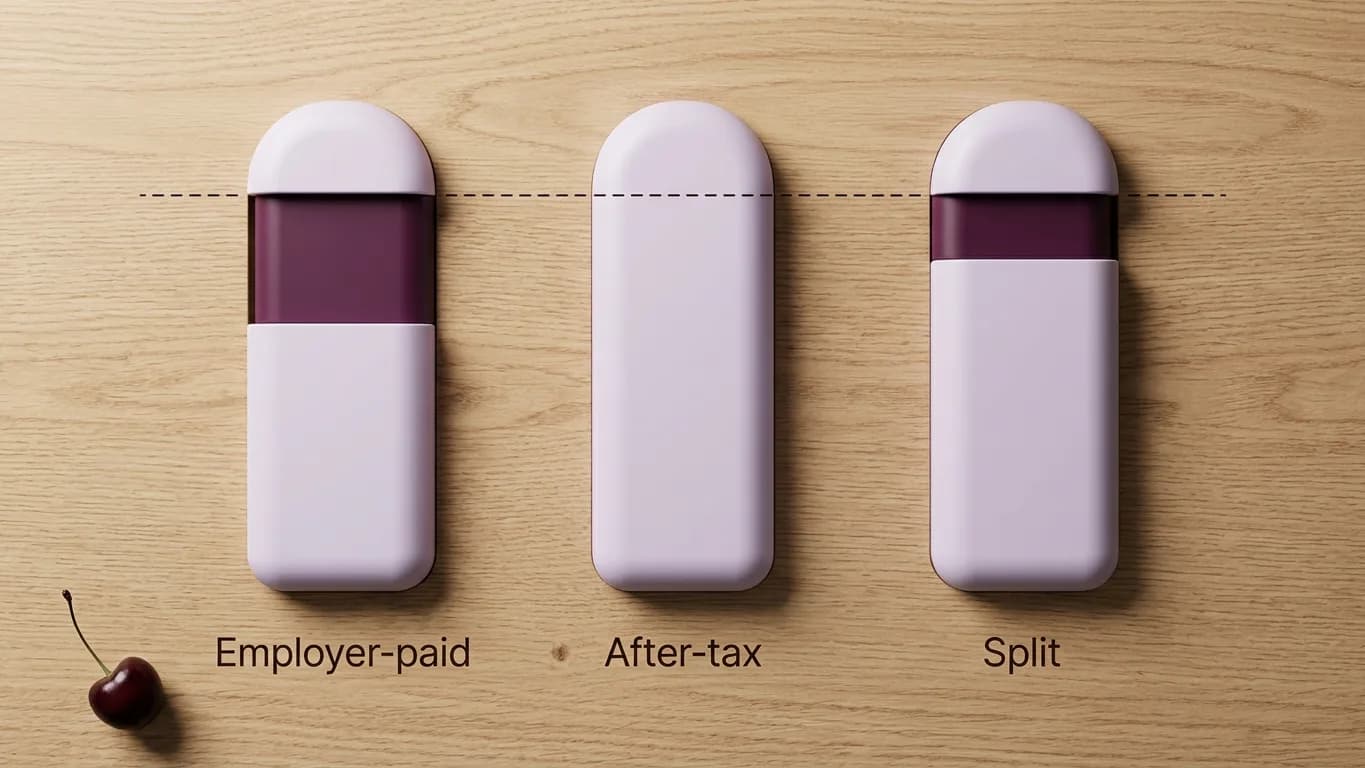
Short-term disability benefits are taxable when the premium was paid with untaxed money and tax-free when it was paid with taxed money. That one rule, from Internal Revenue Code sections 104 and 105, explains the employer-paid case, the pre-tax payroll deduction case, the split-premium case, and why two colleagues on the same plan can get different W-2s.
Topic

Topic: the same benefit, two tax outcomes, decided by the premium.
Is short-term disability taxable?
It depends on who paid the premium and with what kind of dollars. If your employer paid the premium, or you paid it through a pre-tax payroll deduction under a Section 125 cafeteria plan, the benefits are taxable income and, for the first six months after you stop working, also subject to Social Security and Medicare tax. If you paid the premium yourself with after-tax dollars, the benefits are tax-free. If the premium was split, the same share of each benefit check is taxable as the employer (or pre-tax) share of the premium, calculated for group plans over the three policy years before the disability began. The authority is Internal Revenue Code section 104(a)(3), which excludes accident and health insurance benefits from income, and section 105(a), which pulls back into income any benefit attributable to employer contributions the employee was never taxed on. Taxable benefits appear in box 1 of your W-2; tax-free benefits appear in box 12 with code J. State disability and paid medical leave benefits follow the same contribution logic under IRS Revenue Ruling 2025-4.
Why does the premium decide whether disability benefits are taxed?
The tax code's position is that you should pay tax on disability income once, and only once. Money that has already been taxed, your after-tax wages, can buy insurance whose payout is tax-free, because the tax was collected when you earned the premium. Money that was never taxed, your employer's payment or your own pre-tax deduction, buys insurance whose payout is taxed, because otherwise that income would escape tax entirely. Section 104(a)(3) states the exclusion; section 105(a) carves out the exception for employer-financed coverage. Every real-world case is an application of that pair.
The trap is the pre-tax deduction. Many employers let employees pay their share of disability premiums through a cafeteria plan so the premium reduces taxable wages. That saves a few dollars a month while you are healthy and makes the entire benefit taxable when you are not, because the regulations treat a pre-tax employee contribution as an employer contribution (Treas. Reg. 1.125-1). For a benefit that arrives when income is already down 40 percent, the trade is usually a poor one, which is why some employers now default disability premiums to after-tax and let employees opt into pre-tax, or "gross up" the premium as taxable income so the benefit is clean. Ask payroll which way your plan runs before you need it; it is a line on your pay stub, not a decision you can change once a claim starts.
How are taxes calculated on short-term disability?
Three cases cover almost every plan. In the employer-paid case, 100 percent of each benefit check is taxable wages: federal income tax, state income tax where the state has one, and Social Security and Medicare tax (7.65 percent employee share) on payments made within six calendar months after the last month you worked. After that sixth month, the FICA tax stops even though income tax continues (IRC 3121(a)(4)). In the employee after-tax case, nothing is taxable and nothing is withheld; the check equals the benefit. In the split case, the plan applies a ratio: if the employer paid 60 percent of the premium and you paid 40 percent after tax, 60 percent of each check is taxable and 40 percent is not.
For group policies the ratio is not the current year's split but the average over the three policy years before the year in which the disability began, or the whole period the plan has existed if shorter (Treas. Reg. 1.105-1(d)(2)). That rule prevents an employer from flipping the premium split in the year of a large claim. Whether income tax is actually withheld from a taxable benefit depends on who cuts the check. If the employer pays the benefit itself, or the insurer acts as the employer's agent, withholding runs like normal payroll. If an independent insurer pays, it withholds federal income tax only if you ask it to on Form W-4S, so many people receive gross taxable checks and owe the tax in April. Requesting withholding, or making an estimated payment, avoids that surprise.
| Who paid the STD premium | Federal income tax on benefits | Social Security and Medicare | Where it shows on the W-2 |
|---|---|---|---|
| Employer paid 100 percent | Taxable in full | Yes, on payments within 6 months after the last month worked; none after that | Box 1 (and boxes 3 and 5 while FICA applies) |
| Employee paid 100 percent, pre-tax (Section 125) | Taxable in full (treated as employer-paid) | Yes, same 6-month rule | Box 1 (and boxes 3 and 5 while FICA applies) |
| Employee paid 100 percent, after tax | Tax-free | None | Box 12, code J (nontaxable sick pay) |
| Split, e.g. employer 60 / employee after-tax 40 | 60 percent of each check taxable, based on the 3-year premium ratio | Yes on the taxable 60 percent, same 6-month rule | Taxable share in box 1; nontaxable share in box 12, code J |
How much of a short-term disability check do you keep? A worked example
Elena is an accounts manager in Pennsylvania earning $1,500 a week. Her employer's group plan pays 60 percent after a 7-day elimination period, so a back operation and an eight-week recovery produce seven plan-paid weeks of $900 each, $6,300 in total. Under scenario A her employer pays the whole premium. Every $900 is taxable: the insurer, acting as the employer's agent, withholds Social Security and Medicare of $68.85 a week (7.65 percent, because the payments fall inside the six-month window), federal income tax at her 22 percent marginal rate of roughly $198, and Pennsylvania's 3.07 percent flat tax of $27.63. Her weekly deposit is about $605, and her W-2 for the year shows the $6,300 in boxes 1, 3, and 5.
Under scenario B, Elena's employer offers the same plan but she pays the premium, about $11 a week, from after-tax wages. She has paid roughly $570 a year for the coverage. Her seven benefit checks arrive at the full $900 with no withholding, her W-2 shows $6,300 in box 12 with code J, and none of it goes on her return. The after-tax premium cost her about $125 a year in extra income tax compared with paying it pre-tax; the claim saved her roughly $2,060 in tax on the benefit. Under scenario C, a 50/50 split with her half after tax, $450 of each check is taxable and $450 is not, the withholding halves, and box 1 and box 12 each carry $3,150. The plan, the percentage, and the recovery are identical in all three scenarios. Only the premium arrangement changed.
Are state disability and paid medical leave benefits taxable?
The same contribution logic applies, and since January 2025 the IRS has said so explicitly for state paid family and medical leave programs in Revenue Ruling 2025-4. Family leave benefits (bonding, caring for a relative) are taxable federal income in full, because they are not payments for your own sickness, but they are not wages, so no Social Security or Medicare tax applies and the state reports them on a Form 1099. Medical leave benefits for your own condition are split exactly like a private plan: the portion attributable to your own after-tax payroll contributions is excluded from income under section 104(a)(3), and the portion attributable to the employer's contributions is taxable wages under section 105, subject to the sick-pay withholding and reporting rules. A state that funds medical leave 50/50 therefore produces a benefit that is half taxable.
The five state temporary disability programs sort themselves the same way. California SDI and Rhode Island TDI are funded entirely by employee payroll deductions, and neither state treats the benefits as federally taxable income (California's exception is SDI paid in place of unemployment benefits, which is taxable). New Jersey TDI and New York DBL are funded partly by employers, and the employer-attributable share of those benefits is taxable. Hawaii TDI is employer-provided, so its benefits are generally taxable. State income tax follows its own rules: several states exempt disability benefits their own program pays, and a few states with no income tax make the question moot. The benefit statement your state or insurer sends in January tells you what was reported, and that is the document to hand to whoever prepares your return.
How do you report short-term disability on your tax return?
Taxable benefits paid by your employer or by an insurer acting as its agent come to you on your regular W-2, folded into box 1 wages, and you report them as wages. Taxable benefits paid by an independent third party come on a separate W-2 from the insurer, with box 13 marked third-party sick pay, and you report those as wages too. Nontaxable benefits are shown for information only in box 12 with code J, and you do not enter them anywhere on Form 1040. If an insurer paid you a taxable benefit and did not withhold, the W-2 will show wages with little or no federal tax in box 2, and the balance is due with your return, potentially with an underpayment penalty if it is large enough and you made no estimated payment.
Two adjacent questions come up every year. First, the employer's premium payments for your disability coverage are not income to you when paid; they are an excludable fringe benefit, so nothing about the premium itself appears on your return in the employer-paid case. Second, disability benefits are not earned income for the Earned Income Tax Credit or for IRA contribution purposes once you have reached your employer's minimum retirement age, but they are treated as earned income before that age (IRS Publication 525). For most people on a short-term claim of a few weeks, the whole subject reduces to a single check: does your W-2 for the year include the benefit in box 1, and if so, was enough tax withheld.
Internal Revenue Code 104(a)(3) and 105(a) (exclusion and employer-contribution exception), 3121(a)(4) (six-month FICA rule for sick pay), Treas. Reg. 1.105-1(d)(2) (three-year premium ratio for group policies), Treas. Reg. 1.125-1 (pre-tax contributions treated as employer contributions), IRS Publication 15-A (third-party sick pay withholding, Form W-4S, W-2 reporting, box 12 code J), IRS Publication 525 (disability income), IRS Revenue Ruling 2025-4 (state paid family and medical leave benefits). State programs: California EDD (SDI not taxable except in lieu of UI), Rhode Island DLT (TDI not taxable, TCI taxable), New Jersey Department of Labor (TDI), New York Workers' Compensation Board (DBL), Hawaii DLIR (TDI), checked September 2026. Elena's figures use 2026 rates for FICA (7.65 percent) and Pennsylvania (3.07 percent) and an assumed 22 percent federal marginal rate; they illustrate the mechanics, not a specific taxpayer's liability. Not tax advice. This article explains US federal and state leave law at a general level and is not legal advice. State program rules, benefit rates and caps change, usually each January, so confirm the current figures with the agency that runs the program or with qualified counsel.
Frequently asked questions
- Do you pay taxes on short-term disability?
- You do if the premium was paid by your employer or by you through a pre-tax payroll deduction. You do not if you paid the premium with after-tax dollars. Split premiums produce a split benefit, taxable in the same proportion as the employer's share of the premium over the three policy years before the disability began.
- Is short-term disability taxed as regular income?
- Taxable benefits are treated as wages: they are subject to federal income tax at your ordinary rates and to Social Security and Medicare tax for payments made within six calendar months after the last month you worked. There is no special disability tax rate and no separate schedule; the amount is folded into your wage income for the year.
- Does short-term disability get reported on a W-2?
- Yes. Taxable benefits appear in box 1 (and boxes 3 and 5 while Social Security and Medicare apply), either on your employer's W-2 or on a separate W-2 from the insurer with box 13 marked third-party sick pay. Nontaxable benefits from an after-tax premium appear in box 12 with code J and are not reported on your return.
- Is short-term disability taxable in California?
- California SDI benefits are funded entirely by employee payroll deductions and are not federally taxable, except when paid in place of unemployment benefits, and California does not tax them either. A private employer-paid STD plan in California is taxable under the normal federal rule; the state's exemption applies to the state program, not to private insurance.
- Is short-term disability taxable in New Jersey?
- New Jersey TDI is funded by both employers and employees, and the share of benefits attributable to the employer's contributions is subject to federal income tax and, within the six-month window, Social Security and Medicare tax. New Jersey does not tax TDI benefits on the state return. Private plan benefits follow the standard premium rule.
- Should I pay my disability premium pre-tax or after-tax?
- For most people after-tax is the better choice. A pre-tax premium saves a small amount each month while you are working and makes the whole benefit taxable when you are on leave and income is already down to 60 percent. An after-tax premium costs slightly more each month and makes the benefit tax-free. If your employer offers a choice, or a gross-up option, take the after-tax route unless the premium is large relative to the expected benefit.
About the author
Blasko Sarcevic
Founder, Time-Out Zone
Connect on LinkedIn Connect on LinkedIn
Blasko writes about leave management, policy design, and running time-off operations at scale.
Related
Keep the paid weeks and the unpaid weeks straight
Time-Out Zone records which weeks of a leave were insurer-paid, which were PTO, and which were unpaid, so payroll has the timeline it needs when the W-2 questions arrive in January.