When Does FMLA Reset? The Four 12-Month Methods, Explained With Dates (2026)

Blasko Sarcevic
Published
The 12 weeks of FMLA leave live inside a 12-month period, and the law lets the employer define that period in one of four ways. Under three of them the entitlement comes back all at once on a date; under the fourth it comes back one day at a time. One employee's leave run through all four methods, the stacking problem, and the rules for changing your mind.
Topic
Topic: which 12 months the clock runs on.
When does FMLA reset?
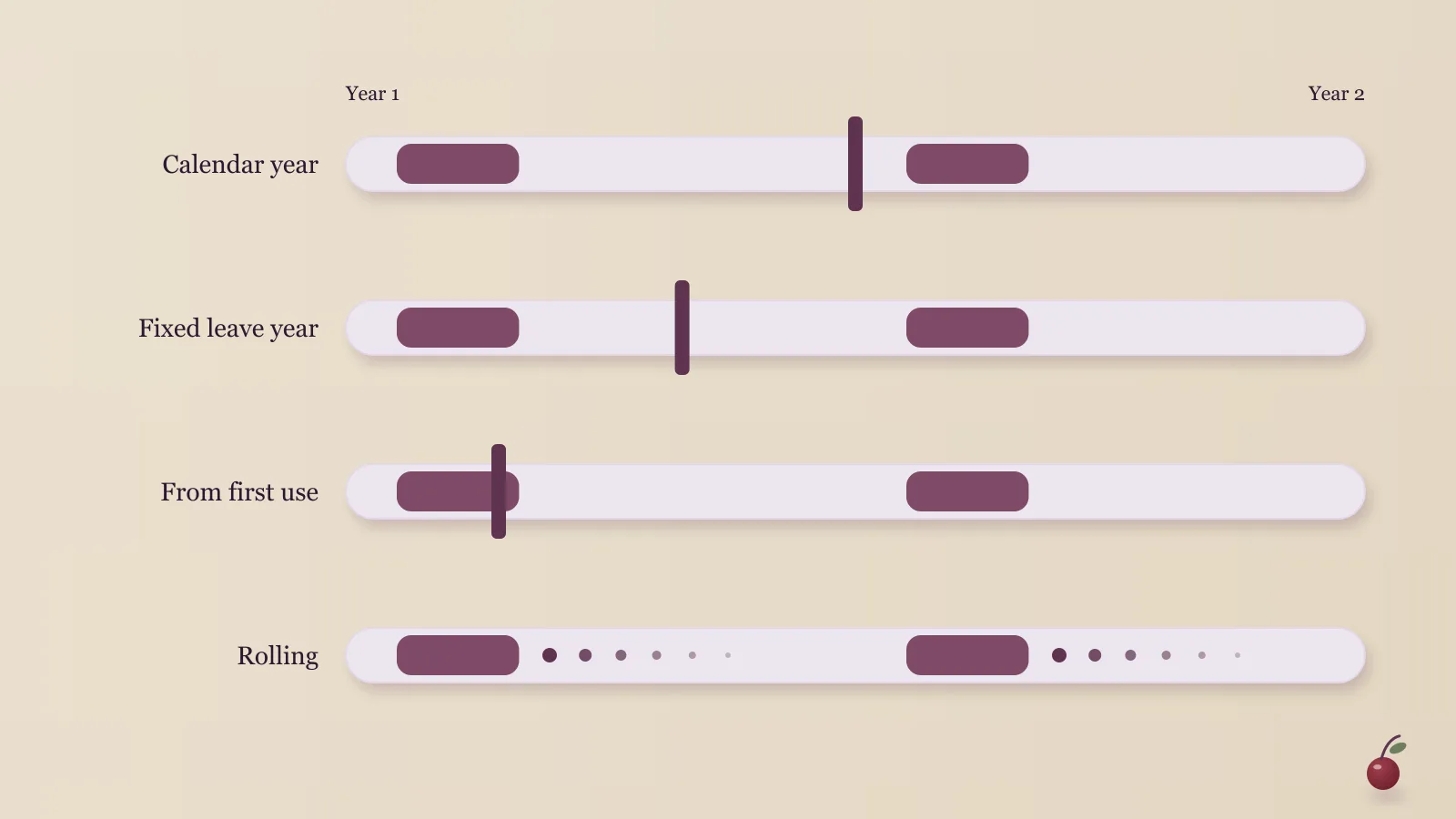
FMLA leave does not reset on a fixed date for everyone. The regulations let each employer choose one of four ways to define the 12-month period in which an employee may take 12 workweeks of leave: the calendar year; any fixed 12-month leave year such as a fiscal year or the employee's anniversary date; the 12 months measured forward from the first day an employee takes FMLA leave; or a rolling 12-month period measured backward from each day leave is used. Under the first three, the full 12 weeks return on the first day of the new period. Under the rolling method there is no single reset: each hour of leave returns exactly 12 months after it was taken. The employer must apply one method to all employees, disclose it in the rights and responsibilities notice, and give 60 days' written notice before changing it. An employer that never chose a method must use whichever is most beneficial to the employee. Source: 29 CFR 825.200.
What are the four FMLA 12-month methods?
The statute says 12 workweeks of leave during any 12-month period and leaves it there. The Department of Labor's regulations fill in the four ways an employer may define the period. The calendar year runs January 1 to December 31. A fixed leave year is any other 12 months the employer picks and applies to everyone: a fiscal year, a year that starts on the anniversary of each employee's hire date, or a year required by state law. The third method measures 12 months forward from the first day an employee takes FMLA leave; the next period begins the first time the employee takes leave after the previous period ends. The fourth is the rolling 12-month period measured backward from the date an employee uses any FMLA leave: on each day of leave, the employee has whatever part of the 12 weeks was not used in the preceding 12 months.
The first three methods are simple to explain and produce a reset date. Their shared weakness is that an employee can use 12 weeks at the end of one period and 12 more at the start of the next, taking up to 24 consecutive weeks of protected leave. The rolling method is harder to explain and has no reset date, but it makes stacking impossible: however the leave is spread, no 12-month window ever contains more than 12 weeks of it. That trade is the reason the rolling method is the most common choice among employers with a leave management system and the least common among employers that track leave by hand.
| Method | How availability is computed | When the full 12 weeks return | Can 24 weeks be stacked? |
|---|---|---|---|
| Calendar year | 12 weeks minus leave used since January 1 | January 1 | Yes, across December and January |
| Fixed leave year | 12 weeks minus leave used since the leave year start | The leave year start date | Yes, across the year boundary |
| 12 months forward from first use | 12 weeks minus leave used since the first day of leave in the period | The first day of leave after the period ends | Yes, at the period boundary |
| Rolling 12 months backward | 12 weeks minus leave used in the 12 months before each day of leave | Never all at once; each hour returns 12 months after it was used | No |
How does the calendar year method work?
Under the calendar year method every employee's entitlement resets on January 1. An employee who used eight weeks in 2026 has four weeks left until December 31 and twelve again on New Year's Day. The appeal is administrative: payroll, benefits and attendance all run on the calendar year, so one more thing that resets on January 1 is easy to explain and easy to audit. The risk is concentrated at the boundary. An employee with a serious condition that starts in the autumn can take 12 weeks from early October to late December and another 12 from the first working day of January, and the employer has no FMLA ground to refuse the second block. Small teams feel this most; a 24-week absence in a department of six is a different problem from a 12-week one.
How does a fixed leave year work?
A fixed leave year is the calendar year method with a different start date. Employers whose fiscal year starts on July 1 often align the FMLA year with it; others use the employee's anniversary date, so each employee has their own reset day but the method is still uniform because it is defined the same way for everyone. Some employers inherit the date from a state statute: Wisconsin's family and medical leave law measures its entitlements over the calendar year, and a multi-state employer may use that method for its Wisconsin employees while using another method elsewhere, a specific exception to the uniformity rule. A fixed leave year has exactly the same stacking exposure as the calendar year; it just moves the boundary to a date the employer chose.
How does the 12 months forward from first use work?
The third method starts an employee's 12-month period on the first day they take FMLA leave and runs it for 12 months. If the first day of leave is February 2, 2026, the period ends February 1, 2027, and the employee has 12 weeks to use within it. The next period does not start automatically on February 2, 2027; it starts on the first day the employee takes FMLA leave after that date, which might be months later. Each employee therefore has a personal period tied to their own history, and an employee who has never taken leave has no period yet. The method is fairer than a fixed year for the employee whose first leave happens to fall just before a reset date, but it carries the same stacking risk at its own boundary, and it forces HR to store a period start date for every employee who has ever used the leave.
How does the rolling backward method work?
The rolling method asks one question on every day of leave: how much FMLA leave has this employee used in the 12 months ending today? Whatever remains of the 12 weeks is what is available. Leave taken 12 months ago and one day is no longer in the window, so it has come back; leave taken 11 months ago is still counted. The Department of Labor's own example is an employee who took four weeks from February 1, four weeks from June 1 and four weeks from December 1 of one year, has nothing left until the following February 1, and from that day regains the leave in the same amounts and on the same schedule as it was used. In hours, which is how the tracking actually happens, every eight-hour day of leave is restored on the same calendar date a year later.
The consequence for the employee is that there is never a day when the full 12 weeks are guaranteed to be available after a period of use; the consequence for the employer is that the maximum leave in any 12 months is 12 weeks, full stop. The arithmetic is the only real cost. A spreadsheet can do it for one employee with a trailing 12-month sum, which is exactly what the intermittent hours tracker on this site does; across a workforce with intermittent leave it is the kind of calculation that belongs in software, where each absence shows the hours it consumes and the date those hours come back.
Can an employer change its FMLA 12-month method?
Yes, with three conditions. The new method must be applied to all employees, the employer must give at least 60 days' written notice to all employees before it takes effect, and the transition must be handled so that every employee keeps the full benefit of 12 weeks under whichever method is more favorable to them during the changeover. An employer moving from the calendar year to rolling backward on July 1 cannot tell an employee who used eight weeks in the spring that the switch has cost them anything; for the transition period that employee is measured under both methods and gets the better result. The regulation adds that a method may never be changed in order to avoid the law's requirements, so a switch announced the week an employee asks for leave will be read exactly as it looks.
The uniformity rule has one exception besides the state statute case: the military caregiver entitlement. Leave to care for a covered servicemember with a serious injury or illness is measured in a single 12-month period that begins on the first day of that leave, whatever method the employer uses for everything else, and the combined total of caregiver leave and other FMLA leave in that period is capped at 26 weeks.
What if the employer never chose a method?
Then the employer has chosen all of them, from the employee's point of view. Where an employer has not selected and communicated a method, the regulation requires the option that provides the most beneficial outcome for the employee to be used in any dispute. In practice that means an employee who wants to stack leave across a year end gets the calendar year, and an employee who wants leave to come back sooner after heavy use gets whichever fixed period happens to favor them. The employer can escape this by selecting a method and giving the 60-day notice, but the selection operates from then on; it cannot be applied backward to an absence that has already happened. The method has to be stated in the rights and responsibilities notice the employer sends when leave is requested, so an employer that has been sending notices without naming a method has been telling employees, in effect, that the most beneficial method applies.
A worked example: Elena's leave under all four methods
Elena works 40 hours a week, Monday to Friday, so her FMLA entitlement is 480 hours. She takes six weeks of continuous leave from Monday, February 2 to Friday, March 13, 2026, which is 30 working days and 240 hours. She recovers, returns, and then needs another six weeks from Monday, August 3 to Friday, September 11, 2026: another 240 hours. By the evening of September 11 she has used 480 hours in seven months. What she has left, and when she gets more, depends entirely on the method her employer chose.
Under the calendar year she has nothing left for the rest of 2026 and 480 hours again on January 1, 2027. Under a fixed leave year running July 1 to June 30 the picture is different: the February leave fell in the 2025-26 leave year and the August leave in the 2026-27 one, so on September 11 she still has 240 hours available until June 30, 2027, and 480 again on July 1, 2027. Under the 12 months forward from first use, her period began on February 2, 2026 and runs to February 1, 2027; both leaves fall inside it, she has nothing left until it ends, and her next period starts on the first day she takes FMLA leave on or after February 2, 2027. Under rolling backward she also has nothing on September 11, 2026, but starting on Tuesday, February 2, 2027 the hours from the first leave begin to return, eight hours for each day she was out a year earlier, so that by March 13, 2027 she has 240 hours again, and by September 11, 2027 the full 480.
The stacking problem shows up if you change the dates. Had Elena instead taken 12 weeks from Monday, October 5 to Friday, December 25, 2026 under the calendar year method, she could have begun another 12 weeks on Monday, January 4, 2027 and stayed out until Friday, March 26, 2027: 24 consecutive weeks of protected leave, all lawful. Under rolling backward the January leave would have found no hours in the window and the second block would not have been FMLA leave at all. Whether that is a feature or a defect depends on which side of the desk you sit, which is exactly why the law leaves the choice to the employer and then insists it be made in the open.
| Method | Hours available on Sept 11, 2026 | Next hours become available | Full 480 hours back |
|---|---|---|---|
| Calendar year | 0 | January 1, 2027 | January 1, 2027 |
| Fixed leave year (July 1 to June 30) | 240 | Already available | July 1, 2027 |
| 12 months forward from first use (Feb 2, 2026) | 0 | Her first leave on or after February 2, 2027 | February 2, 2027 |
| Rolling 12 months backward | 0 | February 2, 2027, then 8 hours per day through March 13, 2027 | September 11, 2027 |
How does the FMLA clock relate to the PTO reset?
They are separate clocks that happen to share a vocabulary. PTO resets when the employer's paid time off policy says it does, usually on January 1 or the employee's anniversary, with carryover rules attached; the guide on when PTO resets covers the common cycles. FMLA resets according to the employer's chosen 12-month method, and the two need not align. An employer with a calendar year PTO policy and a rolling FMLA period will have employees whose PTO refills in January while their FMLA hours trickle back across the year. Where PTO is substituted for FMLA leave, the paid hours reduce both balances at once, but each balance is then restored on its own schedule. The one thing the two clocks share is that both must be disclosed in writing: PTO in the policy, FMLA in the rights and responsibilities notice.
Statutory references: 29 U.S.C. 2612(a)(1) (12 workweeks in any 12-month period); 29 CFR 825.200(a) to (b) (the four permitted methods), 825.200(c) (rolling backward, with the Department's February, June and December example), 825.200(d)(1) (uniform application, 60 days' notice, transition under the more favorable method, no change to avoid the Act), 825.200(d)(2) (multi-state employer exception where a state statute requires a method), 825.200(e) (most beneficial method where none was selected), 825.200(f) to (g) (single 12-month period for military caregiver leave, 26-week combined cap), 825.200(h) (holidays), 825.205 (counting leave in hours), 825.300(c)(1)(i) (the method must be stated in the rights and responsibilities notice). Wis. Stat. 103.10 (Wisconsin's calendar-year measurement). Checked September 2026. This article explains US federal and state leave law at a general level and is not legal advice. State program rules, benefit rates and caps change, usually each January, so confirm the current figures with the agency that runs the program or with qualified counsel.
Frequently asked questions
- Does FMLA reset every year?
- Only under three of the four methods. With the calendar year, a fixed leave year, or the 12 months measured forward from first use, the full 12 weeks return on the first day of the new period. Under the rolling 12-month method there is no annual reset; each hour of leave returns 12 months after it was taken. Your employer's rights and responsibilities notice states which method applies to you, and if it does not, the method most beneficial to you applies.
- What is the FMLA rolling 12-month period?
- A way of measuring the entitlement backward from each day of leave. On any day you take FMLA leave, the employer adds up the FMLA leave you used in the previous 12 months and subtracts it from 12 weeks; what remains is what you have. Leave taken more than 12 months ago has dropped out of the window and is available again. It is the only method under which an employee can never take more than 12 weeks in any 12-month stretch.
- Can you take 24 weeks of FMLA in a row?
- Under a calendar year, fixed leave year or forward-from-first-use method, yes: 12 weeks at the end of one period and 12 at the start of the next, back to back, is lawful. Under the rolling backward method, no. Military caregiver leave is separate: up to 26 weeks in a single 12-month period, combined with any other FMLA leave taken in that period.
- Does intermittent FMLA reset the same way?
- Yes. The method applies to the entitlement, not to the pattern of use. Intermittent leave is counted in hours, so under the rolling method each four-hour or eight-hour absence returns 12 months after the date it was taken, and under a fixed period the hours used since the period start are subtracted from the total. Tracking this by hand is where a trailing 12-month sum in a spreadsheet earns its keep.
- Does FMLA reset if you change employers?
- Your entitlement with a new employer is a fresh 12 weeks, but you have to earn eligibility again: 12 months of service with that employer and 1,250 hours worked in the 12 months before the leave, at a worksite with 50 employees within 75 miles. Leave you used with the old employer does not follow you, and the new employer's 12-month method applies from your first leave with them.
- Do unused FMLA weeks carry over?
- No. FMLA is an entitlement to take up to 12 weeks in a 12-month period, not a bank of weeks you accumulate. Under the fixed methods, weeks you did not use in one period simply do not exist in the next, which starts with a full 12. Under the rolling method the concept does not arise, because availability is always 12 weeks minus what you used in the last 12 months.
About the author
Blasko Sarcevic
Founder, Time-Out Zone
Connect on LinkedIn Connect on LinkedIn
Blasko writes about leave management, policy design, and running time-off operations at scale.
Related
Rolling backward, without the spreadsheet
Time-Out Zone applies one 12-month method to everyone, shows each absence with the date its hours come back, and projects the balance forward so a leave team can answer how much is left on any day.