When Does PTO Reset? Calendar Year, Anniversary, and Fiscal Cycles

Jovana Avramovic
Published
The three reset cycles companies use, what actually happens to your balance on reset day, why the answer depends on the carry-over rule rather than the date, and how to find out which cycle your employer runs.
Topic

Topic: the day a PTO year starts over.
When does PTO reset?
PTO resets on the date your employer's policy defines as the start of a new leave year, and there are three common choices. Most companies reset on January 1, the calendar-year cycle, because it matches payroll and financial reporting. The second pattern is the anniversary cycle, where each employee's PTO year starts on their own hire date, so a colleague hired in June resets in June while you reset in March. A smaller group of companies ties the reset to their fiscal year, for example April 1 or July 1. The reset date alone does not tell you whether unused days survive: that is the carry-over rule, which can roll everything, roll a capped number of days, or clear the balance where the law allows it. Unlimited PTO policies have no balance and therefore nothing to reset. Your employee handbook, your leave system's balance page, or HR can tell you which cycle and carry-over rule apply to you.
The three reset cycles
A reset cycle answers one question: on which date does a new leave year begin? Everything else, how much you get and what survives the turn, is decided by the allowance and the carry-over rule layered on top.
| Cycle | Reset date | Who uses it |
|---|---|---|
| Calendar year | January 1 | The default for most companies; aligns with payroll, taxes, and everyone's mental model of a year |
| Anniversary year | Each employee's hire date | Companies that want proration to disappear: every employee starts a full year on day one |
| Fiscal year | Company fiscal year start (April 1, July 1, October 1) | Organizations whose budgeting dominates planning: schools, government contractors, retailers |
What happens to your balance on reset day
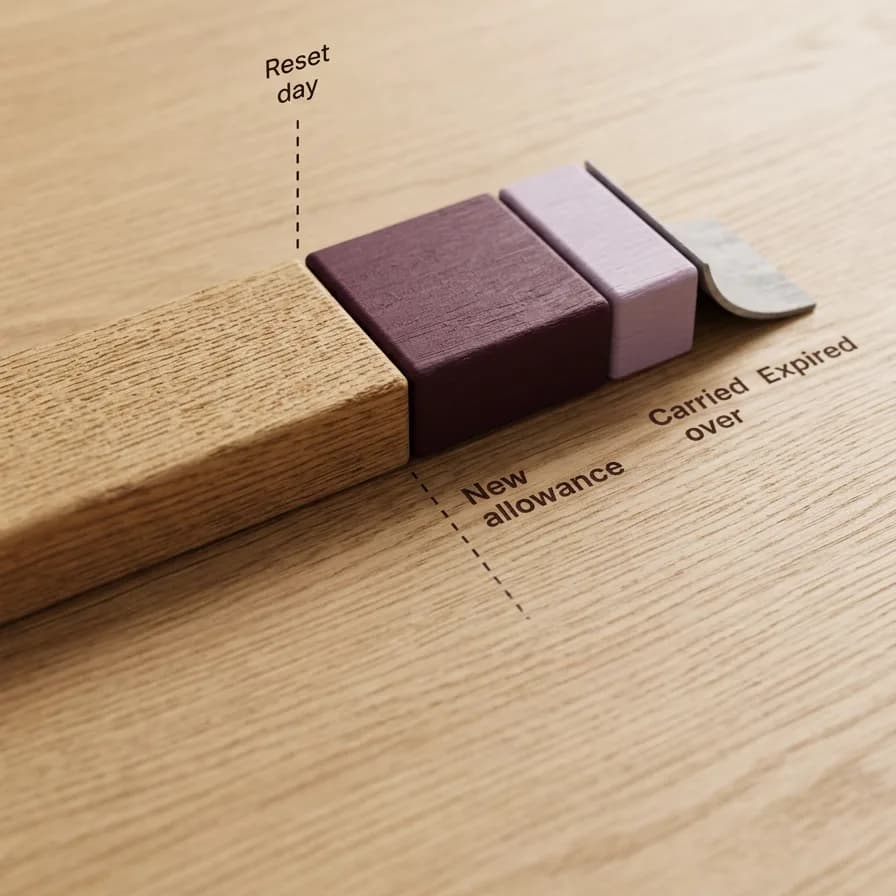
The reset date starts a new year; the carry-over rule decides what the old year leaves behind. With full carry-over, your unused days simply add to the new allowance. With capped carry-over, a fixed number of days rolls (five is a common cap) and the rest expires, often with a use-by date like March 31. With use-it-or-lose-it, the balance clears entirely, though several US states treat accrued PTO as earned wages and prohibit that forfeiture.
This is why two people can both "reset on January 1" and have completely different experiences: one starts the year with 15 fresh days plus 5 carried ones, the other starts with 15 and lost 4. The reset mechanics are covered in depth in our carry-over explainer, and the policy design side in the year-end playbook, both linked below.
Calendar or anniversary: how companies choose
The calendar cycle wins on simplicity. One reset date means one year-end communication push, one rollover run, and reports that match the fiscal reality of most businesses. Its cost is proration: someone hired in September earns only a third of the annual allowance in their first calendar year, which needs explaining.
The anniversary cycle eliminates proration, since every employee starts a complete personal year on their hire date, and it spreads year-end usage spikes across twelve months. The price is operational: balances reset somewhere in the company almost every week, year-end reminders become a rolling process, and comparing team balances mid-year is harder. Leave systems handle the mechanics either way; the choice is really about whether HR prefers one intense year-end or a permanent low-level hum.
Resets in accrual and lump-sum policies
In a lump-sum policy the reset is visible: the full allowance appears on the reset date. In an accrual policy the reset is quieter, because days are earned per pay period all year; what the reset does there is apply the carry-over rule to the accumulated balance and restart the counting for the new year.
Unlimited PTO removes the concept entirely. With no balance to track, nothing expires and nothing rolls; the policy questions move to approval norms and minimums instead.
How to find your reset date
Three places answer it in under a minute. The employee handbook or PTO policy states the leave year explicitly, usually in the first paragraph of the vacation section. Your leave system shows it on the balance page, typically as the period the current balance belongs to. And payslips or accrual statements often print the leave year alongside the balance.
If your company runs its policy in Time-Out Zone, the reset cycle is configured per policy (calendar, anniversary, or a custom date) and the balance page always shows the current cycle, so the question answers itself.
US state rules on PTO forfeiture and payout vary and change over time; this article describes common practice at a general level and is not legal advice.
Frequently asked questions
- Do I lose my PTO when it resets?
- Only if the policy says so. Full carry-over keeps everything, capped carry-over keeps a fixed number of days, and use-it-or-lose-it clears the balance, though states that treat accrued PTO as earned wages prohibit forfeiture. Check the carry-over rule, not just the reset date.
- Does PTO reset on January 1 or on my work anniversary?
- Depends on the employer. The calendar cycle (January 1) is the most common; anniversary cycles reset each person on their own hire date; some companies use their fiscal year. The handbook or your leave system's balance page states which one applies.
- Do sick days reset on the same date as vacation?
- Usually, but not always. Companies with separate sick leave often reset it on the same cycle for simplicity. Where state or local law mandates paid sick leave, the law may define its own accrual year and carry-over minimums independent of the vacation policy.
- What happens to a negative PTO balance at reset?
- A negative balance does not vanish. Most policies deduct the borrowed days from the new year's allowance, so you start with less. The details belong in the policy's negative-balance rule; if it is silent, ask HR before assuming a clean slate.
About the author
Jovana Avramovic
Product Excellence, Time-Out Zone
Jovana writes hands-on guides to time-off workflows, calendar tooling, and the rules behind vacation, sick leave, and payouts.
Related
Run resets on autopilot
Time-Out Zone supports calendar, anniversary, and custom reset cycles, applies your carry-over rule automatically, and shows every employee their current leave year.