PTO Carry-Over Explained: Rollover Rules, Caps and Expiry

Blasko Sarcevic
Published · Updated
How PTO rollover works, the difference between carry-over allowances, accrual caps and use-it-or-lose-it, and how to design year-end rules that hold up.
Topic

Topic: unused PTO at the turn of the year.
How does PTO carry-over work?
PTO carry-over (also called rollover) lets employees move unused paid time off into the next year instead of losing it. Companies typically use one of four year-end models: full carry-over (everything rolls, sometimes indefinitely), capped carry-over (for example up to 5 days, often with a use-by date like March 31), use-it-or-lose-it (unused days are forfeited at year end), and accrual caps (accrual pauses once the balance hits a ceiling, so nothing needs to expire). Which models are allowed depends on where employees work: several US states (including California, Montana, and Nebraska) treat accrued PTO as earned wages, which makes use-it-or-lose-it forfeiture unenforceable; the accrual cap is the standard compliant alternative there. Whatever the model, the mechanics that prevent disputes are the same: a written rule stating how many days roll and when they expire, automatic reminders before any deadline, and a system that applies the rule consistently instead of a year-end spreadsheet.
The four year-end models compared
Every PTO policy needs an answer to the same question: what happens to unused days on December 31? Four models cover almost every real policy.
| Model | How it works | Trade-off |
|---|---|---|
| Full carry-over | All unused days roll into the next year | Simple and generous; balances and liability can grow unchecked |
| Capped carry-over | Up to N days roll, often with a use-by date | Balanced default; needs reminders and clean tracking |
| Use-it-or-lose-it | Unused days are forfeited at year end | Caps liability; banned where PTO counts as earned wages |
| Accrual cap | Accrual pauses at a ceiling; nothing expires | Compliant everywhere; requires accrual-based earning |
Where use-it-or-lose-it is not allowed
In states that treat accrued PTO as earned wages (California is the best-known example, alongside Montana, Nebraska, and Colorado), earned days cannot be forfeited, which makes classic use-it-or-lose-it clauses unenforceable there. State rules shift, so check your state labor department's current position before relying on any list.
The compliant alternative is the accrual cap: instead of taking earned days away, the policy stops granting new ones once the balance reaches a ceiling (for example 1.5x the annual allowance). The employee loses nothing they earned; accrual simply resumes once they take time off.
Caps, use-by dates and reminders
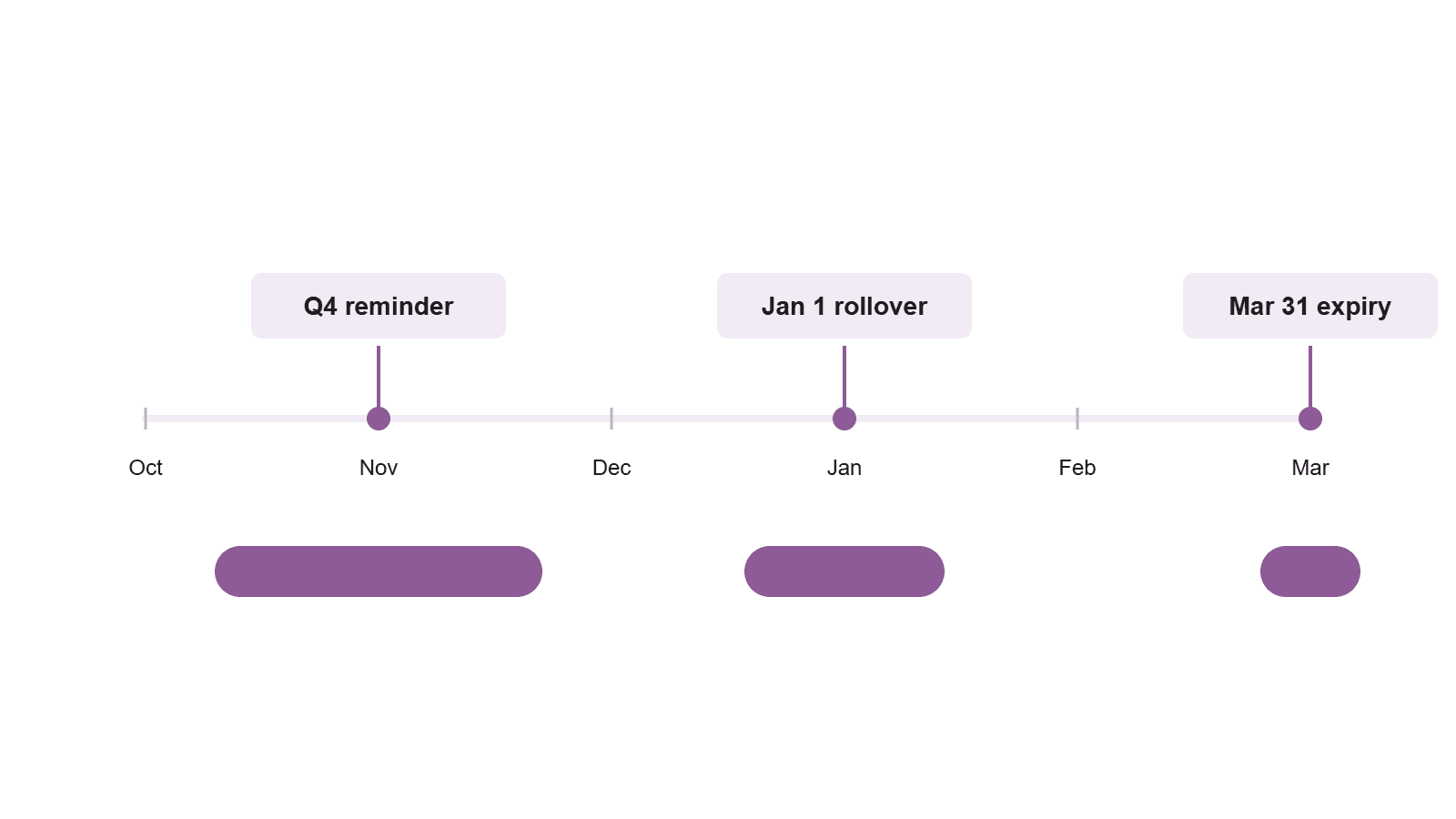
Capped carry-over is the most common middle ground: a fixed number of days rolls over, and carried days expire on a use-by date such as March 31. The cap keeps the liability bounded; the use-by date concentrates usage early in the year rather than stacking two full allowances.
The failure mode is silent expiry. Days that vanish without warning destroy more trust than any strict rule, so the reminder process matters as much as the rule itself: tell each person in Q4 how many days they have left and exactly when carried days expire.
Carry-over and payout are different questions
Carry-over governs what happens at year end while employment continues. Payout governs what happens when employment ends, and in payout states, accrued unused PTO must be paid out at termination regardless of the carry-over model.
The two interact through the balance: generous carry-over means larger balances, which means larger payout liability. That is a big part of why finance teams care about caps, and why the PTO payout calculator is worth running before you settle on a model.
US employers have a third question sitting next to these two: whether accrued PTO is substituted during FMLA leave. Substitution draws the balance down while the employee is on protected leave, so it changes what is left to carry over at year end and whether a cap is ever reached. The rules for requiring or allowing it are in our guide to FMLA and PTO.
How other countries handle it: the German example
Statutory systems flip the default. In Germany, statutory leave must generally be taken in the calendar year; carry-over into the next year is the exception (allowed for operational or personal reasons) and carried days must be used by March 31. Courts have added a twist: statutory leave only expires if the employer explicitly warned the employee in time: no warning, no expiry.
If you operate in both worlds, keep the statutory layer and the company layer separate: statutory minimums follow the legal rules per country, and the company's additional days follow the policy. The German version of this article covers the BUrlG rules in detail.
Designing a carry-over rule that holds up
A dispute-proof carry-over rule has four ingredients:
- A written rule: how many days roll over, and when carried days expire.
- A compliant fallback where forfeiture is banned, usually an accrual cap.
- Automatic reminders before year end and before the use-by date.
- System-enforced expiry and rollover instead of a year-end spreadsheet.
US state rules on forfeiture and payout vary and change over time; confirm state-specific rules with the relevant labor agency before acting on them. German statutory rules: § 7 BUrlG plus ECJ/BAG case law on the employer's duty to warn. This article explains common US practice at a general level and is not legal advice; state laws and company policies differ, so confirm specifics for your state.
Frequently asked questions
- What does PTO carry-over (rollover) mean?
- Moving unused paid time off into the next year instead of forfeiting it. Policies typically allow full carry-over, a capped number of days, or none at all.
- What does carry forward mean in PTO?
- The same thing as carry-over or rollover: unused leave that moves into the next leave year instead of expiring. Carry forward is the usual term in UK policies and in HR systems, where the "carry forward balance" is the number of days brought over from the previous year, shown separately from the current year's allowance because it often has its own expiry date.
- Is use-it-or-lose-it PTO legal?
- Not everywhere. States that treat accrued PTO as earned wages, like California, Montana, Nebraska, and Colorado, prohibit forfeiture; an accrual cap is the usual compliant alternative. Confirm your state's current rule before writing it into policy.
- How many PTO days typically carry over?
- A common pattern is up to 5 carried days with a use-by date such as March 31. Full carry-over and zero carry-over both exist, depending on state law and company priorities.
- What is the difference between a carry-over cap and an accrual cap?
- A carry-over cap limits how many earned days move into the next year. An accrual cap stops new days from being earned once the balance hits a ceiling: nothing earned is ever taken away.
- Does carried-over PTO get paid out at termination?
- In payout states, accrued unused PTO, including carried days, is generally paid out when employment ends. Elsewhere it depends on the written policy.
About the author
Blasko Sarcevic
Founder, Time-Out Zone
Connect on LinkedIn Connect on LinkedIn
Blasko writes about leave management, policy design, and running time-off operations at scale.
Related
Automate carry-over and expiry
Time-Out Zone rolls balances by your rules, applies caps and use-by dates automatically, and reminds employees before anything expires.