How to Track Intermittent FMLA Hours (With a Free Spreadsheet Template)

Jovana Avramovic
Published
Continuous FMLA leave is one entry with a start and an end. Intermittent leave is forty entries of four hours each, spread across a year, checked against a doctor's estimate and a rolling 12-month window. What the regulations require you to record, how to turn 12 weeks into hours, how the rolling sum works in a spreadsheet, and a free workbook that does it, column by column.
Topic

Topic: forty small absences, one running total.
How do you track intermittent FMLA leave?
Track intermittent FMLA leave in hours, one entry per absence, against an entitlement expressed in hours. The entitlement is 12 workweeks at the employee's normal schedule, so 480 hours for a 40-hour week and 384 for a 32-hour week, and each absence is counted in the smallest increment the employer uses for other leave, never more than one hour. For every absence record the date, the hours missed from the schedule, the type (intermittent, reduced schedule or continuous), a reason code that does not name a diagnosis, and the date the employee gave notice. Then compute what is left under the employer's 12-month method: rolling, subtract the hours used in the 12 months ending on each date, so every hour comes back 12 months after it was taken; fixed leave year, subtract the hours used since the year began. Check the pattern against the frequency and duration on the certification, keep medical documents in a separate confidential file, and keep the log for three years. Source: 29 CFR 825.200, 825.205, 825.500.
What exactly do you have to record?
The recordkeeping regulation is short and specific. For each employee who takes FMLA leave the employer must keep the dates the leave was taken and, where leave is taken in increments of less than a full day, the hours of the leave, identified as FMLA leave in the payroll or leave record. Alongside the dates and hours go copies of the notices the employer gave and any written notices it received from the employee, the documents describing the employer's leave policies and benefit arrangements, records of premium payments during leave, and any record of a dispute about whether leave was FMLA leave. The medical certification and anything else that reveals a health condition goes in a separate confidential medical file, not the personnel file, with access limited to the people who administer the leave.
For intermittent leave that translates into a log with one row per absence. The minimum that will let you answer the questions that get asked later is the date, the hours, the type of leave, a reason code that identifies the certified condition without describing it, and the date the employee gave notice, which is what you will need if a late call-in is ever in dispute. Add a column for the certification the absence falls under, because an employee can have two certified conditions at once and the frequency check is per certification. What does not belong in the log is the diagnosis, the symptoms, or anything the doctor wrote: the log is an hours ledger, and it is going to be seen by more people than the medical file ever should.
How do you convert 12 weeks into hours?
The FMLA entitlement is 12 workweeks, and a workweek is however many hours the employee would normally have worked. For an employee on a fixed 40-hour schedule that is 480 hours; for a 32-hour schedule, 384; for a 4-by-10 schedule, still 480 but spread over four longer days, which matters when a single absence is a 10-hour day. Where the schedule varies so that the weekly hours cannot be determined, the regulation uses a weekly average of the hours scheduled over the 12 months before the leave began, including any hours of leave taken in that period. A part-time employee whose hours vary between 20 and 30 a week over the year has an entitlement of 12 times that average.
Absences are counted in the smallest increment of time the employer uses to account for other forms of leave, and the increment may never be larger than one hour. An employer that lets employees take vacation in 15-minute blocks must count FMLA leave in 15-minute blocks; an employer that accounts in half-hours counts in half-hours; an employer whose smallest increment is a half-day must still count FMLA leave in increments of one hour or less. Only time the employee would actually have worked is counted, so an absence on a scheduled day off, a holiday the employee was not going to work, or a shift that was canceled for everyone is not FMLA leave and does not go in the log. The one exception is physical impossibility: where it is physically impossible for an employee to start or end work mid-shift, as with a flight attendant or a train crew member, the whole period they are forced to be absent may be counted.
The arithmetic is simple; the discipline is in the data. An employee who leaves two hours early for an infusion appointment has taken two hours of FMLA leave, whether or not the payroll system rounds that to a half-day of PTO for pay purposes. The pay increment and the FMLA increment can differ, and the FMLA log records the FMLA increment.
How does the rolling 12-month window change the arithmetic?
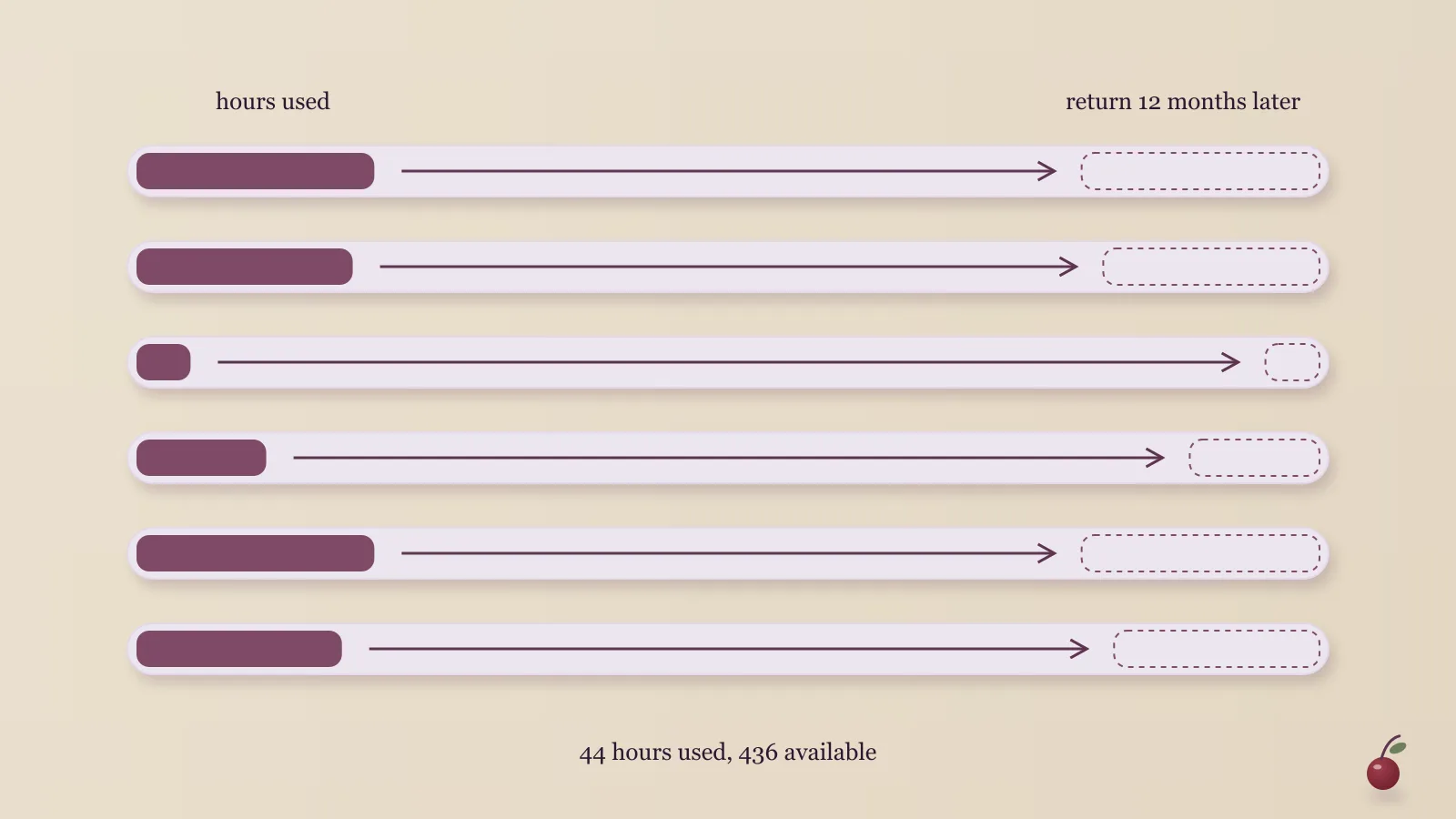
Under a calendar year or fixed leave year the balance is a running subtraction: entitlement minus every hour logged since the period began, reset on the period start. Under the rolling backward method, which most employers with intermittent leave choose because it prevents stacking, the balance on any date is the entitlement minus the hours logged in the 12 months ending on that date. Each hour drops out of the total exactly 12 months after it was taken, so an eight-hour absence on March 9, 2026 is back in the employee's balance on March 9, 2027. There is no reset day; there is a window that slides forward one day at a time.
In a spreadsheet this is a conditional sum. For each row, add up the hours in every row whose date falls after the same date one year earlier and on or before this row's date, and subtract from the entitlement. Excel, Google Sheets and Numbers all do it with SUMIFS and a date arithmetic function, and the template below has the formula written out so nobody has to derive it. The answer the employee will actually want, how many hours they have today and when the next hours come back, is the same sum evaluated as of today plus the date 12 months after the oldest absence still inside the window. The guide on when FMLA resets walks through all four methods with one employee's dates if the mechanics are new.
How do you check absences against the certification?
A certification for intermittent leave gives an estimate of frequency and duration: episodes two times a month lasting one to two days each, or one appointment every three weeks for half a day. The log lets you compare what is happening to what was certified, and the regulations attach consequences to a mismatch in both directions. If absences stay within the certified pattern, the employer generally cannot ask for a new certification more often than every 30 days, and if the certification states a longer minimum duration, not until that duration has passed, with an outer limit of once every six months in connection with an absence. If the pattern changes significantly, for example the employee is absent four times a month against a certification of two, or the absences fall on a suspiciously regular schedule of Mondays and Fridays, the employer may request recertification early and may give the health care provider the record of absences and ask whether the pattern is consistent with the condition.
The check is a comparison, not a verdict. An employee whose condition has worsened will exceed the certified frequency for a legitimate reason, and the right response is a recertification that reflects the new pattern, not discipline. What the log gives you is the evidence to ask the question at the right moment, and the record that you asked it the same way for everyone. Counting the absence days in the current month and comparing them to the certified frequency times the certified duration is a coarse test, but it catches the cases that need a human to look.
What is in the spreadsheet template?
The workbook has three sheets and no macros, so it opens in Excel, Google Sheets, Numbers and LibreOffice. The Setup sheet holds one employee and one leave reason: name or ID, a reason code with no diagnosis, the certification date and its expiry or recertification date, the certified frequency and duration, the normal weekly hours and hours per day, the 12-month method (ROLLING or FIXED) and, for a fixed leave year, its start date. From those it computes the entitlement in hours, the window start for the as-of date, the hours used in the window, the hours available, the same figure in weeks, the date the next hours return under the rolling method, and two checks: whether this month's absence days exceed the certified pattern, and whether recertification is due.
The Log sheet is the ledger: one row per absence with the date, hours missed, type, reason code and the date notice was given. Three calculated columns follow each row: the hours used in the 12 months ending on that day, the hours available after the absence, and the date the hours from that absence return. The Notices sheet carries the paperwork clock for the case: the date the employer learned of the need for leave and the five business day deadline for the eligibility and rights notices, the certification request date and the 15-day return deadline, the cure notice and its seven days, the complete certification and the five business day designation deadline, and the recertification date carried over from Setup. The six sample rows in the Log are the worked example below; delete them and start typing.
Two limits are deliberate. The workbook tracks one employee and one leave reason, because that is the unit the law counts, and combining employees in one sheet is how the wrong person's hours end up on the wrong line. And it holds hours and dates only. The certification itself, the doctor's estimate in words, and any medical detail stay in the confidential file the regulations require; the tracker refers to them by date.
| Sheet and column | What goes in | What it calculates |
|---|---|---|
| Setup, rows 4 to 9 | Employee, reason code, certification date, recertification date, certified frequency and duration | Recertification check; certified maximum absence days per month |
| Setup, rows 11 to 16 | Weekly hours, hours per day, method (ROLLING or FIXED), fixed leave year start, optional as-of date | Entitlement in hours (weekly hours x 12); window start for the as-of date |
| Setup, rows 19 to 28 | Nothing to enter | Hours used in the window, hours and weeks available, next return date, this month's absence days against the certified pattern |
| Log, columns A to E | Date, hours missed, type (I, R, C), reason code, date notice was given | Nothing to enter |
| Log, columns F to H | Nothing to enter | Hours used in the 12 months ending on that date, hours available after the absence, date those hours return |
| Notices, column B | Date the employer learned of the leave, certification request, cure notice, complete certification, designation sent | Five business day and 15 and 7 calendar day deadlines |
A worked example: Jordan's first quarter
Jordan works 40 hours a week on 8-hour days, so the entitlement is 480 hours, and the employer uses the rolling backward method. A certification dated January 12, 2026 covers a chronic migraine condition with an estimated frequency of two episodes a month lasting one to two days each, and it runs for a year, so recertification falls due on January 12, 2027. The first episode takes January 14 and 15, two full days and 16 hours. On February 3 Jordan leaves at noon, four hours. February 19 is a full day. March 9 and 10 are two more full days. Six rows, 44 hours.
After the March 10 absence the Log shows 44 hours used in the 12 months ending that day and 436 hours available. The return column shows when each block comes back: the 16 hours from January 14 and 15 on January 14 and 15, 2027, the four hours from February 3 on February 3, 2027, and so on, which is what Jordan will ask about if the condition flares next winter. The Setup sheet, with the as-of date left blank so it uses today, shows the same 436 hours, or 10.9 weeks at the normal schedule, and the next return date of January 14, 2027. The pattern check compares this month's absence days to the certified maximum of four (two episodes times two days): January had two days, February two, March two so far, all within the pattern. If Jordan were out on March 24, 25 and 31 as well, March would show five days against a maximum of four, and the check would say so. That is the moment to look at the certification and, if the change is real, to ask for recertification rather than to reach for the attendance policy.
The Notices sheet on Jordan's case shows the employer learned of the need for leave on January 5, sent the eligibility and rights notices by January 12, requested certification on January 5 with a return deadline of January 20, received it complete on January 12, and owed the designation notice by January 19. Every date is on one page, and every number in the workbook traces back to a row someone typed.
When does a spreadsheet stop being enough?
A workbook per employee per reason works while the numbers stay small: a handful of open intermittent cases, one leave year method, fixed schedules. It stops working at predictable points. When several employees have open cases, the files multiply and nobody has a caseload view of who is close to exhaustion or overdue for recertification. When an employee has two certified conditions, or FMLA leave running concurrently with a state paid leave program that uses a different period and a different entitlement, the same absence has to be written to two ledgers with two balances. When schedules vary week to week, the entitlement itself needs recomputing from timekeeping data. When a reduced schedule leave runs for months, the daily entries become a second job.
The larger problem is evidentiary. A spreadsheet has no record of who changed a number or when, and no link between the hours and the notices, the certification and the designation that made them FMLA hours. The recordkeeping rule asks for dates and hours identified as FMLA leave; a claim asks for the story behind them. A leave management system holds the case, the absences, the notices and the deadlines together, computes the rolling balance for every employee on every day, and keeps the medical file behind a permission boundary. The template is the right tool until it is not, and the point at which it is not is usually the second employee with intermittent leave.
Where does the file live, and who can open it?
The tracker holds no medical information, but it holds the fact that an employee is on medical leave and the pattern of their absences, which is sensitive in its own right. Keep it in a location with restricted access, name it by employee ID rather than name if the file system is shared, and keep the certification, the doctor's notes and any correspondence with the provider in the separate confidential medical file the regulations require. Managers need to know that an absence is approved leave and how much is left; they do not need the log, and they must not see the certification. Retain the tracker for three years after the leave year it covers, the same period as the rest of the FMLA records.
Statutory references: 29 CFR 825.200(b) to (c) (12-month period methods, rolling backward), 825.202 (intermittent and reduced schedule leave), 825.203 (scheduling planned treatment), 825.204 (temporary transfer to an alternative position), 825.205(a) (increments of leave, one hour maximum, physical impossibility), 825.205(b) (calculating the entitlement for intermittent leave, variable schedules and the 12-month weekly average), 825.303(b) (content of notice for a previously certified condition), 825.305 to 825.306 (certification content including frequency and duration), 825.308 (recertification timing and the changed-circumstances exception, absence pattern provided to the provider), 825.500(c) (dates and hours of FMLA leave in the payroll record), 825.500(g) (confidential medical records). The downloadable workbook implements the rolling and fixed period arithmetic described in 825.200 and is provided as a starting point, not as legal advice on any individual case. Checked September 2026. This article explains US federal and state leave law at a general level and is not legal advice. State program rules, benefit rates and caps change, usually each January, so confirm the current figures with the agency that runs the program or with qualified counsel.
Frequently asked questions
- Can we require intermittent FMLA leave to be taken in full-day increments?
- No. FMLA leave must be counted in the smallest increment the employer uses for other forms of leave, and never more than one hour, so a two-hour absence is two hours of FMLA leave. The only exception is physical impossibility, where the nature of the job makes it impossible to start or end mid-shift. Your paid leave policy may pay in larger increments, but the FMLA log records the actual hours.
- Can we ask employees to schedule intermittent leave around work?
- For planned medical treatment, yes: the employee must make a reasonable effort to schedule it so as not to unduly disrupt operations, subject to the health care provider's approval, and you may ask about the timing. For unforeseeable episodes, such as a migraine or a flare-up, no; the employee must follow your usual call-in procedure and give notice as soon as practicable, and that is all the law allows you to require.
- Can we move an employee on intermittent leave to a different position?
- Only for foreseeable intermittent or reduced schedule leave for planned treatment, and only temporarily to an alternative position that has equivalent pay and benefits and better accommodates the recurring absences. The transfer cannot be used to discourage the leave, and the employee must be returned to the original position when the leave ends. Unforeseeable intermittent leave for a chronic condition does not support a transfer.
- How often can we request recertification?
- Generally not more often than every 30 days, and only in connection with an absence. If the certification states a minimum duration longer than 30 days, not until that period has passed, except that you may always request recertification every six months in connection with an absence. You may ask earlier if the employee asks for an extension, if the circumstances described in the certification have changed significantly, such as the frequency or duration of absences, or if you receive information that casts doubt on the stated reason for an absence.
- Does the employee have to say FMLA every time they call in?
- No, but they must give enough for you to connect the absence to the approved leave. For a condition that has already been certified and designated, the employee must reference either the qualifying reason or the earlier FMLA leave: out with my back again is enough, out sick is not. You may require employees to follow your normal call-in procedure and to say that the absence is for the FMLA condition, and you may ask for clarification if a call is unclear.
- Can we discipline an employee for absences that exceed the certification?
- Not on the basis of the log alone. Absences beyond the certified frequency are a reason to request recertification and, where the provider does not support them, a reason to treat those specific absences as non-FMLA under your attendance policy. Until that process has run, treating an exceeding absence as unexcused invites an interference claim. The log gives you the pattern; the certification process decides what the pattern means.
About the author
Jovana Avramovic
Product Excellence, Time-Out Zone
Jovana writes hands-on guides to time-off workflows, calendar tooling, and the rules behind vacation, sick leave, and payouts.
Related
The tracker, or the thing that replaces it
The workbook covers one employee and one reason. Time-Out Zone keeps every case on one caseload view with the rolling balance for each employee on each day, the notices and deadlines on the same timeline, and the medical file behind its own permission.