Bereavement Leave: What It Is, Typical Days, and Who Pays

Blasko Sarcevic
Published · Updated
What bereavement leave covers, how many days companies typically grant, whether it is paid, which states have their own laws, and how to write a policy that holds up on the worst day.
Topic

Topic: time off after a death in the family.
What is bereavement leave?
Bereavement leave is time off from work after the death of a family member or another close person, used for grieving, funeral arrangements, and estate matters. There is no federal law in the US requiring it: the Fair Labor Standards Act does not mandate bereavement leave, so at the national level it is a voluntary benefit defined by company policy. In practice most US employers do offer it, typically three to five paid days for an immediate family member such as a spouse, child, parent, or sibling, and one to three days for extended family such as grandparents or in-laws. A small but growing group of states has gone further: Oregon, Illinois, California, Washington, Colorado, Minnesota, and Maryland require covered employers to provide or allow bereavement leave in defined situations, with details that differ by state. If travel is required or the loss is especially close, many policies allow extending the leave with vacation days or unpaid time.
Is bereavement leave paid?
Where bereavement leave exists as a company benefit, it is usually paid: the standard offer is a fixed number of paid days per loss, separate from the vacation balance. Because no federal law applies, the policy decides everything: how many days, for which relationships, and whether pay continues.
The state laws differ on this point. Illinois requires up to two weeks of bereavement leave for covered losses but allows it to be unpaid; California requires five days, which may be unpaid beyond what existing paid leave covers; Oregon includes bereavement leave within the Oregon Family Leave Act, up to two weeks per death, unpaid unless a policy pays it. Where a state law and a company policy overlap, the employee gets the stronger protection.
How many days is standard?
Most US policies scale the days to the closeness of the relationship. The common pattern:
| Relationship | Typical paid days |
|---|---|
| Spouse or domestic partner, child | 5 days |
| Parent, sibling | 3-5 days |
| Grandparent, grandchild, in-law | 1-3 days |
| Extended family or close friend | 0-1 day, often discretionary |
Which deaths are covered: defining 'family'
The hardest policy question is not the number of days but the definition of family. Immediate family almost always includes spouse, child, parent, and sibling. Modern policies extend the definition to domestic partners, stepfamily, foster and chosen family, and pregnancy loss; several state laws, including Illinois and California, explicitly cover reproductive loss events such as miscarriage and failed adoption.
A practical approach is a two-tier definition: a generous fixed grant for a defined immediate-family list, plus a discretionary tier the manager can approve for relationships the list cannot anticipate. That keeps the common case automatic and the edge case humane.
State bereavement leave laws
Seven states currently require covered employers to provide bereavement leave or to let existing paid leave be used for it, each with its own scope:
- Oregon: up to 2 weeks per death within its family leave act, for employers with 25+ employees.
- Illinois: up to 10 workdays, unpaid, including reproductive loss events (Family Bereavement Leave Act).
- California: 5 days for employers with 5+ employees; may be unpaid beyond available paid leave. A separate provision covers reproductive loss.
- Washington: seven days of paid family leave under the state paid family and medical leave program for the death of a child within the first year after birth or placement.
- Colorado and Minnesota: earned paid sick leave may be used for bereavement (funeral or memorial, and the financial or legal matters that follow a death) under each state's paid sick leave law.
- Maryland: employers with 15 or more employees that offer paid leave must let employees use it for the death of an immediate family member (Flexible Leave Act).
- Statutes behind this list: Oregon Family Leave Act (ORS chapter 659A), Illinois Family Bereavement Leave Act (820 ILCS 154), California Government Code section 12945.7, Washington RCW title 50A, Colorado Healthy Families and Workplaces Act, Minnesota Earned Sick and Safe Time, Maryland Labor and Employment section 3-802. Thresholds checked September 2026.
Requesting and approving bereavement leave
Bereavement is the one leave type where process friction does real damage. The request usually arrives with no notice, from someone in shock. Policies should keep proof requirements minimal: most companies ask for nothing, some ask for an obituary or death certificate only for extended leaves.
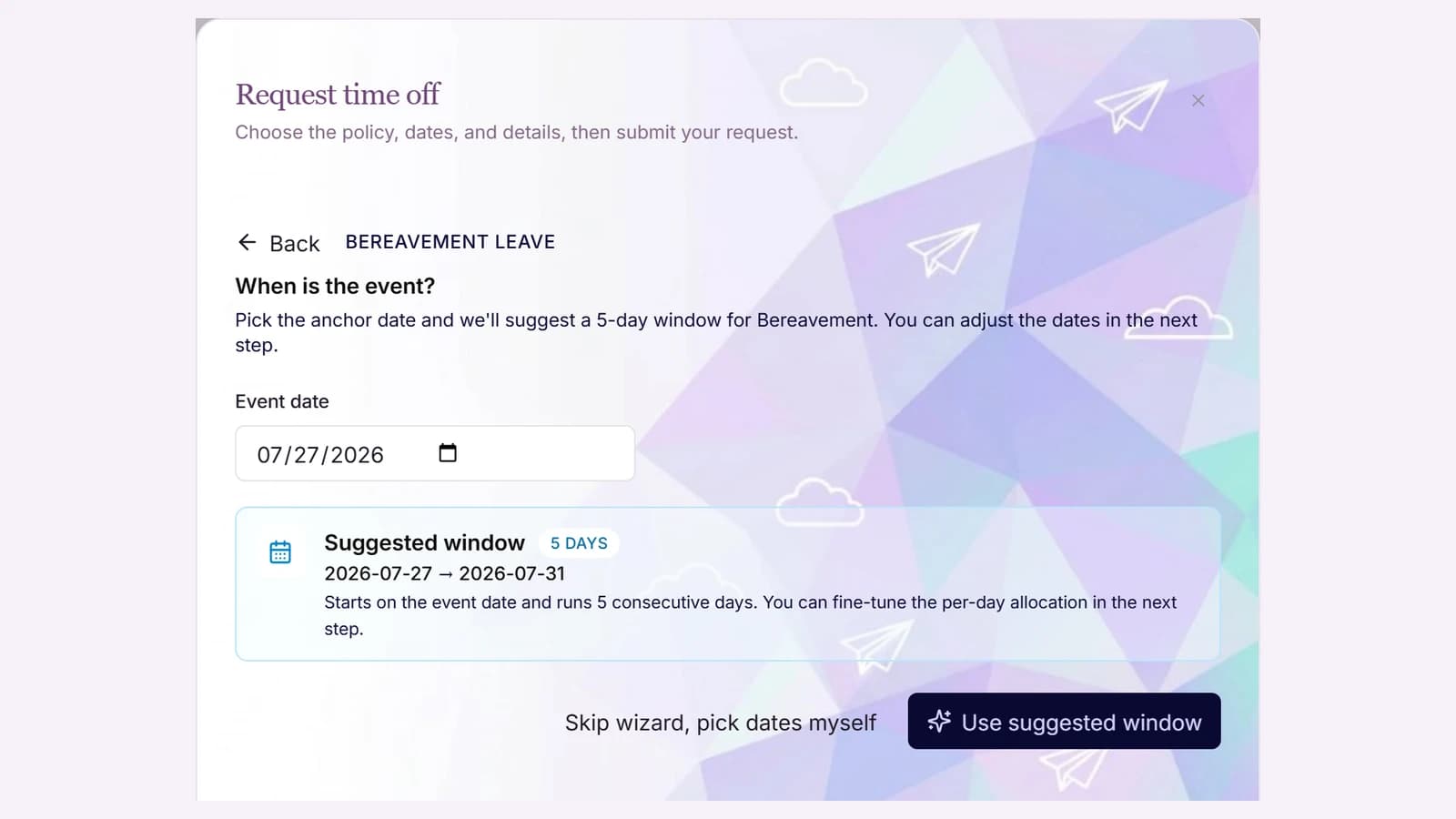
On the system side, the clean setup is a dedicated leave type that does not touch the PTO balance, with auto-approval or a single fast approver. Employees should be able to submit dates after the fact, because nobody plans a funeral around a request form.
Extending the leave when days are not enough
Three to five days is enough for a funeral, rarely for grief. Good policies name the extension paths explicitly: adding vacation days, taking unpaid leave, or moving to a formal leave of absence for a longer period. If the loss triggers a serious mental health condition, FMLA leave may apply for eligible employees, since grief-related conditions treated by a provider can qualify as a serious health condition; the FMLA for mental health guide covers how that is certified. Where nothing protected applies, the personal leave of absence guide covers the terms an unprotected extension runs on, and the how to request a leave of absence guide has the letter.
Managers should also know what they can offer informally: a phased return, remote days, or a lighter load in the first weeks cost little and are remembered for years.
Editorial explainer. State-law summaries reference the Oregon Family Leave Act, the Illinois Family Bereavement Leave Act, California AB 1949 (Government Code section 12945.7), Washington's paid family and medical leave statute, the Colorado and Minnesota paid sick leave laws, and Maryland's Flexible Leave Act; scope and employer thresholds checked September 2026. This article explains common US practice at a general level and is not legal advice; state laws and company policies differ, so confirm specifics for your state.
Frequently asked questions
- What is bereavement leave?
- Time off after the death of a family member or close person, used for grieving and funeral arrangements. In the US it is mostly a company benefit; a handful of states require it.
- Is bereavement leave paid?
- Usually yes when offered as a company benefit, typically three to five paid days for immediate family. State laws vary: some mandate the leave but allow it to be unpaid.
- How many days do you get for bereavement?
- Three to five paid days for an immediate family member is the US standard, with one to three days for extended family. State laws can require more, up to two weeks in Oregon and Illinois.
- Is bereavement leave required by law?
- Not federally. Oregon, Illinois, California, Washington, Colorado, Minnesota, and Maryland have state requirements for covered employers; everywhere else it is policy-defined.
- Who counts as immediate family for bereavement?
- Almost always spouse or partner, child, parent, and sibling. Many policies and several state laws extend to stepfamily, in-laws, grandparents, domestic partners, and reproductive loss.
- Can bereavement leave be denied?
- Where no state law applies, an employer can apply its policy limits. Within the seven states with bereavement provisions, covered employees have an enforceable right for qualifying losses.
About the author
Blasko Sarcevic
Founder, Time-Out Zone
Connect on LinkedIn Connect on LinkedIn
Blasko writes about leave management, policy design, and running time-off operations at scale.
Related
Bereavement leave without the paperwork
Time-Out Zone runs bereavement as its own leave type: fixed day grants per relationship tier, fast approval, and no impact on the PTO balance.