Personal Leave of Absence: What It Is, What It Protects, and How to Write the Policy (2026)

Jovana Avramovic
Published
A personal leave of absence is the leave that is left when no law requires one: time away that the employer grants because it chooses to, for a reason the FMLA, the ADA, USERRA and the state statutes do not reach. It is almost always unpaid, its job protection is whatever the policy promises, and it is the category most often misused, in both directions. What a personal leave is and is not, when it is the right label and when it is a legal mistake, what happens to pay, benefits, accrual and seniority, and the eight decisions a policy has to make.
Topic

Topic: leave the law does not require.
What is a personal leave of absence?
A personal leave of absence is an extended, usually unpaid period away from work that an employer grants at its discretion under its own policy, for a reason no federal or state leave law covers. Typical reasons are extended travel, education, relocation, caring for a relative the FMLA does not recognize, a non-medical family situation, or time out after a long stretch of work. Because no statute requires it, nothing in the law guarantees the job at the end: the policy decides whether the same position is held, a comparable one is offered, or the employee is rehired only if a vacancy exists. Health coverage depends on the plan and the policy; if it ends, COBRA is usually offered. PTO does not accrue unless the policy says so, and seniority may or may not run. The one hard rule is that a personal leave may not replace a protected leave: if the reason qualifies under the FMLA, the ADA, USERRA, a state family leave act or a state paid leave program, the employer must designate the protected leave, whatever the employee called it.
What a personal leave of absence is, and what it is not
Leaves of absence in the United States divide by their source. Some are required by law and come with defined rights: the FMLA's 12 unpaid weeks with job restoration and continued health coverage, the ADA's leave as a reasonable accommodation, USERRA's five cumulative years for military service with reemployment rights, state family and medical leave acts, state paid family and medical leave programs, and a long list of narrow statutes for jury duty, voting, bone marrow and organ donation, school activities, crime victims and domestic violence. Everything outside that set is discretionary. A personal leave of absence is the discretionary category, and its defining feature is that the terms come from the employer's policy and the employer's decision, not from a statute. It is not a lesser form of FMLA leave, not a fallback the employee is entitled to when the FMLA runs out, and not a category an employer can put a protected absence into to avoid the protected leave's rules.
The confusion runs both ways. Employees ask for a personal leave when what they have is a serious health condition, because they do not know the FMLA applies or because they would rather not disclose a medical reason, and employers grant it as personal leave without asking the question that would trigger the FMLA notices. That is a mistake for the employer, because the FMLA obligation to designate leave arises when the employer has enough information to know the leave may be qualifying, and an employee who was never told the FMLA applied and loses their job at the end of a personal leave has a claim. In the other direction, employees assume a personal leave is protected the way FMLA leave is and are surprised to learn that the position was filled. Both problems are solved by the same practice: the personal leave request form asks, in plain words, whether the leave is for the employee's own health, a family member's health, a new child, or military service, and HR routes any yes into the right process before anything is called personal.
What is left, once the protected reasons are removed, is a real and useful category. Extended travel. A degree program or a professional certification. Moving a household across the country. Caring for a sibling, a grandparent, an aunt, a friend, when the state has no program that covers them. A partner's relocation for a year. A family crisis that is not medical, a divorce, a house that has burned down. Recovery from a period of overwork that no clinician is treating. The employee who has used all 12 FMLA weeks and needs a few more. None of these has a statute behind it, all of them happen, and a policy that handles them consistently is better for both sides than a series of individual deals.
Is a personal leave of absence paid?
Almost never, by design. The policy usually requires or allows the employee to use accrued PTO or vacation first, so the first days or weeks may be paid from the balance, and the remainder is unpaid. A minority of employers pay a portion of salary during personal leave for long-tenured employees, and a few offer paid sabbaticals after a set number of years, which are a distinct benefit with their own rules and covered in the sabbatical guide on this site. Disability insurance does not apply, because the employee is not medically unable to work; state paid leave programs do not apply, because the reason is not a covered one; unemployment insurance does not apply, because the employee has not lost the job. For a personal leave, the plan for pay is the employee's savings and the PTO balance.
Two consequences follow for the employee. First, a personal leave is a decision to forgo income for a period, and it should be sized to what the employee can afford rather than to what the policy allows. Second, the PTO question needs an answer before the leave starts: whether the employer requires the balance to be exhausted, whether the employee may keep some for after the return, and whether unused PTO is paid out if the employee does not come back, which in the states that treat accrued vacation as wages, California among them, it must be.
Is your job protected during a personal leave?
Only to the extent the policy says. There is no federal right to reinstatement after a discretionary leave, and the range of what policies promise is wide. The strongest promise is a guaranteed return to the same position with the same pay and benefits, which employers tend to make only for short personal leaves, up to 30 days, where the work can be covered. The middle position, and the most common, is a commitment to return the employee to the same or a comparable position if one is available at the end of the leave, with the employee otherwise treated as laid off or as a priority rehire for a defined period. The weakest is an explicit statement that the leave is unprotected and that the employer may fill the position, in which case the employee's return is a rehire on whatever terms then apply.
The honest version of any of these is the one written down before the leave starts. An employee deciding whether to take four months off to complete a degree needs to know which promise they are getting, and a manager approving the leave needs to know what the company has committed to, because the manager is the one who will be asked to hold the position open or to fill it. A written approval that states the return date, the position the employee will return to or the standard that will be applied, the pay and benefit terms during the leave, and what happens if the employee does not return on the date, is the single document that prevents most disputes. The letter template in the guide on requesting a leave of absence has an employer's acknowledgment for exactly this purpose.
One protection does exist even for an unprotected leave, and it comes from discrimination law rather than leave law. An employer that grants personal leaves inconsistently, approving a man's three months for travel and denying a woman's three months for the same reason, or approving leaves for younger employees and refusing them for older ones, is exposed under Title VII and the ADEA regardless of what the policy says about protection. Consistency is not only a fairness principle; it is the legal defense for a discretionary decision. Employers that want genuine discretion should exercise it against written criteria, such as tenure, business need, coverage and the employee's record, and document the reasoning each time.
What happens to benefits, accrual, and seniority?
Health coverage is the first question because it has a statutory backstop. Nothing requires an employer to continue group health coverage during a personal leave, but the plan document and the policy decide what happens, and there are three common approaches: coverage continues for a defined period, often 30 to 90 days, with the employee paying their normal share; coverage continues for the whole leave with the employee paying the full premium; or coverage ends at the start of the leave. If coverage ends because of the reduction in hours, that is a COBRA qualifying event for employers with 20 or more employees, and the employee must be offered continuation at up to 102 percent of the full premium for 18 months. Several states have mini-COBRA laws for smaller employers. Whatever the approach, the policy should state it and the approval letter should repeat it, because an employee who discovers in month two that their coverage lapsed in week one has a problem that the leave was supposed to prevent.
PTO accrual generally stops during unpaid personal leave, because most accrual formulas run on hours paid or on active service, and the policy should say so explicitly. Seniority is a design choice: some employers keep the original hire date and count the leave as continuous service for tenure-based benefits, some pause it, and some treat leaves over a certain length as a break in service. Retirement plan vesting and eligibility follow the plan document; a leave that includes no paid hours will usually not count as a year of service for vesting. Bonuses and stock vesting are usually prorated or paused under the plan's own terms. Life and disability insurance often terminate or require conversion after a set period on unpaid leave, which matters if the employee is traveling. The policy does not have to be generous on any of these points, but it has to be clear, and it has to treat comparable employees the same way.
The FMLA sets one comparison point that reaches personal leave indirectly. FMLA leave may never be treated worse than other forms of unpaid leave: if PTO accrues during personal leave, it must accrue during FMLA leave; if seniority runs during personal leave, it must run during FMLA leave. Employers designing a personal leave policy more generous than their FMLA practice have, without meaning to, changed their FMLA practice. The two policies should be written together.
The reasons that look personal but have their own statute
A group of absences are routinely filed under personal leave that are in fact protected by narrow laws, and misfiling them removes rights the employee has. Jury duty is protected in every state and under federal law for federal juries, with several states requiring pay for the first days. Voting leave exists in about 30 states, usually a few paid hours if the polls are not open outside working time. Military service, including training, is protected by USERRA for up to five cumulative years with reemployment rights, and state laws extend it to state guard duty. Bone marrow and organ donation are paid leave in a growing number of states, up to 30 days for organ donation in California. Crime victims and witnesses have leave rights in most states to attend proceedings. Domestic violence, sexual assault and stalking leave exists in more than a dozen states and covers court, medical, counseling and relocation time.
Then there are the family reasons that state law protects where the FMLA does not. School activities leave, up to 40 hours a year in California for employers with 25 or more employees and similar in a handful of states, covers attending a child's school events. Bereavement leave is required in Oregon, Illinois, California, Maryland and Washington, in different forms, and is the subject of its own guide here. Several states protect leave for a family member's military deployment. And the 14 jurisdictions with paid family and medical leave programs protect leave to care for siblings, grandparents, grandchildren and domestic partners that the FMLA leaves out. Each of these has its own notice rules, its own duration and its own pay position, and none of them should be granted as a personal leave, because the personal leave policy's discretion does not exist for them. A personal leave request form that lists these reasons is the cheapest compliance control an employer has.
The eight decisions a personal leave policy has to make
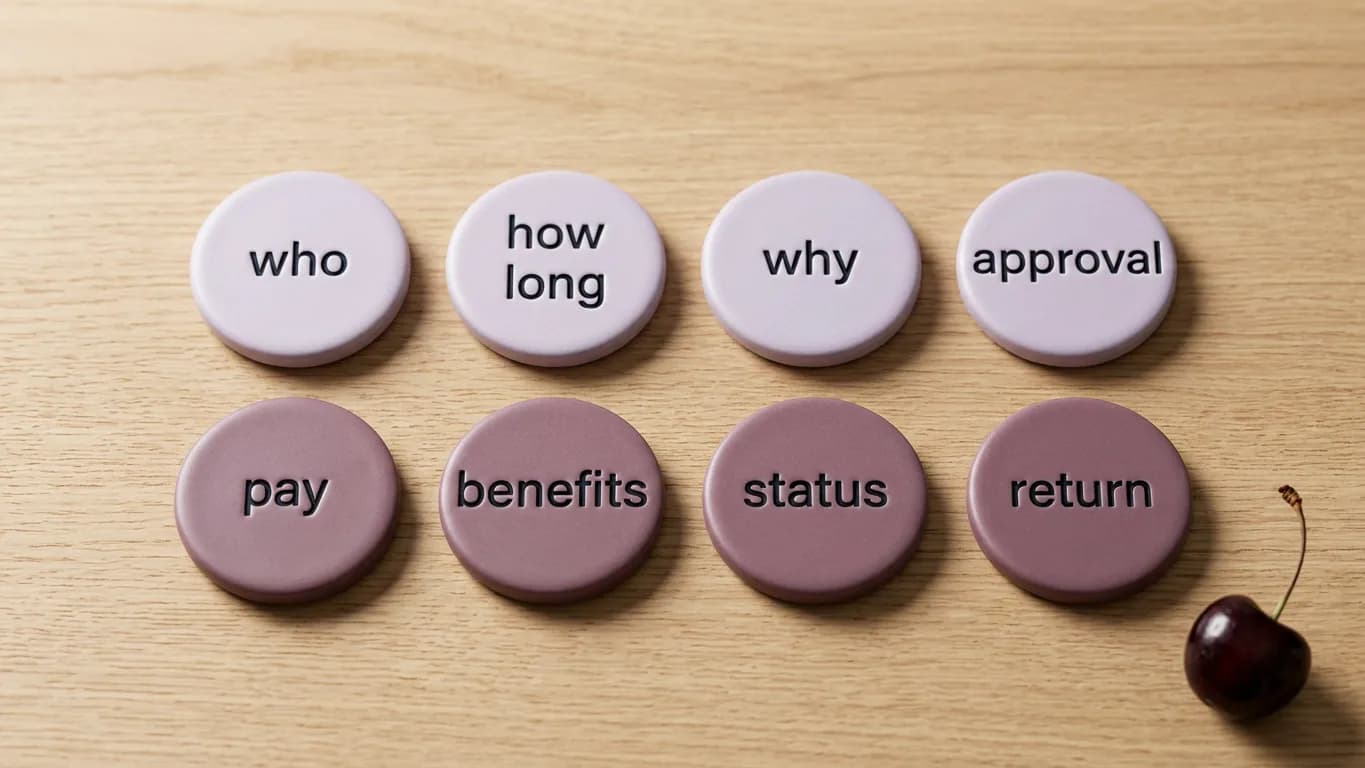
Writing the policy is mostly a matter of answering eight questions in advance, so that each request is a lookup rather than a negotiation. First, eligibility: who may request one, usually employees past a probationary period or with a year of service, and whether part-time employees are included. Second, duration: the minimum and maximum, with 30 days to six months being the common range, whether extensions are possible and who approves them, and whether there is a limit on how often an employee may take one, such as once in any two-year period. Third, reasons: whether the policy lists acceptable reasons, accepts any reason, or requires a business justification, and, in every case, the screening questions that route protected reasons elsewhere. Fourth, approval: who decides, typically the manager and HR together, what criteria they apply, and how long they have to answer.
Fifth, pay: unpaid, with the PTO rule stated, whether use of the balance is required, permitted or prohibited, and whether any portion is paid for long-tenured employees. Sixth, benefits: exactly what happens to health, dental, life and disability coverage, on what date, at whose cost, and the COBRA hand-off. Seventh, status during the leave: whether accrual and seniority run, whether the employee may work elsewhere, what contact is expected, and whether the employee may be recalled. Eighth, return: the promise, whether it is the same position, a comparable one, or a vacancy if available, the notice the employee must give of the return date, what happens if the employee does not return or asks for more time, and whether the leave counts as a break in service for anything.
Two more points belong in the policy without being decisions. The statement that the policy does not replace or limit any leave required by law, and that any absence that qualifies for a protected leave will be treated as one. And the statement that leaves are approved on a consistent basis using the criteria in the policy, which is both a commitment and the beginning of the discrimination defense.
Personal leave, FMLA, ADA and state paid leave, side by side
How the discretionary category compares with the three protected ones an employer most often has to distinguish it from.
| Personal leave of absence | FMLA leave | ADA accommodation leave | State paid family and medical leave | |
|---|---|---|---|---|
| Source | Employer policy | Federal statute | Federal statute | State statute (14 jurisdictions) |
| Who qualifies | Per policy, often 1 year of service | 12 months, 1,250 hours, 50 employees within 75 miles | Qualified employee with a disability; employers with 15 or more employees | Per program; usually wage-based, no tenure test |
| Reasons | Anything not otherwise protected | Own or family serious health condition, new child, military exigency | Employee's own disability | Own or family health, new child, military; wider family definition |
| Duration | Per policy, commonly 30 days to 6 months | 12 weeks in 12 months (26 for military caregiver) | As long as reasonable without undue hardship | 6 to 26 weeks depending on the program |
| Pay | Unpaid; PTO per policy | Unpaid; PTO may be required | Unpaid; PTO per policy | 50 to 90 percent of wages up to a cap |
| Job protection | Only what the policy promises | Same or equivalent position | Same position unless undue hardship | Reinstatement in most programs |
| Health coverage | Per policy; COBRA if it ends | Maintained on the same terms | Per policy, applied without discrimination | Maintained in most programs |
| Employer may decline | Yes, on consistent criteria | No, if eligible and qualifying | Only for undue hardship | No; the state decides the claim |
Two worked examples
Renata has been a project manager at a 90-person software company for five years and asks for three months off to finish a master's thesis. Nothing about the reason is protected. The policy allows personal leaves of up to 90 days for employees with more than two years' service, once every three years, unpaid, with PTO to be exhausted first, health coverage continued for the full leave at the employee's normal premium share, accrual and seniority paused, and a return to the same or a comparable position if available. Her manager confirms the project can be covered, HR checks the screening questions (no health, family or military reason), and the approval letter states her leave dates, that her 64 hours of PTO will pay the first eight working days, that her premium share will be deducted from those days and then invoiced monthly, that her hire date is preserved but her next tenure-based PTO step is delayed by 90 days, and that she must confirm her return date in writing two weeks before it. She returns to the same role. Nothing in this is required by law, and all of it is documented.
Tomas asks the same company for a personal leave because, in his words, he needs a break. The screening questions surface that he has been seeing a doctor for insomnia and that the doctor has suggested time off. HR stops the personal leave process and sends the FMLA notices instead, because the information is enough to suggest a serious health condition and the company has more than 50 employees. His physician certifies a chronic condition with a recommended four weeks of leave, the leave is designated as FMLA, his health coverage is maintained on the same terms by law rather than by policy, and his return to the same position is a legal right rather than a policy promise. Had HR approved a personal leave and filled his role, the company would have owed him FMLA reinstatement anyway, with the exposure that comes from not having told him. The difference between the two cases was one question on a form.
References: 29 CFR 825.209(h) and 825.215(d) (FMLA leave may not be treated less favorably than other unpaid leave for benefits, accrual and seniority); 29 CFR 825.300 to 825.301 (employer's duty to give notice and designate leave once it has information that leave may be FMLA-qualifying); 42 U.S.C. 12111 to 12112 and 29 CFR Part 1630 (ADA reasonable accommodation, including leave); 38 U.S.C. 4301 to 4335 (USERRA, five cumulative years, reemployment); 29 U.S.C. 1161 to 1168 (COBRA continuation for employers with 20 or more employees; reduction of hours as a qualifying event); Title VII of the Civil Rights Act of 1964, 42 U.S.C. 2000e-2, and the Age Discrimination in Employment Act, 29 U.S.C. 623 (consistent application of discretionary leave). Statutes protecting specific reasons: California Labor Code 230.8 (school activities, 40 hours a year, employers with 25 or more employees), 1510 (organ and bone marrow donation, up to 30 business days paid), 230 to 230.1 (crime victims and domestic violence), and Government Code 12945.7 (bereavement); Oregon Revised Statutes 659A.150 ff. (bereavement under the Oregon Family Leave Act); Illinois Family Bereavement Leave Act, 820 ILCS 154. Bureau of Labor Statistics, National Compensation Survey, Employee Benefits in the United States, March 2024 (access to unpaid and paid family leave, private industry). Checked September 2026. This article explains common US practice at a general level and is not legal advice; state laws and company policies differ, so confirm specifics for your state.
Frequently asked questions
- How long can a personal leave of absence be?
- As long as the employer's policy allows, since no law sets the length. Most policies range from 30 days to six months, with extensions at the employer's discretion and a limit on how often an employee can take one. Short leaves are more likely to come with a guaranteed return to the same position.
- Can my employer deny a personal leave of absence?
- Yes. Because no statute requires it, a personal leave is granted at the employer's discretion, usually on criteria such as business need, coverage, tenure and the employee's record. What the employer may not do is decide inconsistently on a basis that discrimination law prohibits, or deny as a personal leave an absence that qualifies for FMLA, ADA, USERRA or state-protected leave.
- Do I keep my health insurance during a personal leave?
- Only if the plan and the policy provide for it. Some employers continue coverage for a set period or for the whole leave with the employee paying part or all of the premium; others end it when the leave begins. If coverage ends, employers with 20 or more employees must offer COBRA continuation for up to 18 months at up to 102 percent of the premium, and many states have similar rules for smaller employers.
- Does PTO accrue during a personal leave of absence?
- Usually not, because most accrual formulas run on paid hours or active service and personal leave is unpaid. The policy should state it. Note that if PTO does accrue during personal leave, the FMLA requires it to accrue during FMLA leave as well, since FMLA leave may not be treated worse than other unpaid leave.
- Can I work another job during a personal leave?
- Only if the policy allows it. Many personal leave policies prohibit other employment during the leave, or require disclosure and approval, because the leave is granted for a stated purpose and because of conflict-of-interest and confidentiality concerns. Working elsewhere without permission is a common ground for treating the leave as a resignation.
- Is a personal leave the same as a sabbatical?
- No. A sabbatical is a benefit, usually paid or partly paid, earned after a set number of years and taken on a schedule the policy defines, often with a purpose such as study or rest. A personal leave is a discretionary, unpaid absence requested for a reason the law does not cover. Some employers offer both under separate policies.
- What should a personal leave approval letter include?
- The leave dates and the return date, the position or standard the employee returns to, how PTO will be used, what happens to health and other coverage and at whose cost, whether accrual and seniority run, any rules about other employment and contact, what the employee must do to confirm the return, and what happens if they do not return on the date. It should also confirm that the leave is not FMLA or other protected leave, and why.
About the author
Jovana Avramovic
Product Excellence, Time-Out Zone
Jovana writes hands-on guides to time-off workflows, calendar tooling, and the rules behind vacation, sick leave, and payouts.
Related
One policy, applied the same way every time
Time-Out Zone lets you define a personal leave type with its own eligibility, duration, approval chain and accrual rule, so every request follows the policy you wrote and every decision is on record.