Sabbatical Leave: What It Is, Pay, and Typical Policies

Blasko Sarcevic
Published · Updated
What a sabbatical is, whether it is paid, how long companies typically grant, who qualifies, and how to design a sabbatical policy that people actually return from.
Topic

Topic: the extended break that is not vacation.
What is sabbatical leave?
A sabbatical is an extended break from work, typically one to six months, granted after a longer period of service, most commonly five to seven years. Unlike vacation, a sabbatical is a one-off block of time meant for rest, study, travel, family, or a personal project, and the job is held for the employee's return. In the US there is no law requiring sabbaticals; they are a voluntary company benefit, so pay, length, and eligibility are whatever the policy says. Common models are fully paid sabbaticals of four to six weeks, partially paid programs at a percentage of salary, and unpaid sabbaticals where the employment relationship continues but salary pauses. Benefits treatment varies: many employers continue health coverage during a paid sabbatical, while unpaid programs often shift premium costs to the employee. The defining features are length, tenure-based eligibility, and a guaranteed return, which separate a sabbatical from ordinary PTO and from a leave of absence taken for a specific life event.
Sabbatical vs vacation vs leave of absence
The three terms get mixed up because all of them mean time away from work. The difference is in purpose and mechanics: vacation is a recurring entitlement used in small blocks, a leave of absence responds to a specific life event such as illness or caregiving, and a sabbatical is a long, planned, one-off break earned through tenure.
| Aspect | Sabbatical | Vacation / PTO | Leave of absence |
|---|---|---|---|
| Trigger | Tenure milestone (e.g. 5 years) | Annual entitlement | A specific life event |
| Length | 1-6 months, one block | Days to a few weeks | Days to months, event-driven |
| Pay | Policy-defined: full, partial, or unpaid | Paid | Often unpaid unless a law or policy applies |
| Recurrence | Once per milestone | Every year | As the event requires |
| Legal basis (US) | None, voluntary benefit | Policy or state accrual rules | FMLA and similar laws for qualifying events |
Is a sabbatical paid?
There is no US legal requirement to pay for a sabbatical, so pay is a policy decision. In practice three models dominate. Fully paid sabbaticals are usually the shortest, often four to six weeks after five or more years of service; they are common in professional services and tech. Partially paid programs stretch longer, for example three months at 50 percent of salary. Unpaid sabbaticals are the most generous in length and the cheapest to offer: the job is protected, but salary stops.
Benefits are the detail people forget to check. During a paid sabbatical most employers keep health insurance, retirement contributions, and tenure accrual running. During an unpaid sabbatical, coverage often continues only if the employee pays their share of premiums, and PTO accrual typically pauses. A written policy should answer both points explicitly.
Who offers sabbaticals and who qualifies
Sabbaticals started in academia, where a research semester after seven years is a long tradition. In the private sector they are a differentiating benefit rather than the norm: SHRM's annual employee benefits surveys have consistently found that only a small minority of US employers offer paid sabbaticals, with a somewhat larger group offering unpaid ones.
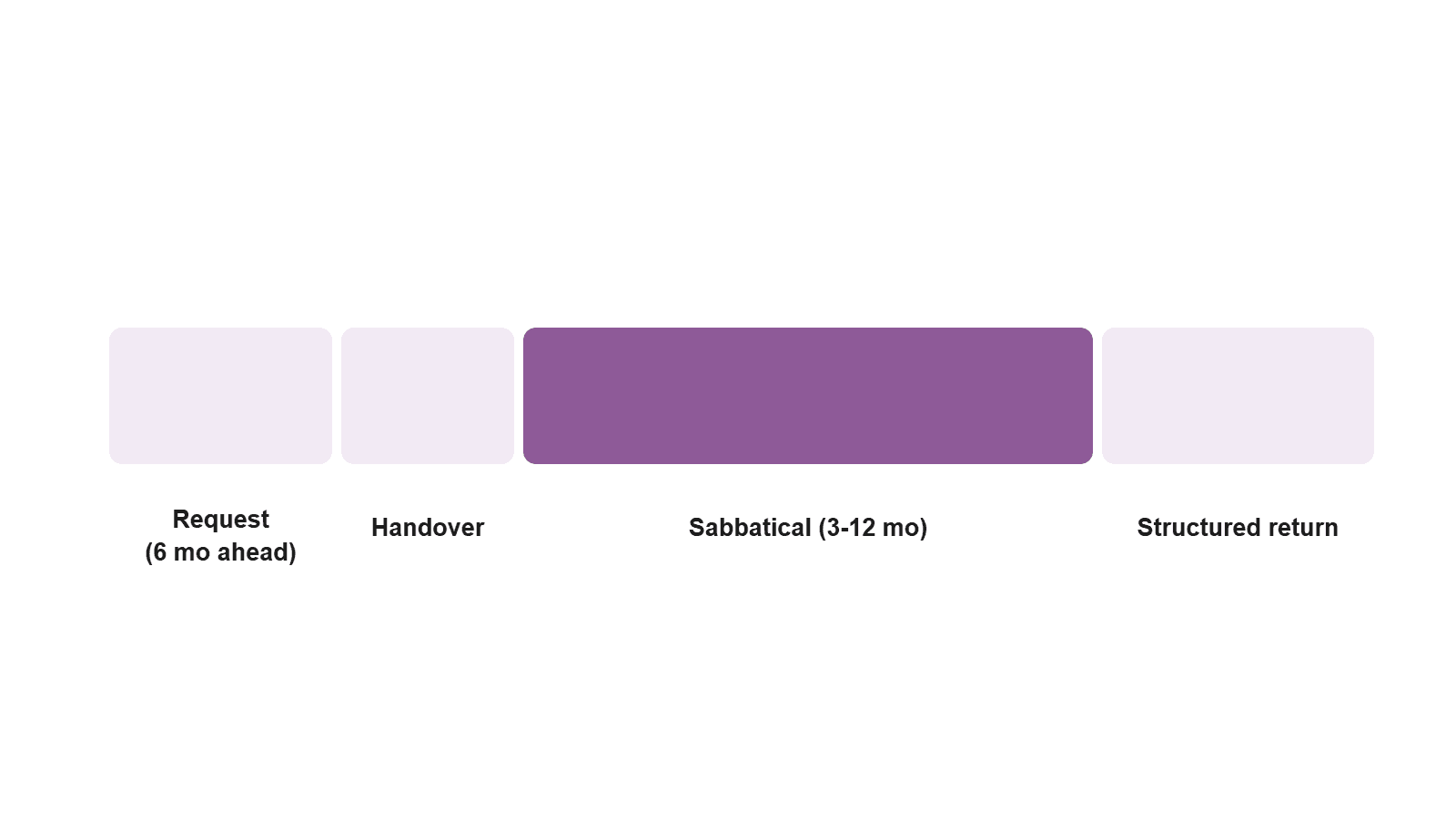
Eligibility is almost always tenure-gated. Five years of continuous service is the most common threshold, with seven years the traditional academic marker. Policies usually add practical guardrails: a minimum notice period of three to six months, manager and HR approval, a cap on how many people can be out at once per team, and a repeat interval so the benefit recurs every five years rather than once ever.
What a good sabbatical policy defines
A sabbatical policy fails in the details, not the headline. Before launching one, write down the answers to the questions that will otherwise surface as one-off negotiations:
- Eligibility: years of service required, and whether the clock resets after each sabbatical.
- Length and pay: the exact weeks granted and the salary percentage, if any.
- Benefits: what happens to health coverage, retirement contributions, and PTO accrual.
- Notice and approval: how far ahead to request, who approves, and how conflicts between overlapping requests are resolved.
- Coverage: how the role is backfilled, and what handover is expected before leaving.
- Return commitment: whether the employee must stay a defined period after returning, and what happens if they resign during or shortly after the sabbatical.
- Interaction with PTO: whether vacation keeps accruing and whether unused PTO can extend the sabbatical.
The return: the part most policies underplan
The riskiest phase of a sabbatical is the re-entry. The employee has been out of the loop for months; the team has rerouted their work. A good policy schedules the return explicitly: the same or an equivalent role in writing, a handover-back period during the first weeks, and a check-in with the manager in the first month.
For the employer, the return is also where the investment pays off. Companies that run sabbatical programs report them as a retention lever for exactly the senior people who are hardest to replace, and as a forcing function that proves the team can operate without a single point of failure.
Tracking sabbaticals separately from PTO
Administratively, a sabbatical should never live inside the vacation balance. It is a different entitlement with different rules: granted by tenure rather than accrued, measured in weeks rather than days, and usually excluded from payout at termination.
The clean setup is a dedicated leave type with its own eligibility rules and its own reporting, so HR can see who is approaching a tenure milestone, who has a sabbatical approved, and how much coverage the team needs. That also keeps the vacation balance honest for everyone else.
Editorial explainer of a voluntary benefit; the prevalence statement reflects the direction of SHRM's annual employee benefits surveys without quoting a single year's percentage, because the figure moves between editions. This article explains common US practice at a general level and is not legal advice; state laws and company policies differ, so confirm specifics for your state.
Frequently asked questions
- What is a sabbatical from work?
- An extended break of typically one to six months, granted after several years of service, with the job held for the employee's return. It is a voluntary company benefit, not a legal entitlement in the US.
- Is sabbatical leave paid?
- It depends on the policy. Common models are fully paid four to six week programs, partially paid longer programs, and unpaid sabbaticals where only the job protection remains.
- How long is a typical sabbatical?
- One to six months. Paid programs cluster at four to six weeks; unpaid programs run longer, sometimes up to a year in academia.
- After how many years do you get a sabbatical?
- Five years of continuous service is the most common eligibility threshold in company policies; seven years is the traditional academic interval.
- Do you keep benefits during a sabbatical?
- Usually yes during a paid sabbatical. During an unpaid one, health coverage often continues only if the employee pays their premium share, and PTO accrual typically pauses. The policy should state both explicitly.
- Can an employer deny a sabbatical?
- Yes. Because sabbaticals are a voluntary benefit, employers can set eligibility rules, cap concurrent absences, and time approvals around business needs.
About the author
Blasko Sarcevic
Founder, Time-Out Zone
Connect on LinkedIn Connect on LinkedIn
Blasko writes about leave management, policy design, and running time-off operations at scale.
Related
Sabbaticals as their own leave type
Time-Out Zone tracks sabbaticals separately from PTO, with tenure-based eligibility, approval routing, and team coverage visibility.