Types of Leave: Every Employee Leave Category Explained

Blasko Sarcevic
Published · Updated
The full map of employee leave types: vacation and PTO, sick leave, parental and family leave, bereavement, sabbaticals, unpaid leave, and the categories in between, with what is paid, protected, and policy-defined.
Topic

Topic: the taxonomy of time away from work.
What are the types of employee leave?
Employee leave splits into a handful of recurring categories. Vacation or annual leave (in the US usually bundled as PTO) is the planned, paid entitlement for rest. Sick leave covers the employee's own illness and is mandated in a growing number of US states. Family and parental leave covers a new child or caring for relatives, protected federally by the unpaid FMLA and paid in several states. Bereavement leave grants days after a death in the family. Public holidays and floating holidays cover fixed and flexible observances. Beyond those sit the longer, rarer forms: a leave of absence for a specific life event, a sabbatical earned by tenure, and unpaid personal leave where no other category fits, plus civic duties such as jury service, voting, and military leave. Each type differs on three axes: whether it is paid, whether a law protects it, and whether it draws from a tracked balance. A clear policy defines every type it offers on all three axes.
The leave-type map at a glance
Every leave type can be located on three axes: paid or unpaid, legally protected or policy-defined, and balance-based or event-based. The table sorts the common types along those lines for the US:
| Leave type | Typically paid? | Legal basis (US) | Balance-based? |
|---|---|---|---|
| Vacation / PTO | Yes | Policy; state rules on payout and expiry | Yes |
| Sick leave | Yes, where mandated | State and local mandates; no federal law | Yes, usually accrued |
| Parental / family leave | Varies | FMLA (unpaid) + state paid programs | No, event-based |
| Bereavement leave | Usually | Six state laws; else policy | No |
| Public + floating holidays | Yes | Policy; no federal requirement | Floating: small yearly grant |
| Leave of absence | Often unpaid | FMLA / ADA / USERRA where qualifying | No |
| Sabbatical | Policy-defined | None, voluntary benefit | No, tenure-gated |
| Jury duty / voting / military | Varies | Federal and state statutes | No |
Vacation, annual leave, and PTO
Vacation (called annual leave in much of the world) is the planned entitlement for rest. US employers increasingly bundle vacation, personal days, and sometimes sick time into a single PTO balance; other countries keep statutory annual leave separate. The design questions live in the policy: how days are granted (accrual versus lump-sum), whether unused days carry over, and whether a payout is due at termination, which several states require.
A minority of companies replace the balance entirely with unlimited PTO, which changes the accounting but not the need for rules.
Sick leave
Sick leave covers the employee's own illness or medical appointments, and increasingly care for a sick family member. There is no federal paid sick leave law, but a large group of states and cities mandate accrual, commonly one hour per 30 worked with an annual cap.
Best practice keeps sick leave in its own bucket so an illness never burns vacation days. Longer illnesses cross over into medical leave of absence territory, where the FMLA protects the job and short-term disability insurance, employer-provided or state-mandated in five states, replaces part of the pay. The short-term disability guide covers the elimination period, the benefit percentage and how the two run side by side.
Parental and family leave
Parental leave covers the birth, adoption, or fostering of a child; family caregiving leave covers a seriously ill relative. The federal FMLA protects up to 12 unpaid weeks for both at covered employers. A growing set of states (California, New York, Washington, New Jersey, and others) adds paid family leave with wage replacement, and many companies top this up with fully paid parental leave of 12 to 26 weeks.
These leaves are event-based: they do not draw from the vacation balance and need their own tracking, including intermittent use where allowed. As of 2026, thirteen jurisdictions pay state family and medical leave benefits. The FMLA guide covers the job-protection side, the paid family leave guide covers the pay side, and the family and medical leave laws by state grid puts every jurisdiction's job protection, pay, disability insurance and sick leave rule in one table.
Bereavement leave
Bereavement leave grants time after a death: typically three to five paid days for immediate family, one to three for extended family. No federal law requires it, though six states now do for covered employers. The full picture, including the state statutes and how to define family, is in the dedicated bereavement leave guide.
Public holidays and floating holidays
Public holidays are the fixed calendar: company-observed days that apply to everyone at a location. Floating holidays are their flexible counterpart, one to three paid days employees use for observances of their choice. Multi-location companies need per-location holiday calendars, since even within one country the observed days differ.
Leave of absence, sabbatical, and unpaid leave
When the event is bigger than any balance, the longer forms apply. A leave of absence is event-driven time away with the job held: medical, family, military, or personal, sometimes legally protected and often unpaid. A sabbatical is the planned version: a one-off block of one to six months earned by tenure, paid or unpaid by policy.
Unpaid personal leave is the catch-all where nothing else fits: no legal protection, terms fully policy-defined. Because these three look similar on a calendar but differ completely in rules, each should be a distinct leave type in the system of record. The personal leave of absence guide covers the eight decisions a personal leave policy has to make, and the leave of absence policy guide gives the full handbook template with the state addenda.
Civic and duty leave
The final group is set by statute: jury duty (job-protected everywhere, pay varies by state), voting leave (mandated in about half the states), and military leave under USERRA, which protects service members' jobs and reemployment rights for cumulative service up to five years. A related statutory category is leave as a reasonable accommodation under the ADA, which has no fixed length and often begins where FMLA leave ends; the USERRA guide and the ADA leave guide cover each in detail.
These are low-volume but high-stakes: getting a jury duty or USERRA case wrong is a legal problem, not a policy debate. Define them explicitly rather than improvising per case.
Running multiple leave types cleanly
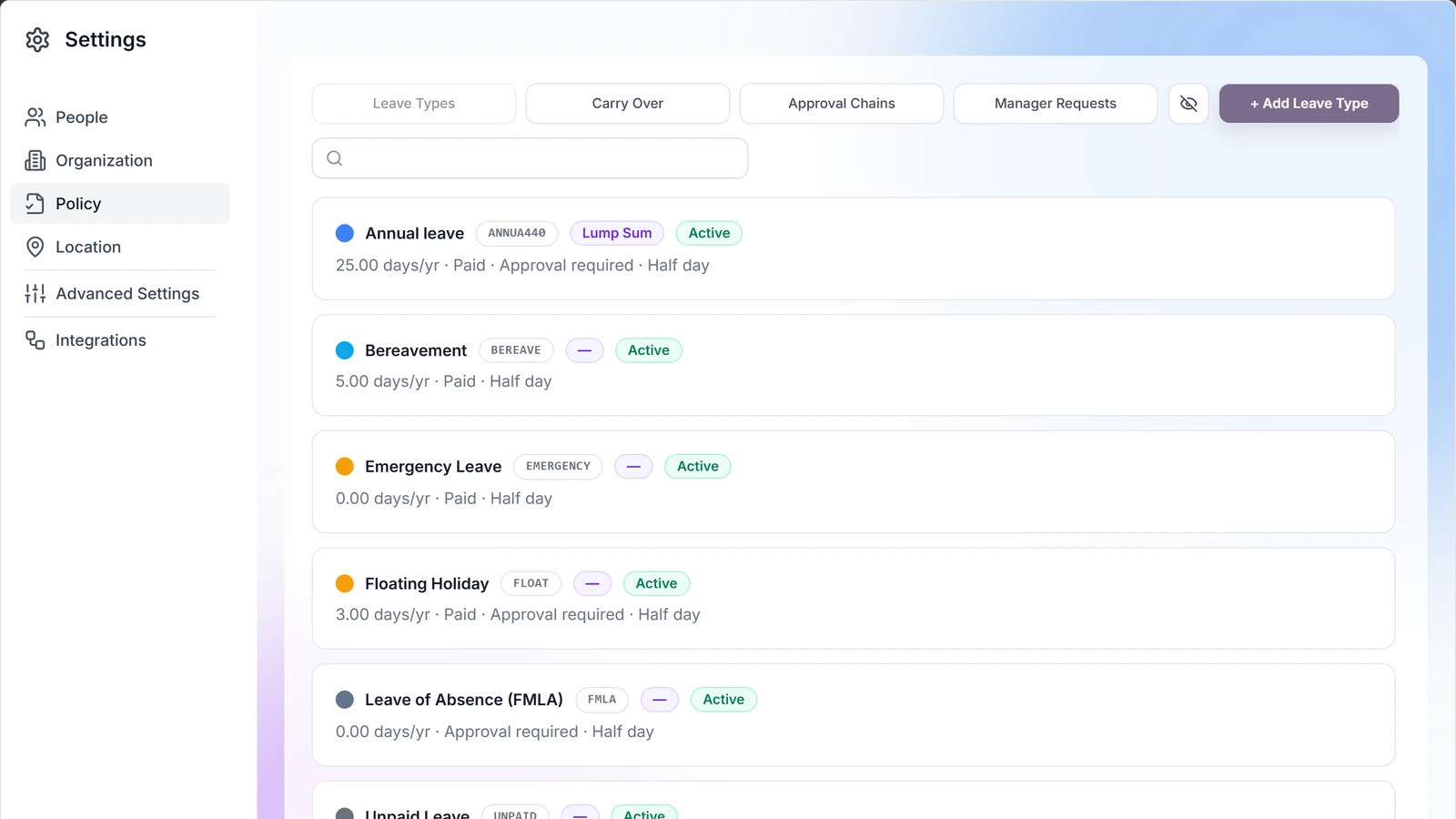
The taxonomy only works if the system enforces it. Each leave type needs its own rules: paid or not, balance or event, accrual and carry-over, approval path, and who is eligible. Mixing types into one balance destroys reporting and creates legal exposure where protected leave is involved.
A leave management system earns its keep here: one request flow for employees, but separate types, balances, and audit trails underneath.
Editorial overview of US leave categories with pointers to the dedicated guides for each type; the state paid leave program list is maintained in the leave of absence guide (checked September 2026). This article explains common US practice at a general level and is not legal advice; state laws and company policies differ, so confirm specifics for your state.
Frequently asked questions
- What are the main types of leave?
- Vacation/PTO, sick leave, parental and family leave, bereavement leave, public and floating holidays, leave of absence, sabbatical, unpaid personal leave, and civic duties like jury service and military leave.
- What is the difference between annual leave and PTO?
- Annual leave is the international term for the yearly vacation entitlement. PTO is the US umbrella that often bundles vacation, personal days, and sometimes sick time into one balance.
- Which types of leave are required by US law?
- Federally: unpaid FMLA leave, leave as a reasonable accommodation under the ADA, pregnancy-related accommodation under the PWFA, military leave (USERRA), and jury duty protection. Many states add paid sick leave, paid family and medical leave, voting leave, and bereavement leave mandates.
- What is the difference between a leave of absence and PTO?
- PTO is planned and drawn from a balance; a leave of absence is event-driven, usually longer, often unpaid, and sometimes legally protected.
- Should sick leave and vacation share one balance?
- Ideally no. Separate buckets keep illness from consuming vacation days and keep state-mandated sick accrual reportable on its own.
About the author
Blasko Sarcevic
Founder, Time-Out Zone
Connect on LinkedIn Connect on LinkedIn
Blasko writes about leave management, policy design, and running time-off operations at scale.
Related
- Learn hub
- Leave of absence explained
- Sabbatical leave explained
- Bereavement leave explained
- Unlimited PTO explained
- Floating holidays explained
- Time off request form template
- What is FMLA
- Paid family leave explained
- Family and medical leave laws by state
- ADA leave of absence
- USERRA and military leave
- Personal leave of absence
- Leave of absence policy template
Every leave type with its own rules
Time-Out Zone models each leave type separately: paid or unpaid, balance or event, accrual, carry-over, and approvals, all in one request flow.