Out-of-Office Message Examples: 20 Templates to Copy

Jovana Avramovic
Published
Copy-paste out-of-office messages for vacation, sick leave, parental leave, business trips, and company closures, plus the three things every good auto-reply answers and the mistakes that make them useless.
Topic

Topic: the message that answers while you are away.
What should an out-of-office message say?
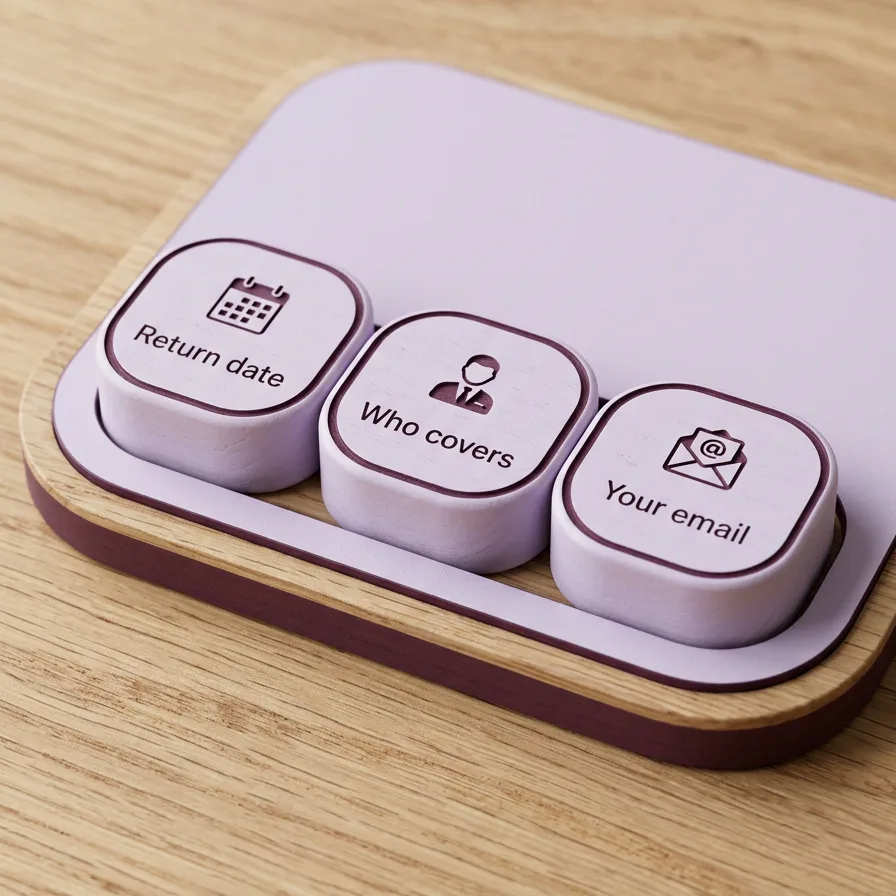
A good out-of-office message answers three questions in two to four sentences: when you are back, who covers for you, and what happens to the email in the meantime. The return date is the single most important line, because it tells the sender whether to wait or to contact your cover. Name the cover with a real email address, otherwise the reference is useless. Saying whether messages are read, forwarded, or answered only after your return decides whether the sender re-sends the same email to your colleague. What to leave out: the reason for your absence (nobody needs to know whether it is vacation or sick leave), apologies, and private phone numbers. Keep the tone neutral and friendly, and set an end date in your email client so the reply switches itself off. The templates below cover the common cases and can be copied as they are; replace the parts in square brackets.
The standard vacation template
The classic, formal enough for any external contact. Replace the parts in square brackets:
- Hello, thank you for your message. I am out of the office until [date] with no access to email. For urgent matters, please contact [name] at [email address]. I will reply to your message as soon as possible after my return. Kind regards, [name]
- Hello, I am on vacation until [date] and will respond to your email after I return. Your message will not be forwarded. In the meantime, [name] ([email address]) will be happy to help. Best regards, [name]
- Hello, I am away from the office and will be back on [date]. If your message can wait, I will get to it first thing after my return; if not, [name] at [email address] has you covered. Best, [name]
With forwarding, or with no cover at all
If messages are forwarded, or nobody covers for you, say so honestly. Nothing erodes trust faster than a named cover who never answers:
- Hello, I am out of the office until [date]. Your email is being forwarded automatically to [name] ([email address]), who will take care of it. Kind regards, [name]
- Hello, I am away until [date] and unable to read email during this time. Your message will not be forwarded; I will reply personally once I am back. Thank you for your patience. Kind regards, [name]
Sick leave: short and without a diagnosis
For sick leave the rule applies twice over: no reason, no details. An open return date is fine when you do not know it yet:
- Hello, I am unexpectedly out of the office today. For urgent matters, please contact [name] at [email address]. I will reply to your message once I am back. Kind regards, [name]
- Hello, I am currently out of the office and cannot yet say when I will return. Please direct your request to [name] ([email address]), who will make sure it is handled. Kind regards, [name]
Parental leave and long absences
When the absence is measured in months, restructure the message: lead with the permanent contact person rather than the return date, and state clearly that the inbox is not being read:
- Hello, I am on parental leave until approximately [month year]. Emails to this address are not being read during this time. Please contact [name] at [email address] for all matters. Kind regards, [name]
- Hello, I am away until [month year]. [Name] has taken over my responsibilities and can be reached at [email address] or [phone number]. Your message will not be forwarded, so please resend it directly. Kind regards, [name]
Business trips and conferences
Traveling with occasional inbox access? Promise delayed replies instead of radio silence:
- Hello, I am traveling for work until [date] and checking email irregularly. Expect a delayed reply. For anything urgent, [name] at [email address] can help right away. Kind regards, [name]
- Hello, I am at [event] this week and replies will be slower than usual. If you are attending too, feel free to say hello; otherwise I will get back to you from [date]. Best, [name]
Public holidays and company closures
When the whole company pauses, the message can say so; it takes the personal edge off the waiting time:
- Hello, our office is closed from [date] to [date]. Messages will be answered in the order received starting [date]. We wish you a great holiday season. Kind regards, [company]
- Hello, we are closed for the public holiday on [date] and back the next working day. Your message will be answered as soon as possible after our return. Kind regards, [company]
Internal and casual versions
If your email client supports separate internal and external replies (Outlook and Teams do), the internal one can carry more detail and less ceremony:
- Hi, I am off until [date]. [Name] is covering [project] and has access to the shared folder. Anything else can wait until I am back. Thanks!
- Hi, out until [date], no email until then. Ping [name] for anything on [project], or drop it in the team channel and I will pick it up when I return.
- Hi, I am on leave until [date]. Decisions on [topic] go to [name] this week. See you when I am back.
How to set the message up technically
The text is half the job; the other half is the time period with a start and end date, so the reply switches itself off. The exact clicks for Outlook, Gmail, and Teams are in our step-by-step guides, linked below.
And the calendar belongs to the same routine: an auto-reply without a calendar block means meetings still land in your vacation. If your team tracks leave in Time-Out Zone, every approved absence appears in Outlook or Google Calendar automatically through the ICS calendar feed.
Frequently asked questions
- Should I say why I am out of the office?
- No. Whether it is vacation, sick leave, or anything else, the reason is not the sender's business and adds nothing. Return date, cover contact, and what happens to the email are all a good message needs.
- How long should an out-of-office message be?
- Two to four sentences. Anything longer does not get read. The longest justified version is the parental-leave message, which adds a permanent contact person and optionally a phone number.
- Should internal and external senders get different messages?
- If your email client offers it, yes. The internal version can be casual and name projects; the external version stays neutral. Outlook and Teams support separate texts for inside and outside your organization.
- Does an out-of-office reply turn itself off?
- Only if you set an end date. Outlook, Gmail, and Teams all offer a time period; without it, the reply keeps firing until you switch it off manually. Set the dates and forget about it.
About the author
Jovana Avramovic
Product Excellence, Time-Out Zone
Jovana writes hands-on guides to time-off workflows, calendar tooling, and the rules behind vacation, sick leave, and payouts.
Related
Request leave once, cover everything else
Time-Out Zone handles requests, approvals, and balances; approved absences land in Outlook and Google Calendar automatically through the calendar feed.