FMLA in Connecticut: Federal Rules, State Leave Laws, and an Eligibility Calculator (2026)

Blasko Sarcevic
Published
How the Family and Medical Leave Act works in Connecticut: the federal eligibility tests and 12 weeks in hours, what Connecticut Family and Medical Leave Act add on top, whether anything pays during the leave, and the calculator preset to Connecticut.
Topic
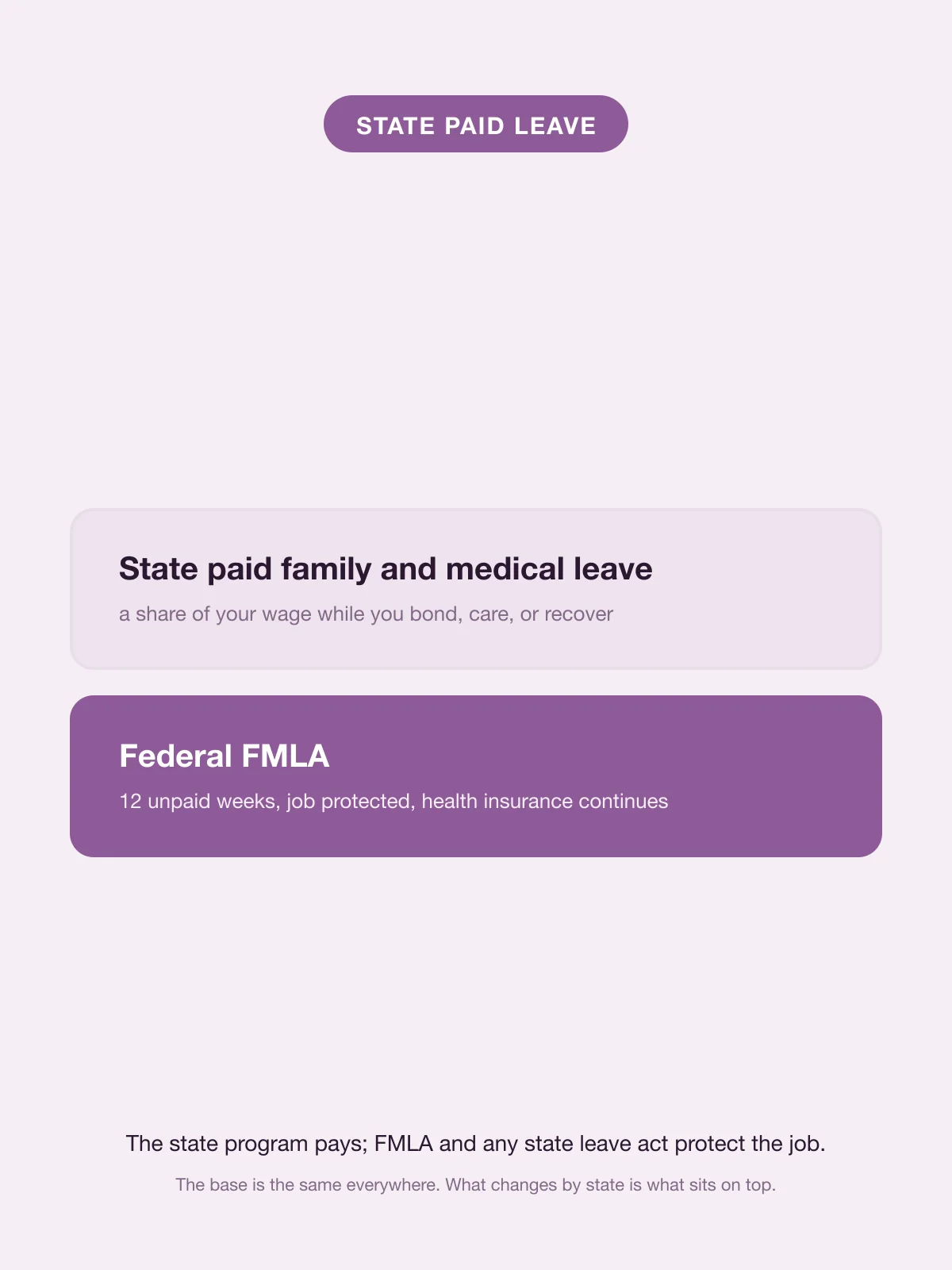
Connecticut: state paid family and medical leave.
1Am I eligible?
- Covered employer: 120 employees on the payroll: the employer is covered (50 or more in 20 or more workweeks).
- 12 months of service: Enter both dates to check the 12 months of service.
- 1,250 hours worked: 1,600 hours actually worked in the prior 12 months: the 1,250-hour test is met.
- 50 employees within 75 miles: 80 employees at the worksite or within 75 miles of it: the 50-employee test is met.
2How many hours do I get?
3How much is left, and when does it come back?
12 weeks or 60 days at your schedule, under the rolling 12 months (backward) method.
Estimates only, not legal advice. The federal rules are 29 CFR 825.104, 825.110, 825.200, and 825.205; Connecticut statutes on this page have their own tests and clocks. Your employer's payroll records and its chosen 12-month method decide the official figures.
How does FMLA work in Connecticut?
The federal FMLA applies in Connecticut exactly as it does everywhere: up to 12 workweeks of unpaid, job-protected leave in a 12-month period for employees with 12 months of service, 1,250 hours worked in the prior 12 months, and 50 or more employees within 75 miles of their worksite, at a private employer with 50 or more employees or any public agency or school. Connecticut adds Connecticut Family and Medical Leave Act (CT FMLA), which covers employers with 1 or more employees (since January 1, 2022) and gives 12 weeks in a 12-month period, plus 2 weeks for a serious health condition causing incapacity during pregnancy. CT Paid Leave pays a benefit during the leave, paid sick leave is mandated by the Paid Sick Leave Law (expanded 2025), and there is no bereavement leave mandate. Where the state statute and the FMLA both apply they run at the same time. Checked September 15, 2026.
Does the federal FMLA apply in Connecticut?
Yes, and identically to every other state. The federal Family and Medical Leave Act gives an eligible employee up to 12 workweeks of unpaid, job-protected leave in a 12-month period for a serious health condition, a new child, care for a spouse, parent, or child with a serious health condition, or a military exigency, and up to 26 weeks to care for a seriously injured servicemember. To be eligible you need 12 months of service with the employer, 1,250 hours actually worked in the 12 months before the leave, and a worksite with 50 or more employees within 75 miles. Private employers are covered at 50 or more employees on the payroll in 20 or more workweeks; public agencies and schools are covered at any size.
The three employee tests are measured on the day the leave starts, and the third one is the one that surprises people in Connecticut: a covered employer with a small branch has a worksite where nobody is eligible if fewer than 50 employees work at that branch and at other sites within 75 road miles. Hours actually worked in the prior 12 months decide the 1,250-hour test; paid time off and holidays do not count. The calculator on this page runs all three tests and, when one fails, names the date or the hours that would satisfy it.
What Connecticut leave laws add to the FMLA
One state statute sits on top of the FMLA in Connecticut. Connecticut Family and Medical Leave Act (CT FMLA) (Conn. Gen. Stat. 31-51kk to 31-51qq) applies to employers with 1 or more employees (since January 1, 2022) and gives 12 weeks in a 12-month period, plus 2 weeks for a serious health condition causing incapacity during pregnancy for own serious health condition, bonding, care for a covered family member, military exigency, organ or bone marrow donation. Eligibility: 3 months of employment with the current employer; no minimum hours. It widens the family circle beyond the FMLA's spouse, parent, and minor child to include spouse, sibling, child, grandparent, grandchild, parent, and any individual related by blood or affinity whose close association is the equivalent of family. Runs concurrently with the federal FMLA where both apply, but reaches far more people: a 10-person employer, a 4-month employee, or a part-timer on 20 hours is covered by CT FMLA and not by the federal law.
| Statute | Employers covered | Leave | Employee eligibility |
|---|---|---|---|
| Connecticut Family and Medical Leave Act (CT FMLA) (Conn. Gen. Stat. 31-51kk to 31-51qq) | Employers with 1 or more employees (since January 1, 2022) | 12 weeks in a 12-month period, plus 2 weeks for a serious health condition causing incapacity during pregnancy | 3 months of employment with the current employer; no minimum hours |
Is FMLA leave paid in Connecticut?
The FMLA itself pays nothing. Whether the 12 weeks are paid depends on the state program, any disability insurance, and the employer's own paid leave, which may be substituted for the unpaid leave under 29 CFR 825.207. Connecticut runs CT Paid Leave: benefits since January 2022. Up to 12 weeks, plus 2 for pregnancy incapacity. It covers the employee's own serious health condition as well as bonding and family care, so there is no separate disability program. CT Paid Leave pays money only; the job protection for the same weeks comes from CT FMLA, which is why the two were redesigned together in 2022 to share the 12-week entitlement and the 3-month eligibility rule.
While the state benefit is paid the leave is not unpaid, so an employer may not require PTO to run at the same time; several programs let the employee top up to full pay with PTO if the employer agrees. Paid sick leave is mandated statewide by the Paid Sick Leave Law (expanded 2025), accruing at 1 hour per 30 hours worked up to 40 hours/year; expansion phases in coverage for nearly all employers through 2027. Those hours can be substituted for unpaid FMLA leave. The Connecticut paid leave calculator linked below estimates the weekly benefit under the current formula and cap.
Bereavement, sick leave, and the smaller Connecticut statutes
Bereavement: Connecticut has no statewide bereavement leave mandate for private employers, and the federal FMLA does not cover bereavement either, so time off after a death comes from the employer's policy or from paid sick or PTO balances where the policy allows it.
The smaller statutes a multi-state employer has to carry in Connecticut, one line each.
How the 12-month period and the calculator work in Connecticut
The federal entitlement in Connecticut is 12 workweeks in the 12-month period the employer has chosen: calendar year, a fixed leave year, 12 months forward from first use, or a rolling 12 months measured backward from each day of leave. The method must be applied to everyone, disclosed in the rights and responsibilities notice, and changed only on 60 days' written notice. Under the rolling method every hour returns 12 months after the day it was taken; under the other three the full entitlement returns on one date. Connecticut Family and Medical Leave Act (CT FMLA) runs on its own clock (12 weeks in a 12-month period, plus 2 weeks for a serious health condition causing incapacity during pregnancy), which is not necessarily the employer's federal 12-month method, so Connecticut employers keep two balances for an employee who qualifies under both, and the calculator below tracks the federal one.
The calculator on this page is preset to Connecticut. Run the eligibility panel as of the leave start date, convert the schedule into hours (480 for a 40-hour week), then enter the leave taken and the employer's method to see the hours available today, the hours available on a future date, and, under the rolling method, the dates on which used hours come back.
Sources and last check
This page was checked on September 15, 2026 against Connecticut Department of Labor, CT FMLA; CT Paid Leave Authority (ctpaidleave.org); Conn. Gen. Stat. 31-51kk ff., 31-57r ff. The federal rules are 29 U.S.C. 2601 ff. and 29 CFR Part 825. State thresholds and programs change, most often on January 1; the paid leave figures on the linked calculator carry their own effective dates.
General information only, not legal advice. State leave statutes and their thresholds change, and several interact with the federal FMLA in ways that depend on the reason for leave. Confirm with the state agency named on the page and with employment counsel before relying on it. Sources: Connecticut Department of Labor, CT FMLA; CT Paid Leave Authority (ctpaidleave.org); Conn. Gen. Stat. 31-51kk ff., 31-57r ff; 29 U.S.C. 2601 ff.; 29 CFR Part 825. Checked September 15, 2026.
Frequently asked questions
- Is there a Connecticut FMLA?
- Connecticut has its own statute: Connecticut Family and Medical Leave Act (CT FMLA) (Conn. Gen. Stat. 31-51kk to 31-51qq), 12 weeks in a 12-month period, plus 2 weeks for a serious health condition causing incapacity during pregnancy at employers with 1 or more employees (since January 1, 2022). The federal FMLA applies alongside, with its 12 weeks, 50-employee threshold, and 1,250-hour test.
- How many weeks of FMLA do you get in Connecticut?
- 12 workweeks in a 12-month period under the federal FMLA (26 for military caregiver leave), counted in hours at your schedule: 480 hours for a 40-hour week. Connecticut Family and Medical Leave Act (CT FMLA) gives 12 weeks in a 12-month period, plus 2 weeks for a serious health condition causing incapacity during pregnancy, and where both apply they run concurrently.
- Is FMLA paid in Connecticut?
- Not by the FMLA itself, but CT Paid Leave pay a benefit during qualifying leave, and the FMLA protects the job at the same time where you meet its tests.
- Who is eligible for FMLA in Connecticut?
- Employees with 12 months of service, 1,250 hours actually worked in the prior 12 months, and 50 or more employees within 75 miles of their worksite, at a covered employer (50 or more employees, or any public agency or school). Connecticut Family and Medical Leave Act (CT FMLA) has a different test: 3 months of employment with the current employer; no minimum hours, at employers with 1 or more employees (since January 1, 2022).
- Does Connecticut have bereavement leave?
- No statewide mandate for private employers. The federal FMLA does not cover bereavement either, so time off after a death comes from the employer's policy or from sick or PTO balances where the policy allows.
- Can my employer make me use PTO during FMLA in Connecticut?
- For the unpaid portion, yes, under 29 CFR 825.207. While CT Paid Leave is paying, the leave is not unpaid and the employer cannot require PTO to run at the same time; a top-up to full pay is by agreement.
About the author
Blasko Sarcevic
Founder, Time-Out Zone
Connect on LinkedIn Connect on LinkedIn
Blasko writes about leave management, policy design, and running time-off operations at scale.
Related
Tracking FMLA hours across a team?
Time-Out Zone keeps every leave type, balance, and approval in one place, so FMLA hours, state leave, and company PTO stay consistent without a spreadsheet per employee.
Questions about FMLA tracking?
See how Time-Out Zone tracks intermittent hours, rolling balances, and state leave for teams in more than one state.