FMLA Calculator: Eligibility, Hours, and Your 12-Month Balance (2026)

Blasko Sarcevic
Published
Three questions the Family and Medical Leave Act makes people compute by hand: am I eligible, how many hours do I actually have, and when do the hours I used come back. The calculator answers all three from the regulations, and the state pages add what your state layers on top.
Topic
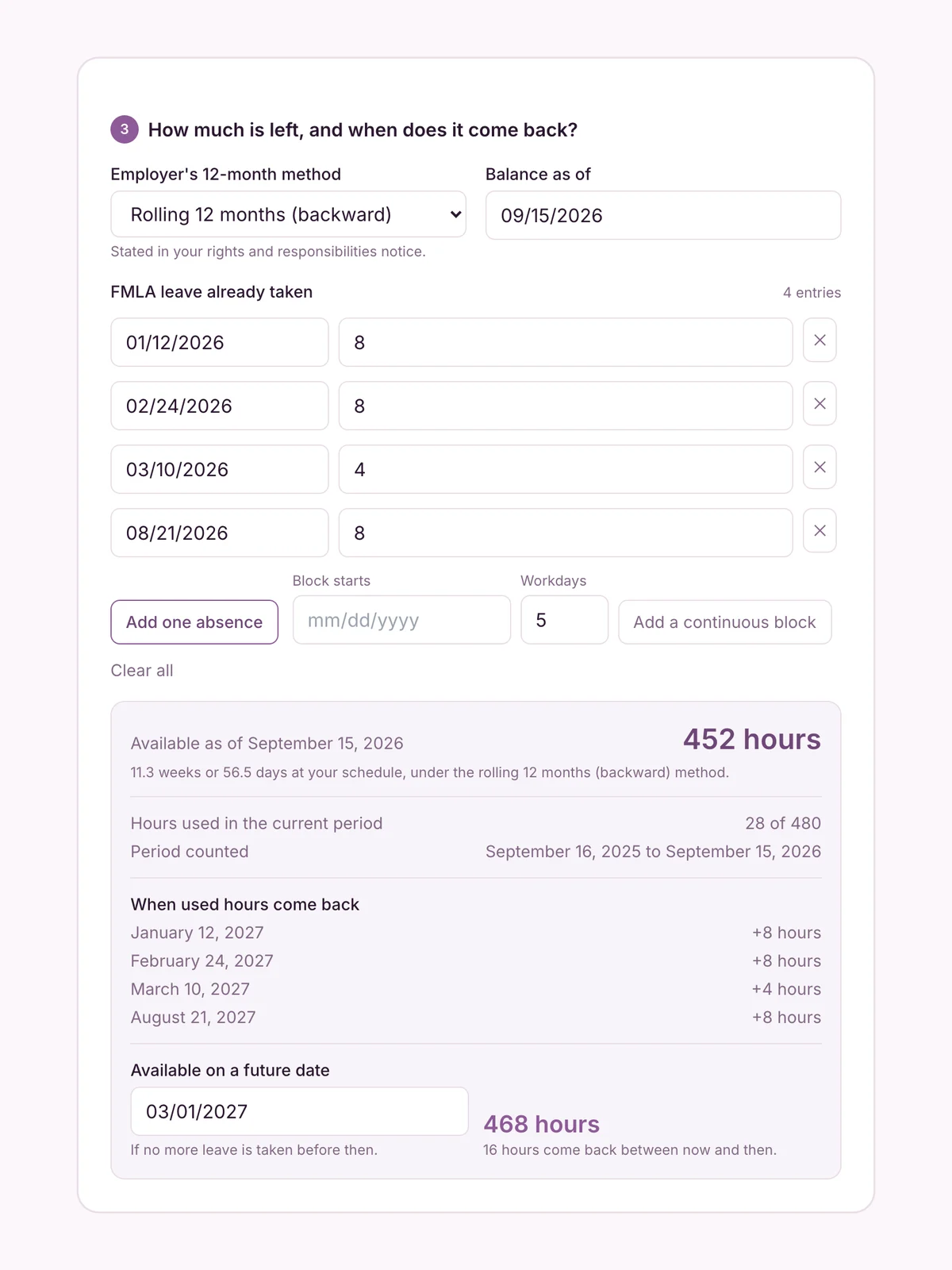
FMLA calculator: the rolling 12-month balance with the dates used hours come back.
1Am I eligible?
- Covered employer: 120 employees on the payroll: the employer is covered (50 or more in 20 or more workweeks).
- 12 months of service: Enter both dates to check the 12 months of service.
- 1,250 hours worked: 1,600 hours actually worked in the prior 12 months: the 1,250-hour test is met.
- 50 employees within 75 miles: 80 employees at the worksite or within 75 miles of it: the 50-employee test is met.
2How many hours do I get?
3How much is left, and when does it come back?
12 weeks or 60 days at your schedule, under the rolling 12 months (backward) method.
Estimates only, not legal advice. The federal rules are 29 CFR 825.104, 825.110, 825.200, and 825.205. Your employer's payroll records and its chosen 12-month method decide the official figures.
How is FMLA leave calculated?
FMLA leave is calculated in three steps. First, eligibility: you need 12 months of service with the employer (not necessarily consecutive), 1,250 hours actually worked in the 12 months before the leave starts, and 50 or more employees at your worksite or within 75 miles of it; the employer must also be covered, which for a private company means 50 or more employees on the payroll in 20 or more workweeks. Second, the entitlement: 12 workweeks at your normal schedule, so 480 hours for a 40-hour week, 384 for 32 hours, 450 for 37.5, and 26 weeks for military caregiver leave. Third, the balance: the employer picks one of four 12-month periods, and under the rolling method every hour you take comes back exactly 12 months after the day you took it, while under the calendar, fixed, or forward methods the full 12 weeks return on one date. The calculator runs all three steps. Source: 29 CFR 825.110, 825.200, 825.205.
Who is eligible for FMLA leave?
The federal Family and Medical Leave Act gives an eligible employee up to 12 workweeks of unpaid, job-protected leave in a 12-month period for a serious health condition, a new child, care for a spouse, parent, or child with a serious health condition, or a military exigency, and up to 26 weeks to care for a seriously injured servicemember. To be eligible you need 12 months of service with the employer, 1,250 hours actually worked in the 12 months before the leave, and a worksite with 50 or more employees within 75 miles. Private employers are covered at 50 or more employees on the payroll in 20 or more workweeks; public agencies and schools are covered at any size. All three employee tests are measured on the day the leave would start, not on the day you ask, so an employee hired 11 months ago who asks in month 11 for leave beginning in month 13 is eligible.
The hours test is the one most often miscounted. Only hours actually worked count under the Fair Labor Standards Act principles the regulation adopts: paid vacation, sick days, holidays, and unpaid leave do not, though hours a returning servicemember would have worked do. A full-time employee on 40 hours clears 1,250 with about 31 working weeks, so the test bites on part-timers, new hires, and people who were themselves on extended leave in the prior year. The worksite test counts everyone on the payroll at the site plus every other site within 75 road miles, including part-timers, and remote employees are counted at the office they report to. A covered employer can therefore have a worksite where nobody is eligible: a company with 58 employees split 44 and 14 across two cities 100 miles apart is covered, and no one at either site passes the 50-within-75-miles test.
How many hours of FMLA leave do you get?
The entitlement is 12 workweeks, and 29 CFR 825.205(b) converts it to hours at the employee's normal schedule, because intermittent and reduced-schedule leave are charged in hours. A 40-hour employee has 480 hours; a 32-hour employee has 384; a nurse on three 12-hour shifts has 432. If the schedule varies, the employer averages the weekly hours over the 12 months before the leave. Overtime that the employee is normally scheduled to work counts toward the schedule, so a mandatory 48-hour week produces 576 hours, and the employer may charge overtime hours the employee misses against the entitlement, but voluntary overtime does not count either way.
Increments matter for intermittent leave. The employer must track FMLA leave in the smallest increment it uses for any other type of leave, and never more than one hour, so a company that lets people take PTO in 15-minute increments has to count FMLA the same way. A two-hour medical appointment costs 2 hours, not a half day. Holidays inside a full week of leave count against the entitlement; a holiday in a week of partial leave does not, unless the employee was scheduled to work it.
| Weekly schedule | 12 weeks in hours | Full days at 8 hours | 26 weeks (military caregiver) |
|---|---|---|---|
| 20 hours | 240 hours | 30 | 520 hours |
| 24 hours | 288 hours | 36 | 624 hours |
| 30 hours | 360 hours | 45 | 780 hours |
| 32 hours | 384 hours | 48 | 832 hours |
| 37.5 hours | 450 hours | 56.3 | 975 hours |
| 40 hours | 480 hours | 60 | 1040 hours |
| 48 hours | 576 hours | 72 | 1248 hours |
How does the rolling 12-month period work?
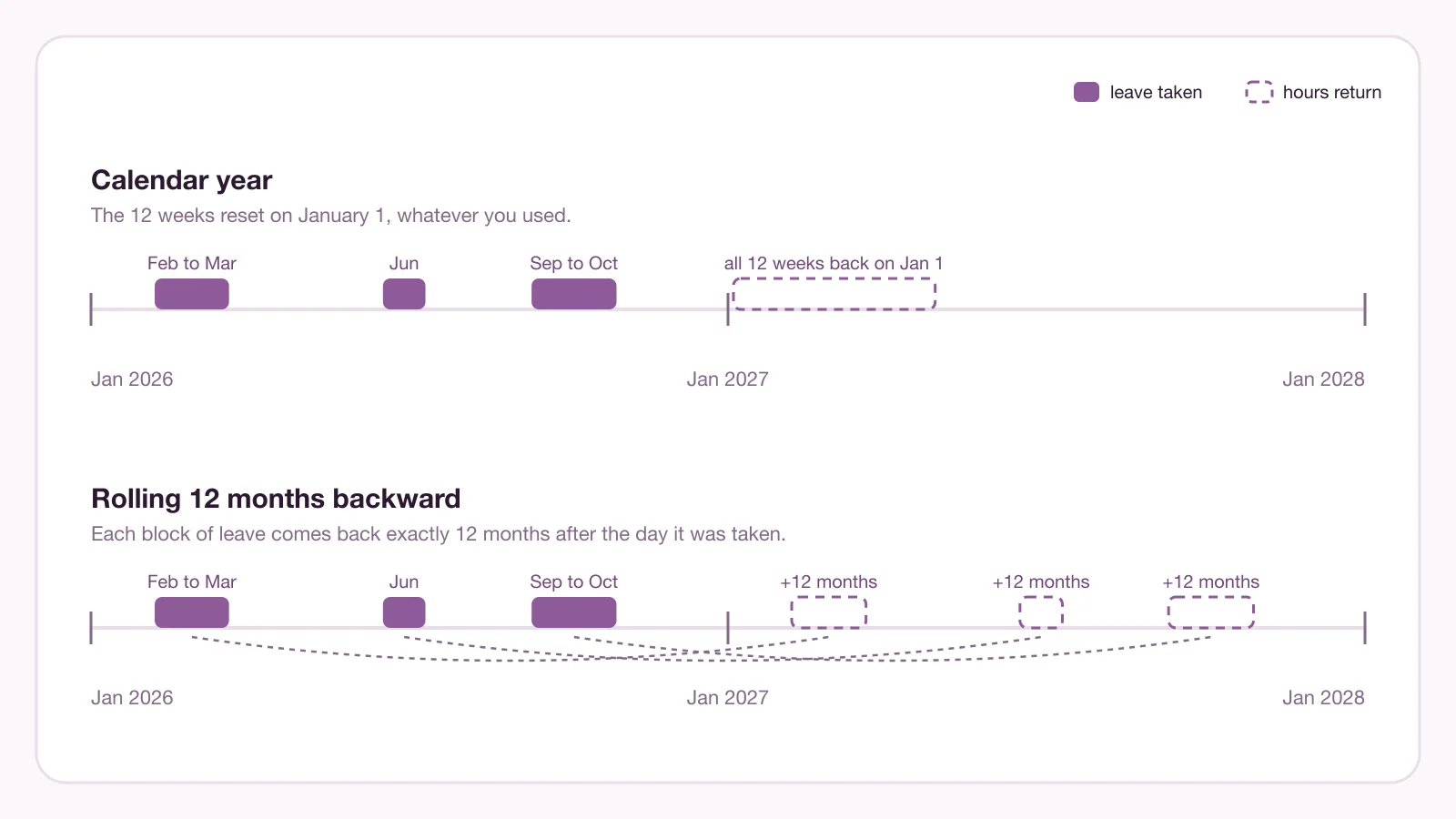
The regulations let each employer choose one of four ways to define the 12 months in which 12 weeks may be taken, and the choice changes when leave comes back. Under the calendar year, a fixed leave year, or 12 months measured forward from the first day of leave, the full 12 weeks return on one date, and an employee who times two leaves around that date can be away for 24 weeks in a row. Under the rolling method, measured backward from each day leave is used, the entitlement on any given day is 12 weeks minus whatever was used in the previous 12 months, so every hour comes back exactly one year after it was taken and no 12-month span ever contains more than 12 weeks.
The Department of Labor's own example makes the rolling arithmetic concrete: four weeks taken from February 1, four from June 1, and four from December 1 leave nothing available on January 15 of the next year. On February 1 the first February day returns, by the end of February all four February weeks are back, and the June weeks follow in June. The calculator reproduces this: enter the absences, choose rolling, and it lists the restoration dates hour by hour. The employer must apply one method to everyone, disclose it in the rights and responsibilities notice, and give 60 days' written notice before switching; an employer that never chose a method must use the one most favorable to the employee.
| 12-month method | When the 12 weeks come back | Can leave stack across the boundary? |
|---|---|---|
| Calendar year | January 1 | Yes: 12 weeks ending December 31 and 12 more starting January 1 |
| Fixed leave year (fiscal year, anniversary date) | The first day of the new leave year | Yes, at the leave-year boundary |
| 12 months forward from first use | 12 months after the first day of FMLA leave | Yes, at the end of the 12 months |
| Rolling 12 months measured backward | Each hour returns 12 months after the day it was taken | No: never more than 12 weeks in any 12-month span |
What do state laws add to the FMLA?
The FMLA is a floor. 23 of the 51 jurisdictions have their own job-protected family, medical, parental, pregnancy, or adoption leave statute for private employers, some far broader than the federal law: Connecticut covers employers with one employee and employees with three months of service, California covers employers with five and lets you name one designated person a year, Oregon and New Jersey count siblings, grandparents, and anyone whose association is the equivalent of family. Thirteen jurisdictions pay a benefit during leave through a state program, and four of those also run mandatory disability insurance; 21 have a paid sick leave mandate. Where a state law applies alongside the FMLA the two usually run at the same time, but a state statute that excludes the employee's own condition (New Jersey) or pregnancy (California) can protect a second stretch after the federal 12 weeks are gone.
The table lists every state's layer at a glance. Seventeen states, the ones people search for most, have their own page with the state statutes, the paid leave picture, and the calculator preset to that state; the other 34 rows follow in the next two updates. The unpaid federal entitlement is identical on every row, so the state pages spend their words on what differs: thresholds, family circles, how the state law runs with the FMLA, what pays, and the bereavement and sick leave rules.
| State | State job-protected leave law | State paid leave | Paid sick leave mandate |
|---|---|---|---|
| Alabama | Adoption Promotion Act | Voluntary insurance only | None |
| Alaska | None beyond the FMLA | None | Ballot Measure 1 (2024) |
| Arizona | None beyond the FMLA | None | Fair Wages and Healthy Families Act |
| Arkansas | None beyond the FMLA | Voluntary insurance only | None |
| California | California Family Rights Act (CFRA); Pregnancy Disability Leave (PDL) | Paid Family Leave (PFL) within State Disability Insurance plus State Disability Insurance (SDI), up to 52 weeks, employee-funded | Healthy Workplaces, Healthy Families Act |
| Colorado | Family Care Act | Family and Medical Leave Insurance (FAMLI) | Healthy Families and Workplaces Act |
| Connecticut | Connecticut Family and Medical Leave Act (CT FMLA) | CT Paid Leave | Paid Sick Leave Law (expanded 2025) |
| Delaware | None beyond the FMLA | Delaware Paid Leave (Healthy Delaware Families Act) | None |
| District of Columbia | D.C. Family and Medical Leave Act (DCFMLA) | DC Paid Family Leave (Universal Paid Leave) | Accrued Sick and Safe Leave Act |
| Florida | None beyond the FMLA | Voluntary insurance only | None |
| Georgia | None beyond the FMLA | None | None |
| Hawaii | Hawaii Family Leave Law (HFLL) | Temporary Disability Insurance (TDI), employer-provided, up to 26 weeks | None |
| Idaho | None beyond the FMLA | None | None |
| Illinois | None beyond the FMLA | None | Paid Leave for All Workers Act |
| Indiana | None beyond the FMLA | None | None |
| Iowa | Pregnancy disability leave (Iowa Civil Rights Act) | None | None |
| Kansas | None beyond the FMLA | None | None |
| Kentucky | Adoption leave | Voluntary insurance only | None |
| Louisiana | Pregnancy disability leave | None | None |
| Maine | Maine Family and Medical Leave | Maine Paid Family and Medical Leave | Earned Paid Leave Law |
| Maryland | Parental Leave Act | Family and Medical Leave Insurance (FAMLI) (enacted, not yet paying) | Healthy Working Families Act |
| Massachusetts | Parental Leave Act; Small Necessities Leave Act | Massachusetts Paid Family and Medical Leave (PFML) | Earned Sick Time Law |
| Michigan | None beyond the FMLA | None | Earned Sick Time Act |
| Minnesota | Pregnancy and Parenting Leave | Minnesota Paid Leave | Earned Sick and Safe Time |
| Mississippi | None beyond the FMLA | None | None |
| Missouri | None beyond the FMLA | None | None |
| Montana | Maternity Leave Act | None | None |
| Nebraska | None beyond the FMLA | None | Healthy Families and Workplaces Act |
| Nevada | None beyond the FMLA | None | Paid Leave Law (SB 312) |
| New Hampshire | Pregnancy as temporary disability | Voluntary insurance only | None |
| New Jersey | New Jersey Family Leave Act (NJFLA) | Family Leave Insurance (FLI) plus Temporary Disability Insurance (TDI), up to 26 weeks | Earned Sick Leave Law |
| New Mexico | None beyond the FMLA | None | Healthy Workplaces Act |
| New York | None beyond the FMLA | New York Paid Family Leave (PFL) plus Disability Benefits Law (DBL), up to 26 weeks | Paid Sick Leave Law |
| North Carolina | None beyond the FMLA | None | None |
| North Dakota | None beyond the FMLA | None | None |
| Ohio | Maternity leave rule (Ohio Civil Rights Commission) | None | None |
| Oklahoma | None beyond the FMLA | None | None |
| Oregon | Oregon Family Leave Act (OFLA) | Paid Leave Oregon | Paid Sick Time Law |
| Pennsylvania | None beyond the FMLA | None | None |
| Rhode Island | Parental and Family Medical Leave Act | Temporary Caregiver Insurance (TCI) within TDI plus Temporary Disability Insurance (TDI), up to 30 weeks, employee-funded | Healthy and Safe Families and Workplaces Act |
| South Carolina | None beyond the FMLA | Voluntary insurance only | None |
| South Dakota | None beyond the FMLA | None | None |
| Tennessee | Pregnancy and adoption leave | Voluntary insurance only | None |
| Texas | None beyond the FMLA | Voluntary insurance only | None |
| Utah | None beyond the FMLA | None | None |
| Vermont | Parental and Family Leave Act | Voluntary insurance only | Earned Sick Time Law |
| Virginia | None beyond the FMLA | Virginia Paid Family and Medical Leave (enacted, not yet paying) | None |
| Washington | Pregnancy disability leave (Washington Law Against Discrimination) | Washington Paid Family and Medical Leave | Paid Sick Leave Law (Initiative 1433) |
| West Virginia | None beyond the FMLA | None | None |
| Wisconsin | Wisconsin Family and Medical Leave Act | None | None |
| Wyoming | None beyond the FMLA | None | None |
Using the calculator as HR
The eligibility panel is the first five business days: when an employee gives notice, run the three tests as of the leave start date, and the result is the substance of the eligibility notice, including the reason if a test fails. The entitlement panel fixes the number the designation notice should state, in hours, at the employee's actual schedule. The balance panel is the running ledger: under the rolling method it tells you, for any date, how many hours the employee has and when the next hours return, which is the question intermittent leave generates every month. For a full year of intermittent tracking with notice deadlines, the free spreadsheet tracker (intermittent-fmla-hours-tracker.xlsx) linked below does the same arithmetic in a workbook.
None of this is legal advice, and two limits are worth stating. The 1,250-hour test depends on payroll records of hours actually worked, which for exempt employees the employer often does not keep; the regulation then presumes the hours were worked unless the employer can prove otherwise. And the state statutes have their own clocks (New Jersey's 12 weeks in 24 months, Wisconsin's calendar year, Connecticut's own 12-month method) that the federal balance does not track, so a multi-state employer keeps a second column per statute.
State guides with the calculator preset
Each state page explains the state's job-protected leave statutes, how they run with the FMLA, whether anything pays during the leave, the bereavement and sick leave rules, and the smaller statutes a multi-state employer has to know, with the calculator preset to that state.
- Alabamafederal only
- Alaskafederal only
- Arizonafederal only
- Arkansasfederal only
- Californiapaid leave + disability
- Coloradopaid leave
- Connecticutpaid leave
- Delawarepaid leave
- District of Columbiapaid leave
- Floridafederal only
- Georgiafederal only
- Hawaiidisability only
- Idahofederal only
- Illinoisfederal only
- Indianafederal only
- Iowafederal only
- Kansasfederal only
- Kentuckyfederal only
- Louisianafederal only
- Mainepaid leave
- Marylandfederal only
- Massachusettspaid leave
- Michiganfederal only
- Minnesotapaid leave
- Mississippifederal only
- Missourifederal only
- Montanafederal only
- Nebraskafederal only
- Nevadafederal only
- New Hampshirefederal only
- New Jerseypaid leave + disability
- New Mexicofederal only
- New Yorkpaid leave + disability
- North Carolinafederal only
- North Dakotafederal only
- Ohiofederal only
- Oklahomafederal only
- Oregonpaid leave
- Pennsylvaniafederal only
- Rhode Islandpaid leave + disability
- South Carolinafederal only
- South Dakotafederal only
- Tennesseefederal only
- Texasfederal only
- Utahfederal only
- Vermontfederal only
- Virginiafederal only
- Washingtonpaid leave
- West Virginiafederal only
- Wisconsinfederal only
- Wyomingfederal only
General information only, not legal advice. State leave statutes and their thresholds change, and several interact with the federal FMLA in ways that depend on the reason for leave. Confirm with the state agency named on the page and with employment counsel before relying on it. Sources: 29 U.S.C. 2601 ff.; 29 CFR Part 825, in particular 825.104, 825.110, 825.111, 825.200, 825.205, 825.300; U.S. Department of Labor, Wage and Hour Division, FMLA fact sheets 28, 28A, 28H, 28I; state statutes as cited on each state page. Checked September 15, 2026.
Frequently asked questions
- How do I calculate 1,250 hours for FMLA?
- Add up the hours you actually worked in the 12 months immediately before the day your leave starts. Paid time off, sick days, holidays, and unpaid leave do not count; overtime you worked does. A 40-hour employee reaches 1,250 hours after about 31 full weeks of work, so a full-time employee who was out for more than 21 weeks in the prior year can fail the test. If the employer has no record of an exempt employee's hours, the regulation presumes the test is met.
- How many hours is 12 weeks of FMLA?
- It depends on your schedule: 480 hours for a 40-hour week, 384 for 32 hours, 450 for 37.5, and 600 for 50 scheduled hours. The entitlement is 12 workweeks at your normal schedule, averaged over the prior 12 months if it varies. Military caregiver leave is 26 workweeks, so 1,040 hours at 40 hours a week.
- When does my FMLA reset?
- Under the calendar-year method, on January 1; under a fixed leave year, on its first day; under the forward method, 12 months after your first day of FMLA leave; under the rolling method, there is no single reset, and each hour you used comes back 12 months after the day you used it. Your employer's method is stated in the rights and responsibilities notice.
- Does FMLA reset every year?
- Only if your employer uses the calendar year or a fixed leave year, in which case the full 12 weeks return on the same date each year. Under the rolling method, which most large employers use, the entitlement is recalculated every day as 12 weeks minus the leave taken in the previous 12 months.
- Can FMLA be taken in hours?
- Yes. Intermittent and reduced-schedule leave are charged in hours, in the smallest increment the employer uses for other leave and never more than one hour. A two-hour appointment costs 2 hours of the 480. Continuous leave is charged by the workweek, so a full week off costs one twelfth of the entitlement whatever the schedule.
- Is FMLA the same in every state?
- The federal law is identical everywhere, but the states are not. Some have their own family and medical leave statutes with lower thresholds and wider family definitions (California, Connecticut, New Jersey, Oregon, Wisconsin, and others), 13 states and the District pay a benefit during leave, and 21 have paid sick leave mandates. The state pages linked below cover each one.
About the author
Blasko Sarcevic
Founder, Time-Out Zone
Connect on LinkedIn Connect on LinkedIn
Blasko writes about leave management, policy design, and running time-off operations at scale.
Related
Tracking FMLA hours across a team?
Time-Out Zone keeps every leave type, balance, and approval in one place, so FMLA hours, state leave, and company PTO stay consistent without a spreadsheet per employee.
Questions about FMLA tracking?
See how Time-Out Zone tracks intermittent hours, rolling balances, and state leave for teams in more than one state.